
 Started on December 10; finished on December 12.
Sorry to have been absent in my blogging duties since late August. I've got my reasons. I fully intend to complete the 100 Years of Oklahoma Presidential Elections but that project has proven rather time intensive in both research and writing, so I'll take a small break before finishing that article to give an update on the national social acceptance since the relocation of the Seattle Super Sonics to Oklahoma City in 2008 and the success of the Oklahoma City Thunder since its arrival in Oklahoma City from its inaugural 2008-2009 season through this point in time, five seasons later. On this very night, December 9, 2012, the Thunder whipped the Indiana Pacers in the Chesapeake Energy Arena for their 8th straight victory this season and achieving the 2012-13 current record of 17-4 through the 1st quarter of this year's regular season.
As will appear below, virtually all vestiges of the Thunder's Seattle baggage has been shorn, particularity when combined with ESPN sports columnist Bill Simmons' remarks about the "Zombie Sonics" and/or "the team which shall not be named" ostensibly being laid to rest. Footnote 1
Please don't misunderstand ... it's not that Simmons' opinions particularly matter in the real world all that much, because they don't ... but Simmons was the last significant national columnist who persisted in the practice of using snide, sarcastic and unfriendly names which were ascribed to my team, the Oklahoma City Thunder.
Footnote 1. As will be seen at the end of this piece, one must put a footnote to Bill Simmons' "Footnote 1" contained in an article published by him on October 11, 2012, from which footnote some conclude that Simmons has actually turned a new leaf and that he has laid to rest the name "Zombie Sonics" when referring to the Oklahoma City Thunder. At best, whether he has turned over such a leaf must also be qualified with the words, "kinda sorta." I'll get back to his Footnote 1 at the end of this piece. That said, some have interpreted his October post as having abandoned his tirade against the Oklahoma City Thunder. But, the truth is, whether Simmons agrees or not, the words Zombie Sonics are no longer a part of anyone's nomenclature or thought processes (with the possible exceptions of Simmons and die-hard fans of the Seattle Super Sonics).
Where to begin? With ESPN sports writer Bill Simmons who dubbed the Oklahoma City Thunder as the Zombie Sonics way back when? No, I'll hold that to the butt-end of the post, where it rightly belongs.
 Instead, I'll begin with the November 8, 2012, New York Times Magazine cover article by Sam Anderson, the New York Times Magazine’s critic at large. Actually, it was within this article that I first learned that Simmons had "retired" the cleverly designed nasty phrase that he earlier coined. Anderson's article is a long one and you can read it from its source, but it is simply too good, too thorough, not to set out verbatim, as it is below.
 A Basketball Fairy Tale in Middle America By SAM ANDERSON Published: November 8, 2012 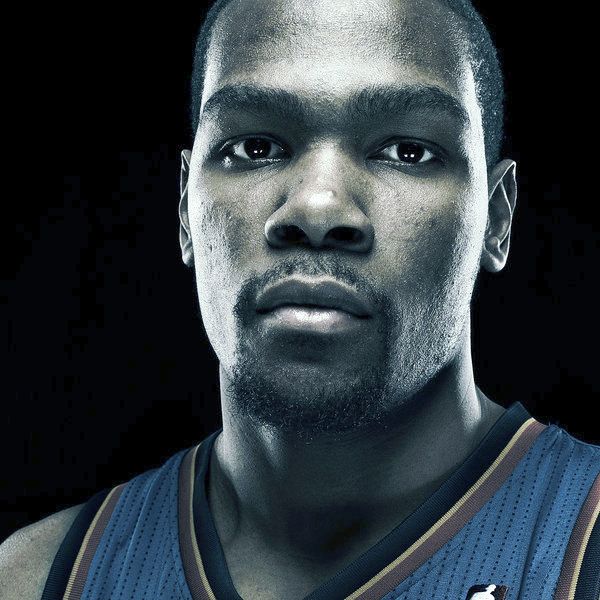 N.B.A. scoring champions are, as a rule, weirdos and reprobates and in some cases diagnosable sociopaths. Something about dominating your opponent, publicly, more or less every day of your life, in the most visible aspect of your sport, tends to either warp your spirit or to be possible only to those whose spirits are already warped. Michael Jordan, when he wasn’t busy scoring, was busy punching a teammate in the face and gambling away small fortunes. Allen Iverson, in his spare time, recorded an aesthetically and morally terrible rap album and gave an iconic speech denigrating the very notion of practice. Kobe Bryant is and shall forever be Kobe Bryant. Wilt, Shaq, Pistol Pete, Dominique, McGrady, McAdoo, Rick Barry — it’s a near-solid roster of dysfunction: sadists, narcissists, malcontents, knuckleheads, misanthropes, womanizers, addicts and villains. While it’s true that plain old N.B.A. superstars do occasionally manage to be model citizens (cf. Tim Duncan, Grant Hill, Steve Nash), there is something irredeemable about a scoring champion. N.B.A. scoring champions are, as a rule, weirdos and reprobates and in some cases diagnosable sociopaths. Something about dominating your opponent, publicly, more or less every day of your life, in the most visible aspect of your sport, tends to either warp your spirit or to be possible only to those whose spirits are already warped. Michael Jordan, when he wasn’t busy scoring, was busy punching a teammate in the face and gambling away small fortunes. Allen Iverson, in his spare time, recorded an aesthetically and morally terrible rap album and gave an iconic speech denigrating the very notion of practice. Kobe Bryant is and shall forever be Kobe Bryant. Wilt, Shaq, Pistol Pete, Dominique, McGrady, McAdoo, Rick Barry — it’s a near-solid roster of dysfunction: sadists, narcissists, malcontents, knuckleheads, misanthropes, womanizers, addicts and villains. While it’s true that plain old N.B.A. superstars do occasionally manage to be model citizens (cf. Tim Duncan, Grant Hill, Steve Nash), there is something irredeemable about a scoring champion.
Kevin Durant, the star of the Oklahoma City Thunder, is the youngest scoring champion in N.B.A. history. At 24, he has led the league in scoring for three consecutive seasons, and all signs point to him keeping that up for the foreseeable future. It follows, then, that Durant should also be a prodigy of a head case. He should have been arrested for reckless driving at around age 9, broken his hand in a strip-club brawl at age 12 and accidentally shot his chauffeur no later than age 15. Instead, Durant has a reputation roughly on par with Gandhi. He seems to be — not just for a scoring champion, but for anyone — almost inhumanly humble. His motto, which he intones constantly, is “Hard work beats talent when talent fails to work hard.” His pregame ritual involves kissing his mother, as does his postgame ritual. Once, in college, during probably the greatest freshman season of all time, a reporter asked Durant if he realized that he had just single-handedly outscored the entire opposing team in the second half of a game. Durant answered, with absolute sincerity, “Who, me?” When I asked the Thunder coach, Scott Brooks, to tell me about his superstar, he laughed. “Whatever you say nice, you can print it out and I’ll just say I said it,” he said. “Because it’s true.” Durant could be forgiven for wanting to brag a little. He is currently the second-best basketball player in the world — a category in which he trails only LeBron James, who is four years older, and whose Miami Heat beat the Thunder last year in the finals. The budding rivalry between KD and LBJ (off the court they’re friends, Olympic teammates and sometimes, controversially, workout partners) is the kind of thing the N.B.A. has been fantasizing about for decades, a yin and yang as tightly balanced as any since Magic and Bird. LeBron and Durant are, conveniently for storytelling purposes, opposites. LeBron looks like something out of a Marvel comic: a sentient pile of muscles. Durant looks like something from a Pixar movie — a humanoid praying mantis. He is 6 feet 9 inches tall and almost disturbingly skinny, with disproportionately long arms. Sportswriters, struggling to describe him, have compared him to capellini and a pterodactyl. His body looks almost like an engineering mistake, and early in his career it seemed as if it might actually be one: before the 2007 draft, there was a minor kerfuffle when it was discovered that Durant couldn’t bench-press 185 pounds, the standard predraft litmus test, even a single time. (The next pick in the draft, Al Horford, lifted it 20 times.) LeBron entered the league as a teenager and promptly knocked around all of the grown men who tried to guard him. As a 19-year-old rookie, Durant drifted around, shooting jumpers and trying to avoid contact, and still spent much of his time picking himself up off the floor. Although he won Rookie of the Year, he wasn’t particularly efficient in doing so, and his team was horrible. Despite their discrepancy in visible muscle tone, Durant has strengths that LeBron will probably never have. LeBron’s jump shot, for instance, is funky-looking, jerky, angular and streaky. Durant’s is natural, pure, quick and stunningly accurate — somehow, his ridiculous arms manage not to get in the way but to amplify his power, so it looks as if he’s shooting with zero effort even from 30 feet away. Durant’s real advantage over LeBron, however, is civic. LeBron infamously held a prime-time TV special in the summer of 2010 to announce that he was abandoning Cleveland for the glamour of Miami — a P.R. debacle known as the Decision. When he arrived in Miami, he took part in a histrionic rally at which he promised, on a stage surrounded by a W.W.E. -style light show and smoke machines, that his new team was so good it was going to dominate the rest of the league without even trying. It’s impossible to imagine that kind of behavior from Durant. In the middle of the overheated summer of 2010, the day before LeBron’s Decision, Durant announced quietly, on Twitter, that he had just signed a contract to stay in Oklahoma — the third-smallest market in the league, a place devoid of beaches and celebrities and night life — for another five years. You got the feeling he would have committed to the Thunder for the rest of his life if only the Players’ Union would have allowed it.  Durant, in other words, seems to have been invented in a laboratory beneath the Oklahoma City Chamber of Commerce to serve as the international face of Oklahoma — a state known for its citizens’ kindness, levelheadedness, work ethic, community spirit and, above all, humility. (The mayor of Oklahoma City told me that he thinks Oklahomans are humble because of their proximity to Texans, who will never stop bragging about anything.) Led by Durant, the Thunder has become one of the N.B.A.’s best and youngest and most popular teams, an international icon of brotherhood and good will that has helped to usher in golden ages in both Oklahoma City and the N.B.A., an electric blue Trojan horse inside of which Oklahoma has managed to smuggle its ethos to the rest of the world: good folksy folks humbly helping other folksy folks stay humble and helpful. Durant, in other words, seems to have been invented in a laboratory beneath the Oklahoma City Chamber of Commerce to serve as the international face of Oklahoma — a state known for its citizens’ kindness, levelheadedness, work ethic, community spirit and, above all, humility. (The mayor of Oklahoma City told me that he thinks Oklahomans are humble because of their proximity to Texans, who will never stop bragging about anything.) Led by Durant, the Thunder has become one of the N.B.A.’s best and youngest and most popular teams, an international icon of brotherhood and good will that has helped to usher in golden ages in both Oklahoma City and the N.B.A., an electric blue Trojan horse inside of which Oklahoma has managed to smuggle its ethos to the rest of the world: good folksy folks humbly helping other folksy folks stay humble and helpful.
Oklahoma sits right in the middle of the country: it’s not the cultured East or the wild West or the frigid North or the humid South but exactly where all those things meet. The mountains touch the prairies, which touch the plains. This has created, over the millenniums, crazy animals and crazy weather and crazy 25-car pileups of culture. In 1889, the almost unbelievable land run sent tens of thousands of ragtag settlers from all over the country literally racing to claim tracts of practically uninhabitable land. Oklahoma, in other words, is the Hadron supercollider of states: it slams disparate things together, over and over, producing endless crises of cohesion. Even tornadoes, the region’s defining devil winds, are a result of a meteorological collision: a convergence of three different weather systems that happens with freakish regularity in Oklahoma and its immediate environs. Meteorologists in Oklahoma are basically rock stars. Professional athletes, on the other hand, have rarely had much of a presence here. That began to change in 2006, when a consortium of wealthy Oklahomans, led by the financier Clay Bennett, bought the Seattle SuperSonics — a once-proud franchise that had been stuck for years in the drain-swirl of mediocrity. Most people assumed, cynically, that Bennett was buying the team in order to move it, as quickly as possible, to Oklahoma City, his hometown. He had pledged to make a good-faith effort to keep the team in Seattle — an effort that came into suspicion shortly after the sale, when the new owner demanded that Seattle come up with nearly $300 million to build a new arena. Doug Dawgz Note: Anderson's article is a bit weak on this important point. In fact and at the very instant, on July 18, 2006, that the Sonics sale to Bennett's group was announced in a press conference attended by the Sonics former Howard Schultz owner and by Bennett, Clay Bennett made explicitly clear that his intention to leave the team in the Seattle area was contingent upon two things occurring by October 31, 2007, about 18 months later: (1) Seattle and/or Washington must agree to build a new NBA arena, and (2) a contract which would make it possible for the team's owners to make a profit must be agreed to. This pair of items was not hidden ... they were straightforwardly stated by Bennett from the get-go. The same comments apply to a few of Anderson's comments which follow. In his article, Anderson glosses over a good bit of what transpired during the Sonics' rupture from Seattle, as do most commentators. Not very many have taken a really close look at what occurred during this transitional period of time.Seattle refused, at which point the ownership group announced, regretfully, that it was going to have to move the Sonics to a city with a suitable arena — a city that also happened to be Oklahoma City. The fallout was intense: lawsuits, protests, scandal. Even Oklahomans who love the team admit that they were uncomfortable with the way it was acquired. The sportswriter Bill Simmons, in solidarity with the people of Seattle, referred to the Thunder exclusively in his columns as the Zombie Sonics.  One of the miracles of the modern Thunder — and there are several — is how quickly they’ve made people forget the stain of their origin. The re-branding of the franchise has been quick and efficient: the team is now widely perceived as principled, well run and — above all — thoroughly Oklahoman. ESPN recently named it the No. 1 sports franchise in America. This fall, it seemed like a step toward closure when the Seattle City Council approved a plan to build a new basketball arena there. Simmons announced, just a few weeks ago, that he was officially retiring the phrase Zombie Sonics. In almost no time at all, the Oklahoma City Thunder had achieved escape velocity. One of the miracles of the modern Thunder — and there are several — is how quickly they’ve made people forget the stain of their origin. The re-branding of the franchise has been quick and efficient: the team is now widely perceived as principled, well run and — above all — thoroughly Oklahoman. ESPN recently named it the No. 1 sports franchise in America. This fall, it seemed like a step toward closure when the Seattle City Council approved a plan to build a new basketball arena there. Simmons announced, just a few weeks ago, that he was officially retiring the phrase Zombie Sonics. In almost no time at all, the Oklahoma City Thunder had achieved escape velocity.
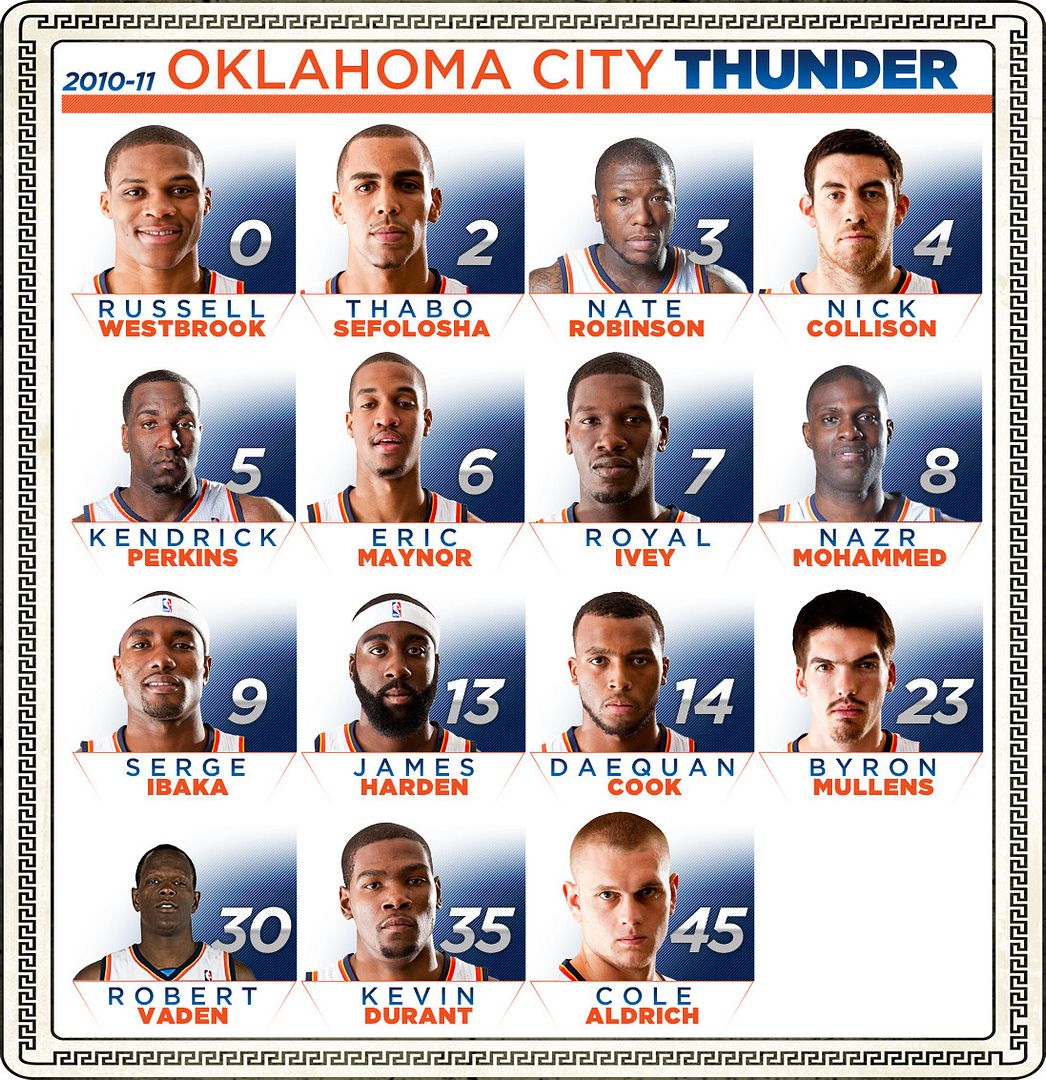
Much of the credit for this turnaround goes to Sam Presti, the Thunder’s general manager. Presti took over the team the year before they left Seattle. He was 29, the youngest G.M. in league history. His first move was to draft Kevin Durant, which anyone would have done. His second, less obvious decision was to strip the roster of all the veterans and big contracts that would have prevented him from rebuilding from scratch. When the team moved from Seattle to Oklahoma City, Presti found himself in charge of not only the worst team in the league but also one of the worst in the history of professional basketball. The Oklahoma City Thunder won 3 games out of their first 32. This record, 3-29, is now a kind of touchstone in the organization — almost everyone I talked to invoked it at some point, and many of them even exaggerated it to 3-30. Most G.M.’s would have panicked, but that isn’t Presti’s way: he moved patiently, methodically. He overhauled not only the roster of the team but also the culture of the organization. This involved rethinking everything, no matter how small, from meeting times to media policy to the decorations on the practice-facility walls. Everyone soon became familiar with the Presti buzzwords: process, system, patience, sustainability. He made a habit of promoting people within the organization so that, from top to bottom, the Thunder became very young and tightly knit. He stressed community outreach to an unusual degree. He devoted extra resources to the development of the young Thunder players and, on the marketing side, refused to call attention to any single player apart from his teammates, even Durant, who was quickly becoming an international superstar. Meanwhile, Presti used high draft picks to surround Durant with other promising young players — Russell Westbrook, Serge Ibaka, James Harden — all of whom overachieved, relative to the rest of their draft classes, to an almost amazing degree. The Presti rebuild, a meticulously rational plan, now looks a lot like a fairy tale. The Thunder has improved, year by year, exactly on schedule: they made the playoffs in their second season, the Western Conference finals in their third and the Finals last year. If the Thunder doesn’t win the title this year, it will seem almost unfair — a violation of the basic laws of narrative. Among basketball fans, Presti has become a mythic braniac legend, the managerial equivalent of Kevin Durant: young, focused, dominant and improbably humble. I met Presti two weeks before the start of training camp at the Oklahoma City National Memorial, a site that commemorates, powerfully, the city’s defining tragedy: the 1995 bombing of the Alfred P. Murrah Federal Building. Presti shook my hand in the lobby, quickly and firmly, and then proceeded to say nothing for many minutes. The museum’s director was giving us a tour, and Presti seemed relieved to cede the floor completely to her. He wore a polo shirt, casual pants, fashionable glasses and hip sneakers. He was very slim — no excess — and was fidgeting a lot, bouncing rhythmically at the knees.  We were at the memorial because, as Presti told me later, “This place is part of our existence.” Presti sits on the memorial’s board, and he makes sure that every player who joins the Thunder visits the site before he ever plays a game. The idea is to teach them the character of the citizenry they’ve just joined, to help them recognize, as Tom Brokaw put it on the night of the bombing, Oklahomans’ “essential sense of goodness, community and compassion.” We were at the memorial because, as Presti told me later, “This place is part of our existence.” Presti sits on the memorial’s board, and he makes sure that every player who joins the Thunder visits the site before he ever plays a game. The idea is to teach them the character of the citizenry they’ve just joined, to help them recognize, as Tom Brokaw put it on the night of the bombing, Oklahomans’ “essential sense of goodness, community and compassion.”
After our tour, Presti and I talked for a while outside. He struck me as one of the most cautious people I’ve ever met, constantly stopping and rephrasing, weighing and reweighing his words, openly worried that I was going to misinterpret the team’s relationship to the memorial as a P.R. grab, or that I was going to focus my article on him at the expense of others. He ascribed most of the Thunder’s success to either luck or his colleagues. The most revealing thing Presti said to me that day had to do with the grounds of the memorial, which were impressively tidy. Despite a suffocatingly hot run of late-summer days, the grass was thick and lush and perfectly mowed, with perfect circles around the perfect trees. Presti pointed out how much work it takes to keep everything looking like that, how much deliberate organization, but also how important it is. At the Thunder’s training center, after a practice in early October, Kevin Durant and I sat on folding chairs at the edge of the gym. He was wearing a black tank top, black shorts and ridiculously colorful shoes. (Loud footwear is one of his few obvious vices.) Practice that day, according to everyone involved, had been “chippy” — Durant’s team had lost a couple of early scrimmages to a team full of rookies and backups, and this had sent everyone, especially Durant and Westbrook, into competitive overdrive. Sitting with Durant a few minutes later, though, I could detect none of that aggressive energy. He was placid, polite, obliging. He said pretty much everything you would expect him to say, in exactly the way you would expect him to say it. He took every opportunity to gush about his teammates, singling out Westbrook and Harden — the team’s two other big scorers — as “killers” and insisting that, despite the media’s constant attempts to create controversy among them, there was no tension on the team about sharing the ball. It would be ridiculous, he said, to “put those guys on a leash just so I can get two or three more shots up a game.” He praised his teammates’ unselfishness and said he had learned to play the same way. He said that, although he’d known almost nothing about Oklahoma City before the team moved there, now he couldn’t imagine playing anywhere else. I told Durant that, all over town, people were giving me spontaneous speeches about what a nice guy he was. His response was, naturally, impeccably nice. “I’m just being me, man,” he said. “I’m just enjoying this all. I can’t complain. I mean, I wasn’t raised to be a jerk to anybody. You know what I mean? My mama wouldn’t like that, so that’s just all I know. Just being nice to people and enjoying what I do.” But how is it possible, I asked, to be as competitive as he must be while also being so nice? Don’t those impulses conflict? He answered with a story. Growing up, Durant told me, he was a sore loser. That all changed one day when he was 11, after he got destroyed by his father in a game of one on one in the driveway. “Of course I knew I was gonna lose,” he said. “He was so much bigger and stronger than me. He was backing me down, dunking, pushing me. He was screaming, talking trash. I scored like one point.” Little Kevin was so upset by the loss (and, presumably, by the bullying) that he burst into tears, ran into the house, locked the door and refused to let his father in. The intensity of his own crying surprised him and, after a while, inspired some self-reflection. “I sat back and thought about it and was like, What am I so mad at?” Durant told me, and in that moment, he said, he made a decision. “It’s good to be passionate, it’s good to hate losing — but I’ve got to channel it the right way,” he said. “You know what I mean? And after a while I just started to learn to leave it where it’s at, get rid of it. Once you’re done and you’re off the court or out of the venue or whatever, go back to being you.” Durant’s story touched on something I’ve thought about often while watching him play. If there’s been one consistent criticism of him, it’s that he’s not aggressive enough — that he fails to use his unearthly skills, as Jordan or Charles Barkley or Kobe would have done, to destroy everybody in his path. There are times, during games, when he seems almost removed from the action, simultaneously there and not there. I always figured that this detachment was just a byproduct of his smoothness: it looks so easy for him, when he strokes four consecutive 3-pointers or tosses in a little half-hook over two defenders, that it’s tempting to imagine he’s thinking about other things the whole time — that the real Kevin Durant is watching from a little viewing platform deep inside his own head, reading a magazine and clipping his nails, ready to re-engage fully when things get intense. But now I suspect that that uncanny stillness, that sense of remove, is the outward manifestation of Durant’s internal control, a sign of his fluency in moving between worlds: aggressive and relaxed, nasty and nice. Occasionally you can see Durant moving between those worlds, and the transition is jarring. There are moments, for instance, when he dunks and in his excitement begins to stare down his opponent, showboat-style, and you think, No, no, no, no, Kevin Durant, so much of my worldview depends on you not being the type of person who stares people down after dunks. And then, inevitably, a second or so later, he seems to catch himself and jogs back down the court to give all the credit to his teammates. You can see the impulse and the correction — the (to get Freudian for a second) ego and the superego. This turns out to be a useful way to think about the Thunder. In “Civilization and Its Discontents,” Freud argues that humans are ruled by two warring impulses: love, which seeks to bind people into larger and larger groups, and aggression, which seeks to tear them apart. For civilization to work, on even the most basic level, each of us has to find an acceptable outlet for that antisocial aggression. Back in the driveway, Durant’s father directed his aggression toward him. Freud argues that most of us, however, learn to turn our aggression inward, where it morphs into what he calls the superego — the policeman of the psyche, watching us constantly to ensure (with its billy club of guilt) that we make choices for the benefit of the group, not just for our own egos. That psychic self-surveillance, Freud says, is one of the big prices we pay for civilization — a kind of voluntary tax we levy against ourselves for the privilege of living with others. Kevin Durant oozes superego. Even as we talked on our folding chairs after practice, I sensed a duality. He was simultaneously genuine and polished, open and guarded. This seems to be an inevitable consequence of living the life of a superstar, especially in a place like Oklahoma City. Last summer there was public outrage, in some quarters, when it was discovered that Durant’s torso — the skin under his jersey, which by design is publicly hidden — is covered with tattoos. One evening I went to the mall to observe one of Durant’s public events. He was at a GameStop, signing copies of a new video game that featured him on its cover. I arrived to find the OKC equivalent of Beatlemania: a line of people, decked out in Thunder gear, stretching out the door and wrapping around the neighboring stores. As I approached the scene, a policeman was dragging a young man who apparently tried to get too close down an escalator. Just then a huge cheer broke out from the crowd. Durant had arrived, through a back entrance, along with a small entourage. I squeezed past the line, stood at the side of the room and watched him throughout the session. He was wearing his signature “KD” gear: hat, T-shirt, sweats. He seemed friendly but also not totally present. Between signatures and photos, he would occasionally grab his phone and sneak a text message under the table. He bantered, here and there, with a couple of kids, but mostly he was quiet and dutiful. His smile seemed automatic. I got the sense that Kevin Durant, the actual 24-year-old guy with the secret tattoos, was hardly even there that night: he was just an avatar for his own fame — this abstract thing that doesn’t actually exist but is millions of times bigger than he is. Not that that was his fault, of course. Even if Durant wanted to genuinely connect with people that night, the sheer scale made it impossible. There was too much inflow for a single person’s outflow. I got a sense of how insane it must be to live that kind of life, in which things are like that every day, everywhere. Is it even possible to be a good, thoughtful, civic-minded person under that kind of pressure? Suddenly all of those sociopathic scoring champions made sense to me. Radical detachment seemed, in a strange and sad way, almost like the proper response. Toward the end of our post-practice conversation, Durant leaned over and started unlacing his shoes. I took this as a signal that he was ready to leave. He was tired, no doubt, and had other things to do. I wrapped up our interview and thanked him for his time. He popped immediately out of his seat and walked away. After a few steps, he seemed to catch himself. He turned around, walked back and shook my hand. “Nice to meet you,” he said. The full name of Oklahoma City is the City of Oklahoma City. The police chief of the City of Oklahoma City is named — I’m not joking — Bill Citty. (“Citty” is pronounced exactly like “city.”) Chief Citty, hearing that I was in town to write about his city, offered to give me a tour. He drove me around in his sedan, neighborhood by neighborhood, casually ignoring traffic laws, occasionally being honked at, for more than three hours. The last hour or so we spent at the Oklahoma State Fair, where he drove me around in a golf cart. Chief Citty’s tour was my introduction to the civic paradox that is modern OKC: a city that, over the last 15 years, has managed to reinvent itself while other cities have melted down, a conservative town that happily submitted to a series of voluntary taxes, a place where the oxymoron “corporate citizen” almost begins to make some kind of sense. Citty grew up in Oklahoma City, so he has seen, firsthand, the major phases of the last 60 years. He was born during the postwar boom, in 1953, when everything was awash in federal money. (It is one of the many paradoxes of Oklahoma that, despite all its rhetoric of rugged individualism and free markets, the economy has been heavily depending on the federal government for decades.) Citty’s mother worked for a gas company downtown, in an office in the First National Center, one of the defining masterpieces of the city’s skyline — a 33-story Art Deco tower with elaborate aluminum decorations based on King Tut’s tomb. As a teenager in the 1960s, Citty watched as the new malls and highways started sucking all of downtown’s energy out into the suburbs, leaving behind the usual inner-city decay. In the 1970s, after some years of hippyish drifting, he decided to cut his hair, shave off his beard and join the City of Oklahoma City Police Department. It was 1977. Citty was assigned to patrol a downtown neighborhood called the Deep Deuce, an African-American community that had once been home to world-famous jazz clubs but had declined, by then, into a hub for drugs and gambling and prostitution. (Just before Citty joined the force, a serial killer dumped the body of a prostitute in the basement of a nearby church.) From his beat downtown, Citty watched the city’s economy boom with oil money. New houses sprouted everywhere. Then, in 1982, he watched it all go bust: banks, farms, oil — everything. People lost their new homes; thriving businesses closed. “What happened to us in the early ’80s,” Citty told me, “is what happened to the U.S. economy in ’08.”  Things were still bad in 1993, when the mayor of Oklahoma City, Ron Norick, persuaded his constituents to do something improbable: to voluntarily tax themselves in order to rebuild the city. The program was called Metro Area Projects, or Maps — a one-cent sales tax that raised more than $350 million. Over the next two decades, Maps and its sequels (the city is currently on Maps 3) would change almost every neighborhood in the city, especially downtown. It built a canal and a minor-league baseball stadium and a new library; it turned an endless stretch of empty warehouses into a vital shopping district; it overhauled the schools; it put water back in the river, which had been so dry that, for decades, the city had to mow it. And of course Maps built a basketball stadium, which would come spectacularly into play many years later. Things were still bad in 1993, when the mayor of Oklahoma City, Ron Norick, persuaded his constituents to do something improbable: to voluntarily tax themselves in order to rebuild the city. The program was called Metro Area Projects, or Maps — a one-cent sales tax that raised more than $350 million. Over the next two decades, Maps and its sequels (the city is currently on Maps 3) would change almost every neighborhood in the city, especially downtown. It built a canal and a minor-league baseball stadium and a new library; it turned an endless stretch of empty warehouses into a vital shopping district; it overhauled the schools; it put water back in the river, which had been so dry that, for decades, the city had to mow it. And of course Maps built a basketball stadium, which would come spectacularly into play many years later.
In 1995, just as Maps was getting rolling, life in the city suddenly came to a stop. On an otherwise ordinary April morning, a 26-year-old terrorist drove a moving truck full of fertilizer and other chemicals into the heart of downtown and parked in front of the nine-story Federal Building. The explosion, at 9:02 a.m., killed 168 people and injured 684. Five blocks west, at Police Headquarters, the tile shook so hard and so many windows broke that Bill Citty assumed the bomb had gone off inside. He figured out its real source only when he saw that the paper raining down everywhere had come from offices inside the Federal Building. He made it there within 20 minutes and stayed for the next month. At that point, Citty was the department’s public information officer, which meant he had to wrangle the media, a suddenly gargantuan task. He became, in a sense, the link between Oklahoma City and the rest of the world. As part of our tour, Citty drove me down to the Deep Deuce, which was now full of bright new brick apartment complexes. He drove me past the State Capitol, the only one in the nation with an oil rig in front of it. He drove me through Automobile Alley, a revitalized hipster pocket. He pointed out the public bike-rental program, Spokies, that opened over the summer. Half of the city seemed to be under construction. Near the basketball arena, an old elevated highway was being torn down: it was now just a lattice of concrete, with on- and offramps that ended in midair. The highway will soon be replaced by a grand boulevard — the Champs-Élysées of OKC — leading right to the Thunder’s home. This public rebuilding helped bring in private investment, which in turn brought in more revenue for public works, which brought in more private investment — and these cycles eventually combined to make Oklahoma City a plausible home for N.B.A. basketball. When it arrived, the growth and the basketball amplified each other. “We’d have a lot of good things happening now even if we didn’t get the Thunder,” Citty told me. “But we got the Thunder because good things were going on, and now even better things are going on.” As an example, he drove me past the Devon Energy Center, the city’s new skyscraper, a 50-story steel-and-glass tube that dwarfs every other building in sight.  This, then, is part of the city’s love affair with the Thunder. It’s more than just a basketball team: it’s the culmination of 20 years of civic reinvention, and the promise of more to come. Over the last five years, the city and its team have undergone a perfect mind meld, so at this point it’s impossible to talk about one without talking about the other. After all of that sacrifice — the grind of municipal meetings and penny taxes and planning boards, the dust and noise and uncertainty of construction, the horror of 1995 — the little city in the middle of No Man’s Land has finally arrived on the world stage. While it’s there, it fully intends to put on a good performance. This, then, is part of the city’s love affair with the Thunder. It’s more than just a basketball team: it’s the culmination of 20 years of civic reinvention, and the promise of more to come. Over the last five years, the city and its team have undergone a perfect mind meld, so at this point it’s impossible to talk about one without talking about the other. After all of that sacrifice — the grind of municipal meetings and penny taxes and planning boards, the dust and noise and uncertainty of construction, the horror of 1995 — the little city in the middle of No Man’s Land has finally arrived on the world stage. While it’s there, it fully intends to put on a good performance.
A basketball team is a kind of miniature society, and the Thunder’s is a strange one. Most great N.B.A. teams are built on a rational distribution of talents: two or three elite players whose skills complement, rather than overlap with, one another’s, supported by a small army of role players. The classic example is the 1986 Celtics, in which Larry Bird’s all-around game and outside shooting were supplemented perfectly by the under-the-basket play of Kevin McHale and Robert Parish. The Thunder, however, were built around three big stars — Durant, Westbrook and Harden — who all have essentially the same talent. Each one is an elite perimeter scorer, and each one needs the ball to be effective. Each could easily be the focus of an offense all by himself. (Harden, who was recently traded after a contract dispute, will now put this theory to the test with the Houston Rockets.) As a result, when the Thunder offense is good, it’s organized chaos — an embarrassment of riches. When it’s bad, which it is less and less frequently, it’s just chaos: stagnation, wild shots, wasted possessions. Scott Brooks, the Thunder’s head coach, told me that he fell in love with basketball in seventh grade, in a small town in Northern California, at a free clinic taught by a local coach. What he loved, immediately, was exactly the problem of this Thunder lineup: the way the game forced you to braid together individual achievement and teamwork, the singular and the collective. Brooks loved that he could go to the gym and work on his game, all by himself, whenever he felt like it, and then, the next day or week, see that work play out in the context of a team. Brooks’s mastery of the individual-collective balance allowed him to become a star in high school and college and then — against all the athletic odds, as a 5-foot-11 nonleaper — to patch together a 10-year N.B.A career playing with seven different teams, including the 1994 champion Houston Rockets. Although Brooks had been a scorer in college, as a pro he accepted the job of the old-school N.B.A. point guard: to get the ball to his various teams’ stars — Patrick Ewing, Charles Barkley, Hakeem Olajuwon — and then get out of the way. This made Brooks the opposite of the Thunder’s point guard, Russell Westbrook. Westbrook is often referred to as the most explosive athlete in the league — his physique is so cartoonishly chiseled that one of his teammates recently compared him to a He-Man doll — and he uses those superpowers to do things Brooks never could have dreamed of: to turn a defensive rebound, in just a few reckless seconds, into a dunk at the other end, or to get his jump shot off over two defenders when everyone in the arena knows it’s coming. This skill set makes him unorthodox as a point guard, to say the least. The Thunder’s horrific start as a franchise in 2008 — that legendary 3-29 — was in part a result of Westbrook’s wildness. He led the league in turnovers for his first season. Early on, there were murmurs that Westbrook couldn’t play point guard, especially next to a scoring superstar like Durant — someone who, many thought, would have benefitted more from a Scott Brooks type, a teammate who would get him the ball and get out of the way. Even as the Thunder improved, there were rumors that Westbrook and Durant resented each other, that they couldn’t coexist, that the ecosystem of the team might be beyond repair. Throughout the losing and the turnovers and the rumors, however, Brooks not only kept playing Westbrook but also encouraged his recklessness. That confidence paid off. Westbrook is now a superstar in his own right — if Durant is the second-best player in the world, Westbrook is probably in the Top 10. He’s still wild, and he still occasionally makes high-profile mistakes, and TV analysts still love to question his shot selection — but he has improved in all of those areas enough that his net effect on the team is overwhelmingly positive. It’s impossible, at this point, to disentangle the bad from the good. In Game 4 of the Finals, Westbrook kept taking wild, flying, contested midrange jumpers — one of the least efficient shots in the sport — and making nearly all of them. He scored 43 points and almost single-handedly kept the Thunder in the game. (They ended up losing, after some LeBron heroics, by 6.) I asked Brooks if he ever had trouble maintaining a balance between chaos and order, crazy Westbrook and sane Westbrook. He laughed. “Trust me, there are times where my hair is almost out,” he said. But he defended his point guard. “Is he a natural John Stockton type? No, but he never will be. Those guys are done. Those guys are over. You’re not seeing those guys coming back. Russell is a dynamic offensive player. I would be a foolish coach if I said, ‘Russell, I don’t want you to go to the basket and draw fouls and score and put pressure on the defense.’ We need that.” He also dismissed the idea of a rift between Westbrook and Durant. “I’m with them every day. Did they have some competitive moments? Absolutely. But that’s how we work here. We challenge each other. It gets chippy. James and Kevin, Serge and Russell, me and Perk, Thabo and Russell — all of us. If it ever gets on the wrong side of being competitive, I’ll step in. But not once have I had to step in, in five years. If Russell and Kevin have problems, then I didn’t get along with any of my teammates.” 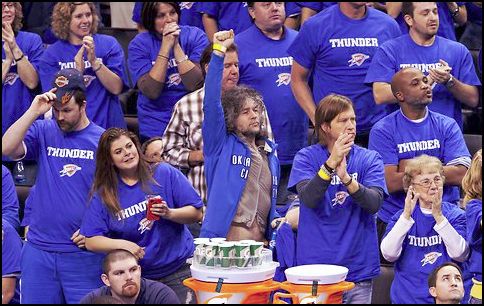 One symptom of a small sports market is a lack of celebrity fans. Among N.B.A. teams, the Lakers are famous for their fame: they have Jack and Penny and Denzel and a whole human gallery of plastic-surgery glamour; the Knicks have Spike and Woody and Chris Rock and a rotating roster of Broadway stars. One symptom of a small sports market is a lack of celebrity fans. Among N.B.A. teams, the Lakers are famous for their fame: they have Jack and Penny and Denzel and a whole human gallery of plastic-surgery glamour; the Knicks have Spike and Woody and Chris Rock and a rotating roster of Broadway stars.
 The Thunder has Wayne Coyne, the singer of the alternative-rock band the Flaming Lips. Coyne is famous for floating over crowds in a giant bubble at concerts and generally behaving like a psychedelic space cadet around town. He was raised in Oklahoma and, unusually — even as his creative peers poured out toward the coasts — he never left. Over the last 15 years, as the Flaming Lips have gained worldwide fame, and as Oklahoma City has begun to rebrand itself as a vital place for young, artsy energy, the city has embraced Coyne, now 51, as a kind of elder statesman. This has turned out to be, for both sides, a rather complicated transaction. Three years ago, the Flaming Lips song “Do You Realize??” was named the official rock song of Oklahoma, but only over the strenuous objections of several state politicians. Coyne’s latest OKC adventure, much blogged about in the city, is a spectacularly ill-advised art gallery called the Womb — a drab old warehouse, in the heart of downtown, that he bought and repainted in explosive rainbow colors, complete with cartoonish naked women and a giant abstract vagina on the front door. After Coyne told the local paper that he was going to have a huge New Year’s party there, at which teenagers might be able to drop acid with Yoko Ono, the fire marshal showed up and shut the gallery down. The Thunder has Wayne Coyne, the singer of the alternative-rock band the Flaming Lips. Coyne is famous for floating over crowds in a giant bubble at concerts and generally behaving like a psychedelic space cadet around town. He was raised in Oklahoma and, unusually — even as his creative peers poured out toward the coasts — he never left. Over the last 15 years, as the Flaming Lips have gained worldwide fame, and as Oklahoma City has begun to rebrand itself as a vital place for young, artsy energy, the city has embraced Coyne, now 51, as a kind of elder statesman. This has turned out to be, for both sides, a rather complicated transaction. Three years ago, the Flaming Lips song “Do You Realize??” was named the official rock song of Oklahoma, but only over the strenuous objections of several state politicians. Coyne’s latest OKC adventure, much blogged about in the city, is a spectacularly ill-advised art gallery called the Womb — a drab old warehouse, in the heart of downtown, that he bought and repainted in explosive rainbow colors, complete with cartoonish naked women and a giant abstract vagina on the front door. After Coyne told the local paper that he was going to have a huge New Year’s party there, at which teenagers might be able to drop acid with Yoko Ono, the fire marshal showed up and shut the gallery down.
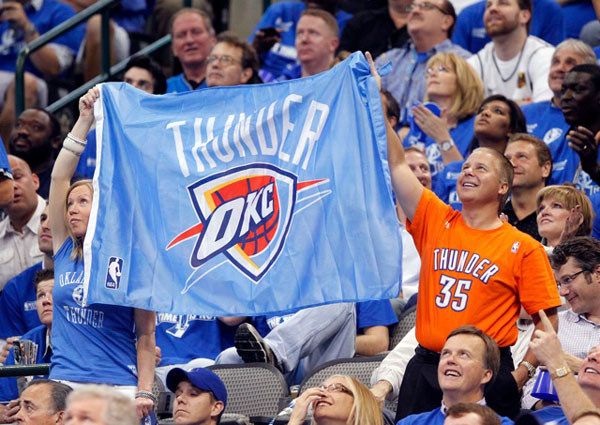
As OKC’s reigning celebrity, Coyne sometimes attends Thunder games, where he sits courtside. Although he seems genuinely fond of the team, he’s not what you would call a sports aficionado. When I asked him if he followed basketball before the Thunder came to town, he had to think for a few seconds. “No,” he said. “I mean, I liked, like, the Harlem Globetrotters. Or some mythical figure like Kareem Abdul-Jabbar” — and he pronounced “Jabbar” in the most amazing way, with an exotically soft “j” and several extra vowels, as if it were the name of a genie that had come drifting one morning out of his bong. Coyne admits that at Thunder games, he doesn’t always understand what’s going on. “It’s not like a Steven Spielberg-scripted event when you’re there,” he told me. “You’re like, Well, did we win? I’m confused. Did they win? And then you look up and you’re like, Well, is the game over?” He said he has been yelled at by other fans for cheering for Kobe Bryant. (“That was wicked! Who is that?” he shouted the first time he saw Kobe score. The crowd told him that it was Kobe and suggested, forcefully, that he stop cheering for him. “But that was wicked!” Coyne responded.) Coyne and I spoke, late one night, sitting in his Prius, which was parked in front of the Blue Note Lounge, a smoky bar at which the Flaming Lips played their first show 30 years ago. He was wearing a gray suit (he’d just come from a wedding), and his gray hair poured out in a big curly plume from his head. His fingernails were painted gold, and his face was lightly dusted with glitter. Coyne believes that the Thunder transcend the limits of their confusing sport — that they channel the energy of the whole community in a way that resonates across the world. Using a variety of accents, he told me stories about people in Germany and Switzerland and Sweden — places where he never used to hear about his hometown — all of a sudden talking to him about how much they love the Thunder. “I think people like the idea that, whether you’re a weirdo rock dude or a basketball player, we all have this spirit of the city,” he said. “Which I don’t think really exists. But I think the Thunder has probably pulled it together more than anything else.” Thunder crowds are notoriously loud and supportive. Visiting players often say it feels more like a college crowd than an N.B.A. crowd. Fans wear color-coordinated shirts for big games, and even when the team was horrible, they never booed. “Sometimes I would think to myself, Do these people realize that we’re down 20 with 3 minutes to go?” Scott Brooks told me, remembering the early days. “We’d be walking through the tunnel and I’d think: O.K., this is the night that I get heckled. This is the night I get popcorn thrown on me. Nothing. Every single game, it was: ‘Hang in there coach. Players, we love you guys.’ ” Coyne sees an analogy between basketball games and rock concerts. Playing a song for the thousandth time, he told me, is just as meaningless as putting a ball through a hoop. Under the right circumstances, however, those things take on great collective meaning. “It’s that idea of everybody being focused on the same thing at the same time and being together in the bigger experience,” he said. “It’s silliness, but all things are like that.” The Thunder has become a surprisingly integral part of hipster life in OKC. Coyne lives in a residential neighborhood called the Plaza District, the main drag of which has been — like so much of the city — radically transformed over the last five years. These days there’s a vintage shop, a tattoo parlor where people come to get Thunder tattoos and, in a building that used to be known as a brothel, a new restaurant devoted to gourmet grilled-cheese sandwiches. I went into an artsy shop called DNA Galleries, across from the grilled-cheese-sandwich restaurant, and it turned out to be full of Thunder gear: local artists had designed, often very cleverly, their own T-shirts, beer cozies, stickers and onesies. Most businesses around town let their employees dress in Thunder gear on game days, which has created a big market for Thunder clothes: many Oklahomans have entirely separate game-day wardrobes. The store’s owner told me that the Thunder changed her life. Saleswise, she said, basketball season is like eight months of Christmas. And now it is time to talk about James Harden’s beard.  The fate of Harden was the first serious test of the Thunder’s utopian culture — the first stubborn wrinkle in Sam Presti’s enlightened basketball collective. The fate of Harden was the first serious test of the Thunder’s utopian culture — the first stubborn wrinkle in Sam Presti’s enlightened basketball collective.
Harden was the first draft pick ever made by the Thunder: they chose him third in 2009. (Kevin Durant, Russell Westbrook and Serge Ibaka all joined when the team was still the Seattle SuperSonics.) His beard, at the time, was modest and closely cropped, the kind of thing you could wear to a business meeting without raising any eyebrows. Harden was a 19-year-old shooting guard with an old man’s game, full of the kinds of tricks you might see at your local Y.M.C.A.: quick shots, misdirections, shifts in speed, counterintuitive arm motions designed to bait defenders into fouls. He wasn’t overwhelmingly athletic, though, and many experts thought the Thunder had selected him too high. During his rookie year, he did little to convince anyone otherwise. As Harden’s beard grew, however, so did his mojo. As it started to hang from his face, his tricks started, improbably, to work in the N.B.A. The beard grew thicker and more unruly, and Harden began to exceed everyone’s expectations. By last season, he had become one of the most effective scorers the N.B.A. has ever seen. By the time the Thunder reached the finals, Harden’s beard was a full-on Rip Van Winkle, and it had become something of an unofficial team mascot. Photos flew around the Internet: a James Harden cake from an OKC bakery, with a huge mess of black icing extending off its cake chin; an Oklahoma City building with a giant beard hanging from its facade; a James Harden tattoo on some anonymous superfan’s arm. The most popular item at the official Thunder retail store, its manager told me, was a Harden-style fake black beard, which fans would wear at home games. Harden’s beard was gratuitous, quirky and improbable — the same set of attributes that made Oklahoma City basketball different than Miami or Los Angeles or New York. Harden’s rise was great for the Thunder — not many third bananas get that good, that fast — but it was also a threat. He had always been a complicated figure in Presti’s scheme. He was an elite scorer willing to come off the bench — a citizen willing to pay a serious tax (in minutes, shots and star potential) to be a part of the Thunder society. The group, in turn, offered Harden some harder-to-measure benefits: As a sixth man, he got to play against the other team’s bench players, which made him look even better than he was. When he shared the floor with Durant and Westbrook, he benefitted from the other team’s obsessive attention to them. But Harden got a little too good. The cost-benefit balance tipped out of whack. He wanted a maximum contract and, by league standards, probably deserved one. The Thunder — having already committed max contracts to Durant and Westbrook, and having just signed Ibaka to a near-max — wanted to pay him less. Near the climactic point of the Harden contract crisis, several people in Oklahoma City joked to me that they would be perfectly willing to pass another Maps tax to help pay for him to stay. Then they made it clear that, actually, they weren’t joking; the people of Oklahoma City would seriously do this. One city official I spoke with thought a penny tax would be too much — maybe an eighth, he suggested, with a quarter of that going to improve the city. Presti’s goal is to build a sustainably excellent organization, which means one that transcends its players. No individual, no matter how important or loved, can ever be allowed to trump the group. At 8:28 on the night of Oct. 27, Kevin Durant tweeted the word “Wow.” Over the next few hours, that message was retweeted more than 10,000 times. The Thunder had traded James Harden, just three days before the start of the season. For the Thunder, this trade marked a passage from innocence (youth, ideals, plenitude) to experience (age, cash, loss). The fairy-tale part of their story, in which they’re magically immune from the muddiness of N.B.A. success, is over. The team will still be good — Presti got a reasonable return for Harden, and of course they still have Westbrook and Durant — but it feels as if they’ll never be the same. Unless, of course, all that collective energy is strong enough to somehow conjure, like a phoenix rising from Harden’s beard, another great individual. |
Is Anderson's long New York Times Magazine article a great read, or what? But, now, it's time to get back to that opening Footnote 1 ...
 Footnote 1 ... Bill Simmons. Like I said at the beginning, when the above article said, "Simmons announced, just a few weeks ago, that he was officially retiring the phrase Zombie Sonics. In almost no time at all, the Oklahoma City Thunder had achieved escape velocity." The New York Times Magazine piece that I'd read and started to post here on December 10 was published November 8, so I was way behind the curve when learning of Simmons' turned leaf. So, finishing the New York Times part, I started my Simmons research.
First, I saw that The Lost Ogle had already written about it on October 16. The Lost Ogle's piece quoted a footnote within in an October 11 column Simmons had published at his Grantland website. The footnote reads:
Footnote 1: Important note for this season: I'm giving up my four-year vow to avoid typing the word "Thunder" in an NBA column after the Sonics were hijacked from Seattle with the implicit consent of the NBA's commissioner, David Stern. It's just too much of a pain in the ass to keep the "Zombies" thing going, and more important, Chris Hansen is definitely bringing the Sonics back to Seattle. That's happening. Let's start looking forward instead of backward.The New York Times Magazine and The Lost Ogle articles concluded from Simmons' footnote that he had "retired" the Zombie reference. But, upon reading the Grantland article which was titled, "The Harden Dilemma," it is plainly evident that such a conclusion was premature, at best. Why? Because in the main article, Simmons called the Thunder "the Zombies" once again:
How will Harden's saga play out? I see three potential outcomes, and only three ...Given the above emphasized text, it becomes evident that Simmons hasn't yet "retired" the Zombies term ... he has simply allowed himself the option of using "Zombies" and "Thunder" (which he earlier said he would never say) interchangeably ... Zombies, Thunder, whatever, it doesn't matter.
• Harden's agent accepts less money to stay in Oklahoma City — a fundamentally ignorant decision that would mean they were brainwashed by Oklahoma City's small-market B.S.. If that happens, lock down the Zombies for two to four titles in the 2010s assuming nothing funky happens (injuries, drugs, a fatal injury during a brawl at the BET Awards, whatever).
• Harden's agent says, "Let's play this baby out." That's actually the best outcome for both parties. Harden guarantees himself a four-year, $64 million offer from someone this summer; Oklahoma City locks Harden into a cheap 2012-13 price ($5.82 million) while also leaving itself the flexibility to (a) trade Harden during the season (doubtful; they'd never mess that dramatically with a potential title team), (b) match Harden's "max" offer next summer and amnesthize Kendrick Perkins (most likely), or (c) match that offer, then trade Harden or Westbrook after the 2013-14 season because the tax penalties will keep getting worse (possible).
• Oklahoma City panics and trades Harden before Halloween, or some time before February's deadline, for 100 cents on the dollar. Totally improbable … and yet, we can't totally rule it out.
So, put Simmons' use of the term in the same general category as Oklahoman sportswriter Berry Tramel's continued use of "Boomers" as an acceptable interchangeable moniker for the Thunder. Although Tramel's term isn't as offensive, both writers continue to use a unique name for the Thunder for their own personal pleasure.
So, Is The Name "Zombie Sonics" really Dead? Yes, it is. But it's not because Bill Simmons said so (because he didn't) ... it's because he is an island to himself amongst professional sportswriters who seems to feel the need to continue to be ugly to the Thunder. He continues to bash the Thunder's owners even if he has become more sympathetic to the city and Oklahoma City Thunder fans (see this Grantland article).
As a December postscript to Simmons' October 11 dire predictions for the Thunder if Sam Presti chose the "improbable" door #3 vis a vis James Harden, we all know by now and despite Simmons' faux-wisdom that Sam Presti DID choose door #3 ... "The Beard" James Harden was traded to the Houston Rockets before October 31, in exchange for Kevin Martin and other assets. In a post-Harden-trade October 30 Grantland article, Simmons predicted ...
You want predictions for the 2012-13 season from me? I have two and two only.What can one objectively say about those remarkable predictions?
1. Miami is going to beat the Lakers in the Finals.
2. Oklahoma City will rue the day it traded James Harden.
First, Simmons' Second Prediction. It's safe to say that all Thunder fans loved "The Beard" and that all fans very much regretted him being traded away, largely done for salary cap penalty issues associated with the Thunder breaching that cap. But, Oklahoma City Thunder fans aren't sufficiently naive to recognize the practical realities that any NBA team (save a precious few like the Heat and the Lakers) have to cope with given last year's collective bargaining agreement. And, while we surely miss The Beard, we have been quick to embrace Kevin Martin, the principal asset acquired in that same trade.
Going into tonight's (December 12) home game against the Hornets (this part of the article is written before that game on December 12), the Thunder is 17-4, leading the NW division by 5½ games. After tonight's game against the Hornets, on December 14 we host Sacramento and there is a good chance that the Thunder will be 19-4 after that. Then, the Thunder host San Antonio on Monday, December 17 in a match-up between, presently, the two best teams in the Western Conference, arguably the two best teams in the NBA right now.
But, wait, there's more! As noted in the New York Times Magazine article, ESPN recently named the Oklahoma City Thunder the best professional sports team in the United States (including the NBA, NHL, MLB, and NFL). In its most recent power-rankings, USA Today deems the Oklahoma City Thunder #1, followed by San Antonio Spurs #2. The Lakers, Simmons' favorite but faltering badly since Simmons made his October 30 predictions, came in at #20.
Now, I know that one-quarter of a season does not a season make. Simmons may well be proved true about Oklahoma City "ruing the day," but, not yet.
I am reminded of a personal story ... when I quit high school band in favor of high school debate way back in the fall of 1959. To excel at either activity took lots of non-school after-hours time, and my family history was in music. But, I had gotten involved with debate a year earlier and it fascinated me. In the fall of 1959, I concluded that I could not do both with excellence and I chose debate which led to me becoming a lawyer. But, when giving my Lawton High School band director, Mr. McHenry, my drop card, he insisted on a private meeting in his office, during which he said, "You are letting your school down, Doug, and you will come to regret this decision."
I'm not dead yet so that eventful day of remorse may yet come to pass. But, now approaching 70 years of age, it ain't likely. Second-guessing on the viability of Sam Presti's decision regarding the James Harden decision appears to be fainter and fainter by the day. Maybe the personal analogy ain't perfect, but it's pretty close to the mark.
You know what, I'll take Sam Presti's decisions over Bill Simmons' predictions any time, any where, any place.
Second, Simmons' First Prediction. Here, Simmons proclaimed the Lakers Western Conference champions this season, and he said, "Miami is going to beat the Lakers in the Finals."
Right. As of the morning of December 12, the Heat were 14-5, not too shabby but certainly not at the top of the Eastern Conference. As for the Lakers, they are 9-13, just having lost to Cleveland. If the season ended now, the Lakers wouldn't even make the playoffs.
Again, I understand that 1/4 of a season does not a season make. But both the Heat and the Lakers are going to have to work their arses off so that Simmons manages to look good by the end of the regular season.
Simmons' Third Prediction. He didn't mention this one in his October 30 article. Rather, it was contained in "Footnote 1" to his October 11 Grantland piece, mentioned above. There, he said,
Chris Hansen is definitely bringing the Sonics back to Seattle. That's happening.Who is he kidding? It would have to be his Seattle following because if and when Seattle gets an NBA team in the future is wholly speculative and which may be in the realm of "Dream On, Teenage Queen."
In the first place, Seattle would need to have in place at least a commitment (if not an established fact) from Seattle/Washington to build a new arena ... part of what the Clay Bennett partnership announced as a "stay in Seattle" condition way back when, but when Seattle/Washington gave the Oklahoma investors group the stiff-arm regarding such a prospect. But, yes, Hanson has made progress about getting a new $480 million NBA/NHL arena in Seattle. Also, see this USA Today article. The problem with this development is that it's all written in disappearing ink ... no commitments, no signatures on the dotted line. Unless the facility is actually built or contracted to be built, whether or not the NBA or NHL might agree to place a team there, not one shovel of the new NBA/NHL proposed arena has yet been shoveled. Hence, even Hansen's proposed arena remains speculative.
In the second place, who says that the NBA has a team to locate in Seattle? For that to be true, either (a) an existing NBA team would need to relocate there, or (b) the NBA would have to expand to include more than the present 30 teams. Without belaboring the point, a study in either possibility is wholly speculative.
So where does reality come face to face with Simmons' prediction, "Chris Hansen is definitely bringing the Sonics back to Seattle. That's happening."
The obvious and simple answer is that Simmons hasn't got a clue and has no credibility concerning Seattle or Oklahoma City at all. He is merely pandering to the Seattle fans that he took under his wing way back when and has, more recently, kinda-sorta thrown under the bus.
Sorry, Seattle, but if/when you are prepared to take Simmons' predictions to the bank as though his opinions were delivered from god-almighty, as you may be, you have my best wishes. He is not the first pied-piper that you may have followed before before this day, the first of whom was probably Chris Van Dyk.




 Posts
Posts


