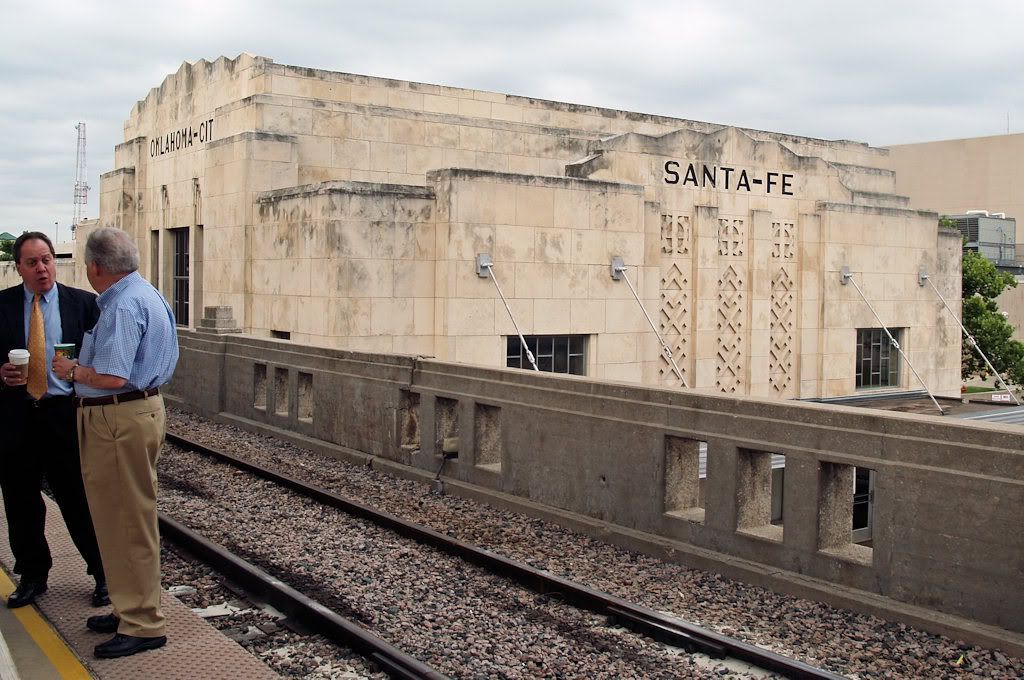
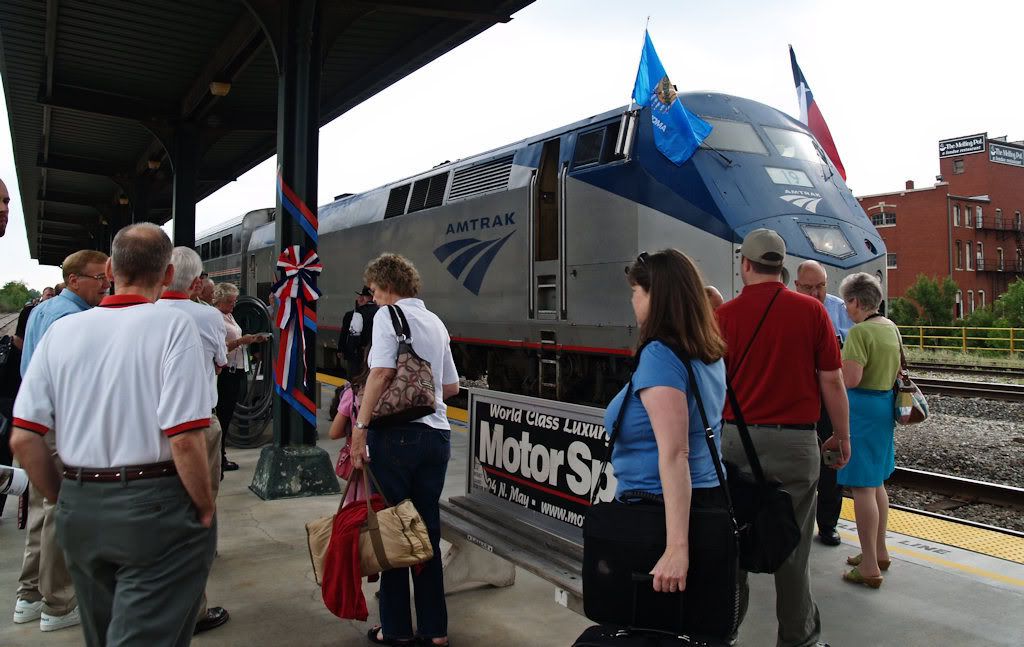
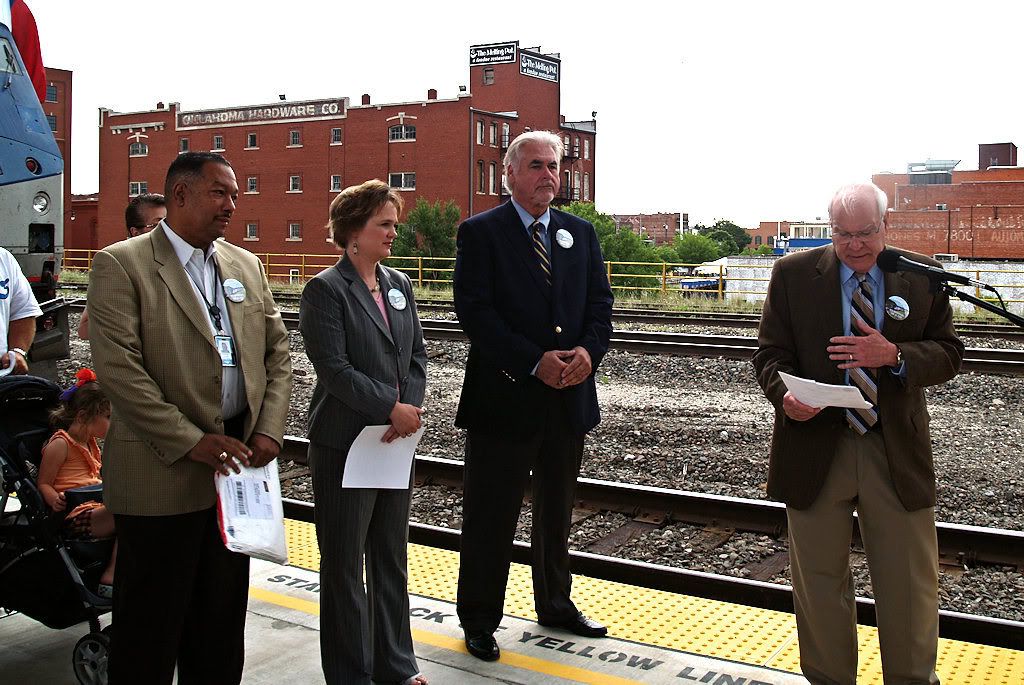
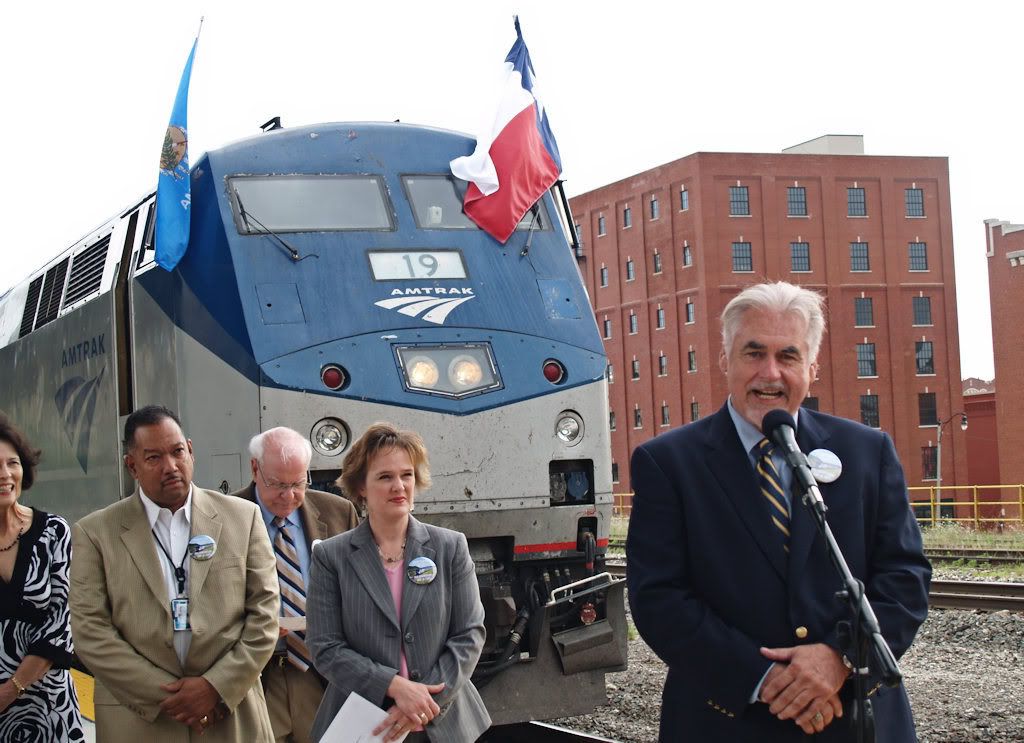
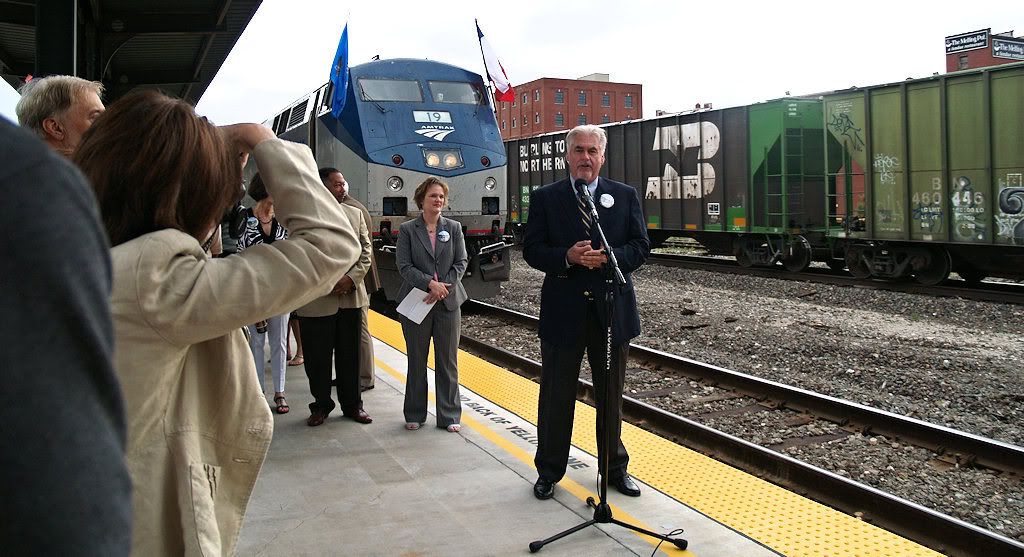
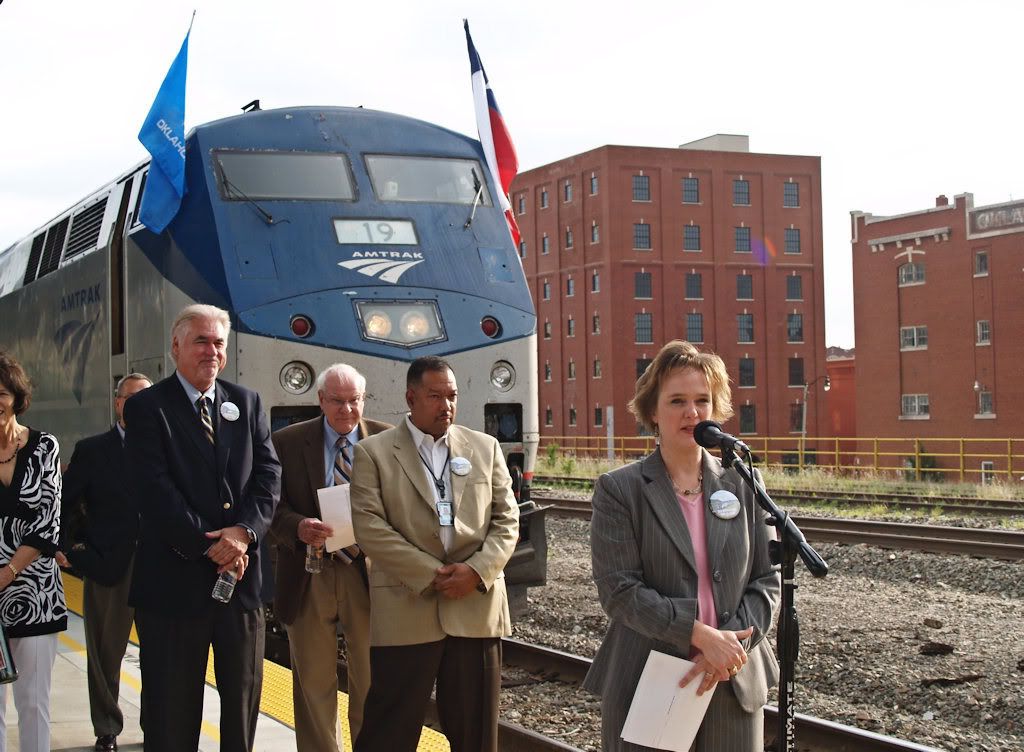
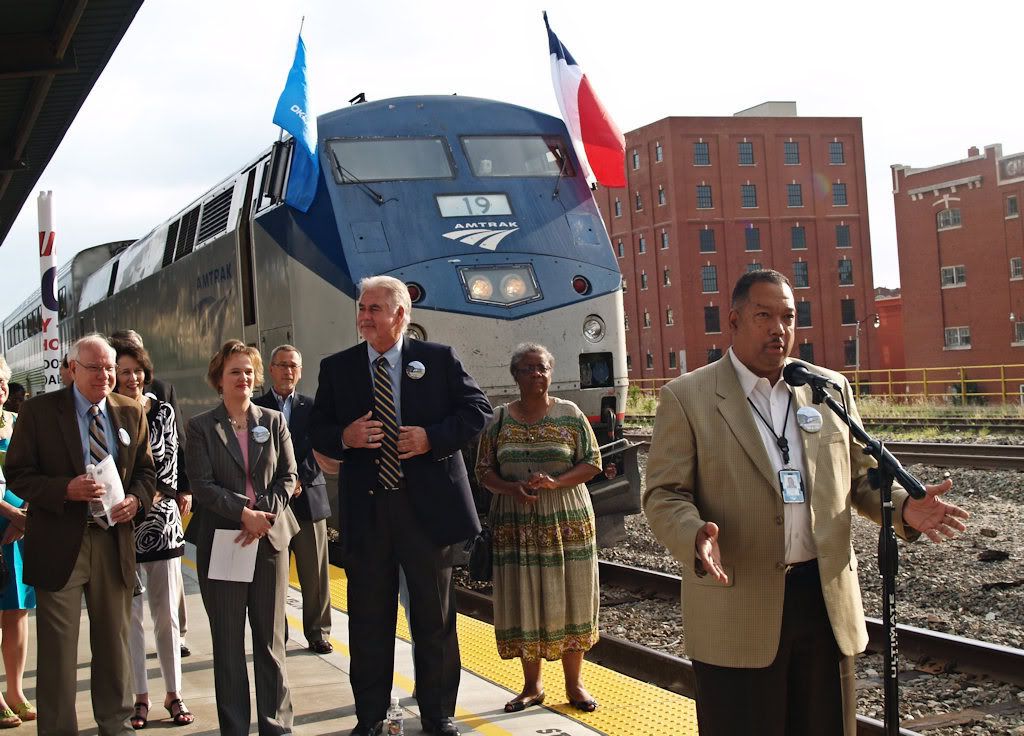
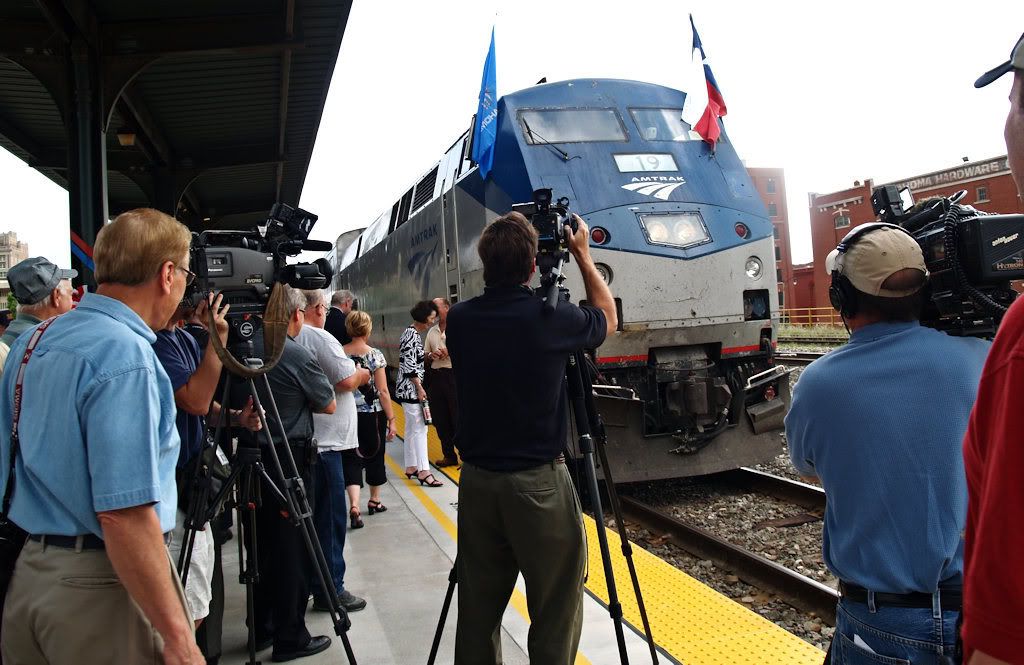
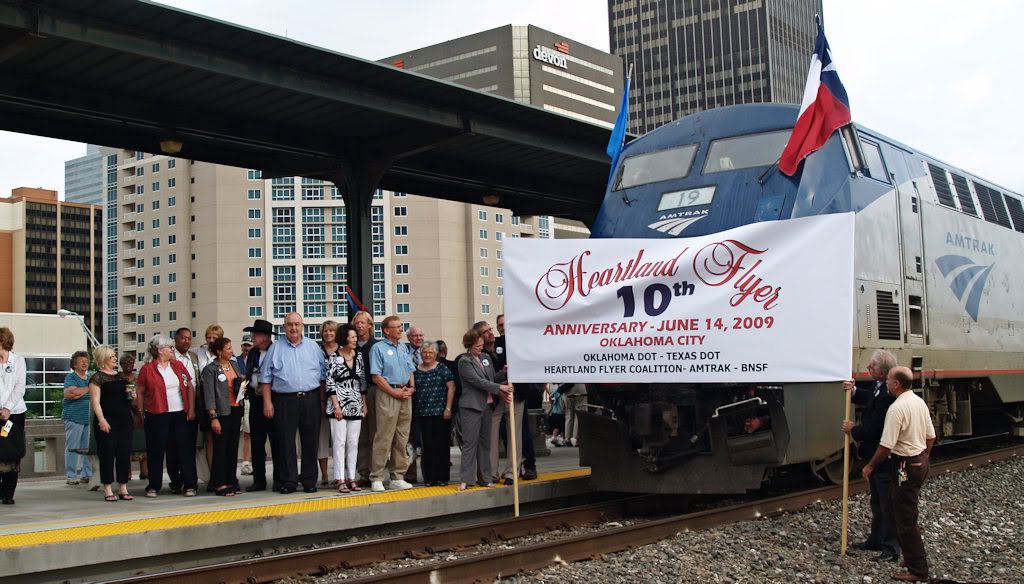
As advertised in the Oklahoman on June 12 and in the Norman Transcript on the same date, about 40 or so people were on hand to celebrate the 10th anniversary of the Heartland Flyer at the Santa Fe Station early Saturday morning on June 13, 2009.
I was one of those in attendance and this article presents the photographs taken on that great day. Small versions of many of those pics are contained in the above flash file — I've used the Andrews Sisters' Chatanooga Choo Choo as the background music since it's kind of a universal train song and we don't have such a song about Oklahoma City trains, as far as I'm aware.
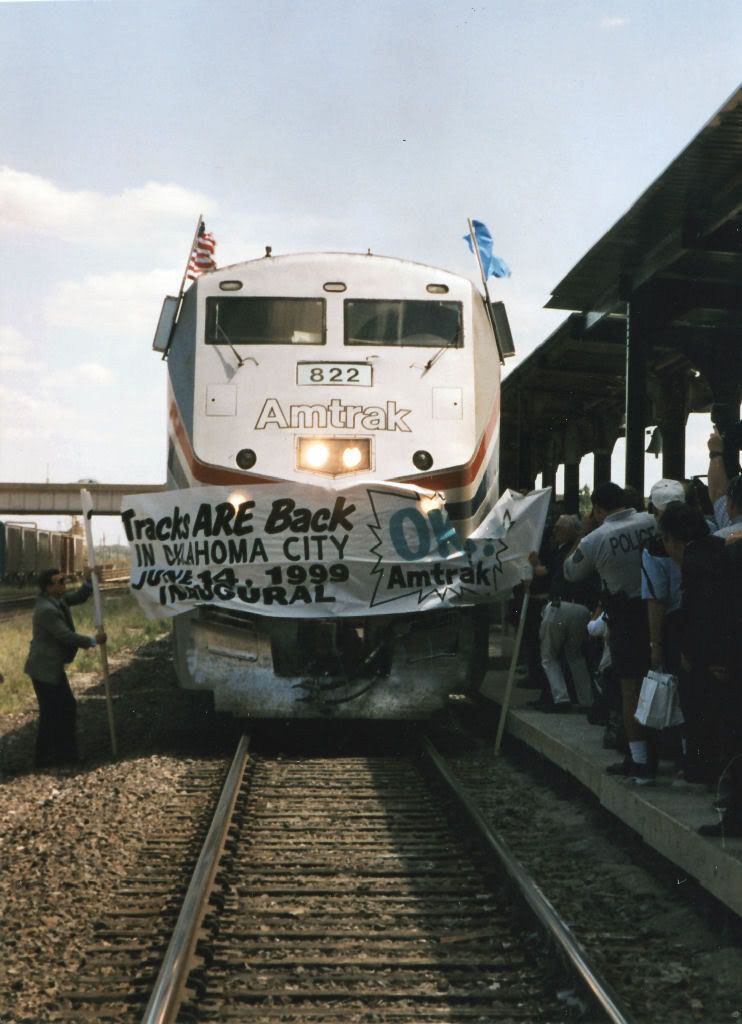
It is recalled that, after a rich 90-year history with passenger trains dating to the April 22, 1889 Land Run, all passenger train service to and from Oklahoma City (and Oklahoma, for that matter) ended in 1979. Through the efforts of many, not the least being those of Dean Schirf, corporate secretary of the Greater Oklahoma City Chamber of Commerce, passenger rail service returned to Oklahoma City on June 14, 1999, with the inaugural run of the Heartland Flyer to and from Ft. Worth, Texas.
The Heartland Flyer is a cooperative effort of the State of Oklahoma, State of Texas, Amtrak, and the Burlington Northern Railway whose tracks are used in the Oklahoma City to Ft. Worth route, and both Texas and Oklahoma pony up $2 million annually to Amtrak to subsidize the daily round trip route and make it possible. The Heartland Flyer website shows the stops and other connections possible from Ft. Worth in the drawing below:
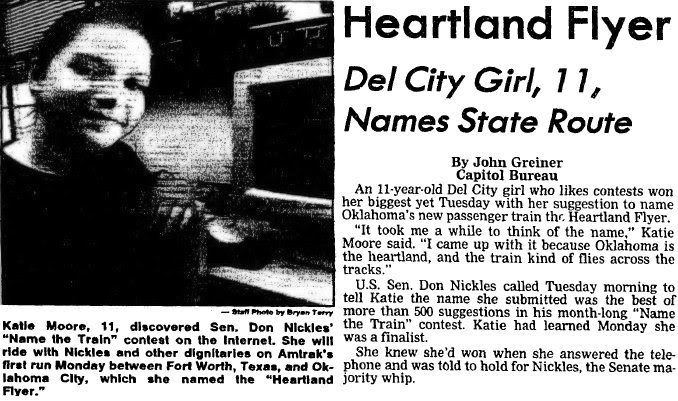
As noted in the Heartland Flyer's history page, when reservations started being taken in May 1999 the route was simply called, "The New Train," but that got changed when Senator Don Nickles sponsored a naming contest among Oklahoma children — the winner was "Heartland Flyer," submitted by 11-year-old Katie Moore. Katie, from Del City, made the Oklahoman's front page on June 9, 1999:
But, would the Heartland Flyer survive? According to the Heartland Flyer's history page, Amtrak officials opined that the route would need around 23,000 passengers in that first year to be considered successful — year-end figures showed that 71,400 passengers had made the trip.
According to a press release by the Oklahoma Department of Transportation,
Approaching the 10th anniversary of the service, the trains have carried more than 625,000 passengers, with the support of the Heartland Flyer Coalition, representing the communities along the 206-mile route.
The same press release quotes Joseph Yannuzzi, Amtrak General Superintendent, Southwest Division, as saying,
This service has exceeded its ridership expectations from the day it started. Even this fiscal year, despite all the economic conditions, ridership on the Heartland Flyer from last October through last month is within about 300 passengers of last year's record pace.
So, I guess that we're doing OK, Oklahoma City!
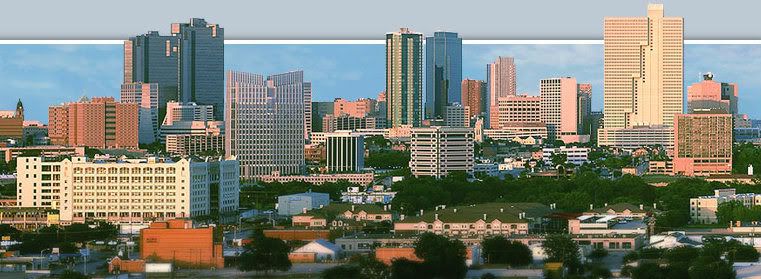
Right now through June 30, a special promotional fare is available — $20 one-way per adult ($40 round-trip)— kids prices are lower. Call 800-USA-RAIL (800-872-724l) to make reservations. Day or Overnight Trip To Ft. Worth. If for no other reason, it would be a fun day-or-overnight trip just to enjoy downtown Ft. Worth which boasts a sparkling and fun downtown and Sundance Square not unlike Oklahoma City and Bricktown — though Ft.Worth's are generally more upscale than our local counterparts. If you're spending the night, there are plenty of good downtown hotels but if you prefer a charming and well-done bed-and-breakfast, I easily recommend The Texas Whitehouse to you which is about 3 miles southwesterly from the rail depot — they will pick you up at the depot and return you downtown, no charge (at least, they did a few years ago), and the food and quarters were outstanding when I was there.
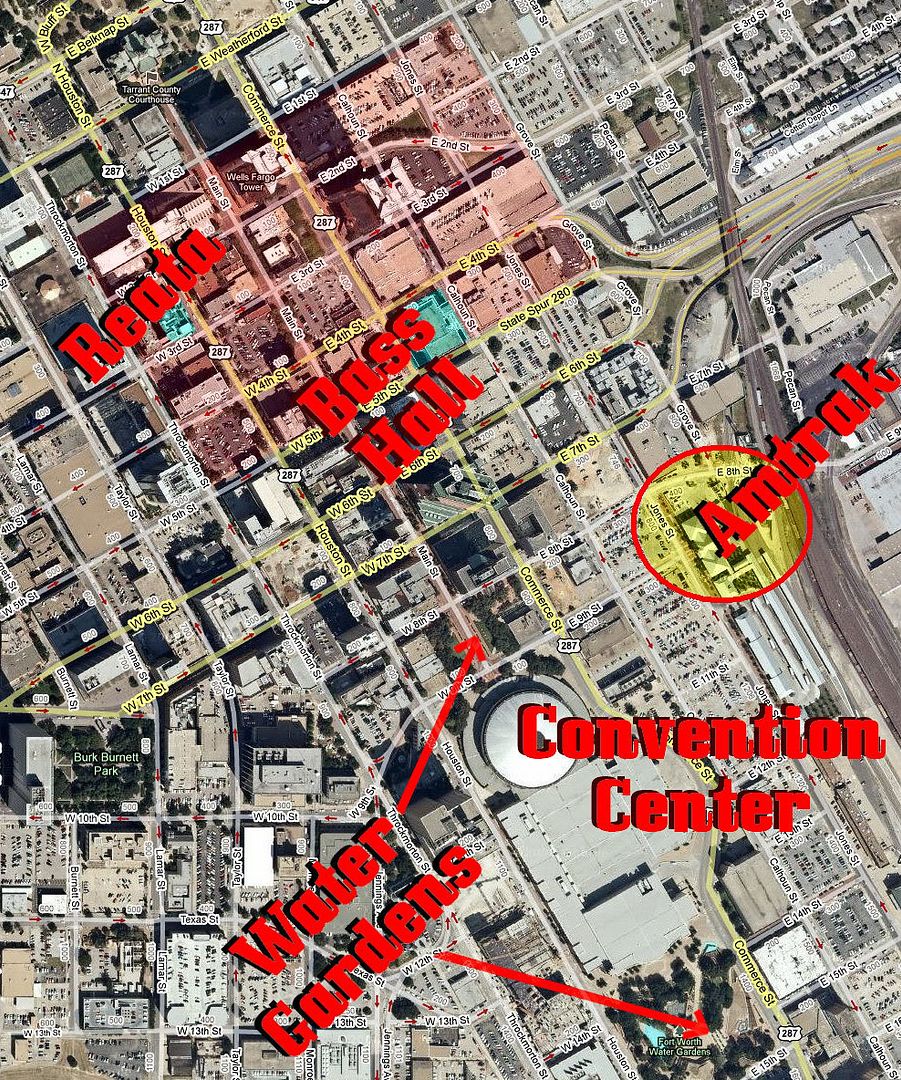
A Starter Map — click map for larger
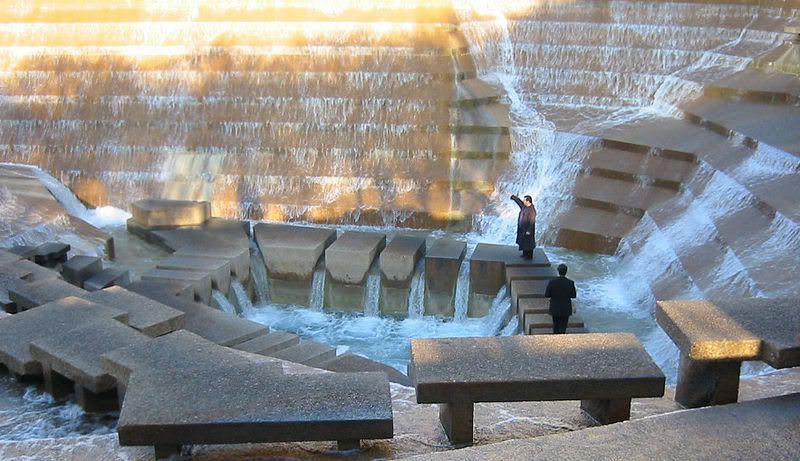
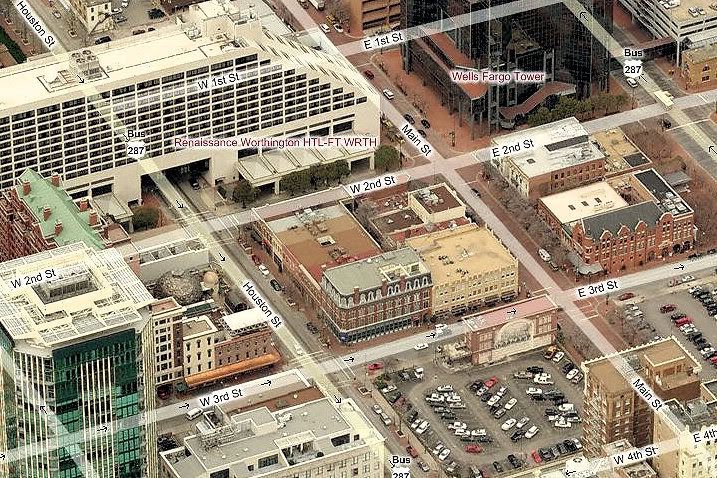
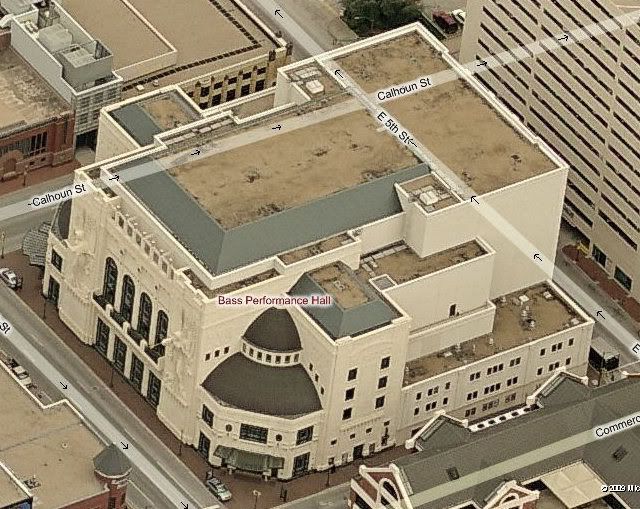
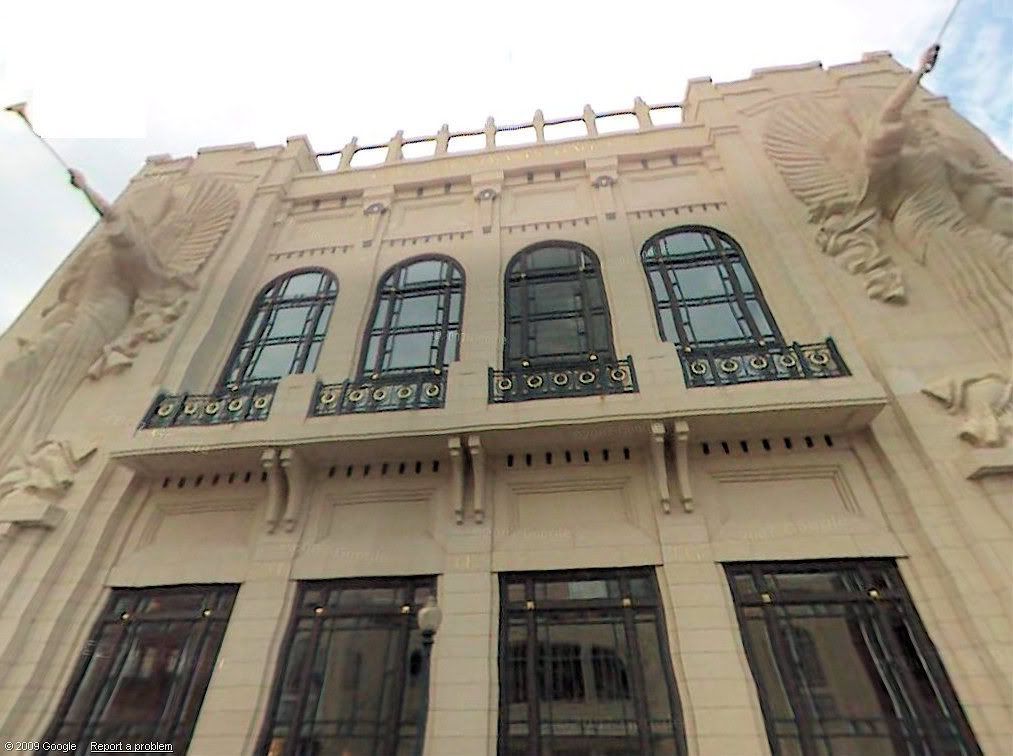
The Amtrak depot, Sundance Square (the salmon colored area), Bass Performance Hall, Water Gardens, Riata Restaurant, Convention Center, and Water Gardens are marked or highlighted.
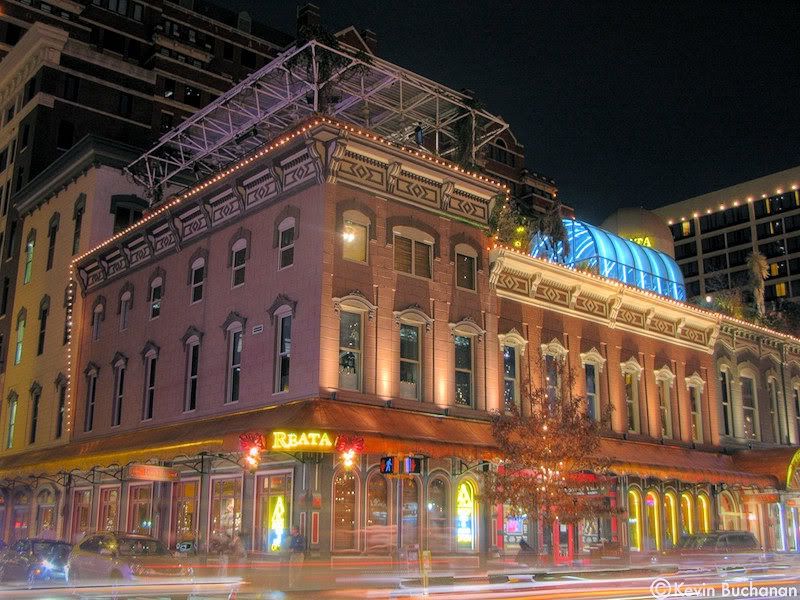
Reata Restaurant is my recommendation for at least one meal, even though dinner prices are on the high side (probably similar to Nonna's) but lunch is considerably more affordable. The 4-story restaurant is modeled on the theme of the movie Giant and it's fun just walking around the place; it has a rooftop eating area; the food is great. It is the building with the copper awning, lower left, and is marked in the map below.
According to Ft. Worth's official city website, you can ride "Molly The Trolley" while getting around downtown ...
Free trolley service runs on the “Downtown Get Around” route every day from 7 a.m. to 11 p.m. through Aug. 22.
The project is a trial program sponsored and paid for by the downtown hotels, the Fort Worth Transportation Authority and Downtown Fort Worth Inc. They appear to be the same trolleys we have in use here.
Oh, and by the way, FREE parking lots and garages abound in the Sundance Square area — hint hint to OKC! According to Ft. Worth's Visitors Bureau, Ft. Worth calls itself "The City of Cowboys & Culture." Hmmm ... sounds familiar! Event Photographs. OK, OK, enough of the Ft. Worth plug. Here are the photos from yesterday's celebration in Oklahoma City. Click on any image for a 1024 px wide view.
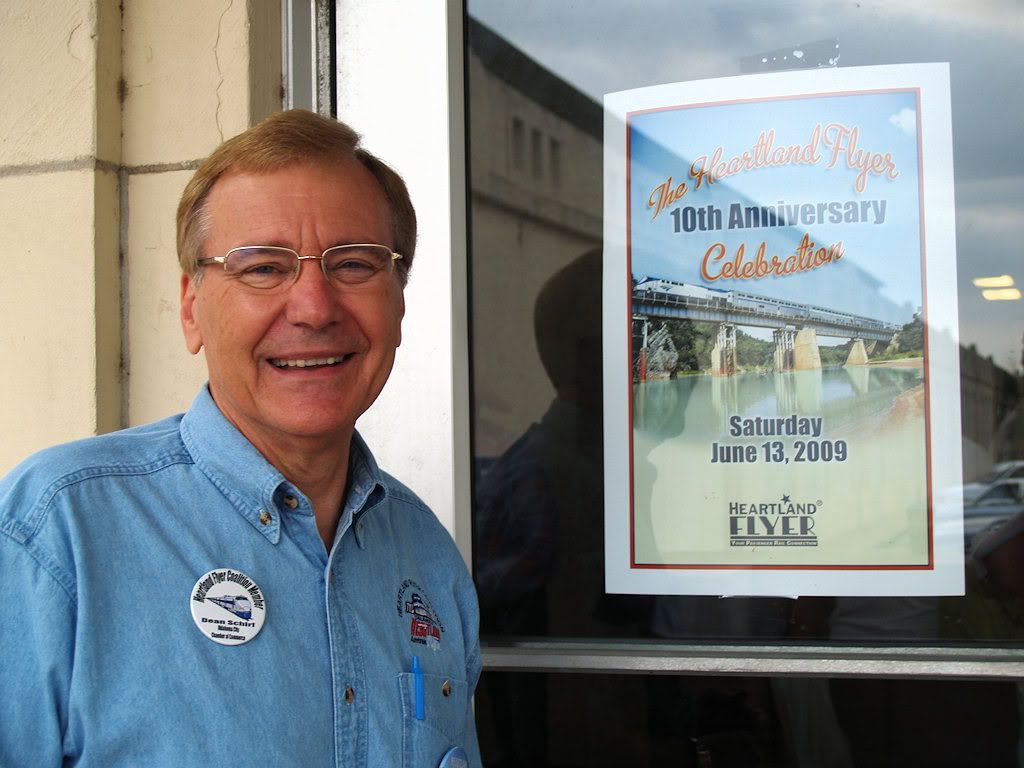
Dean Schirf By The Event Poster
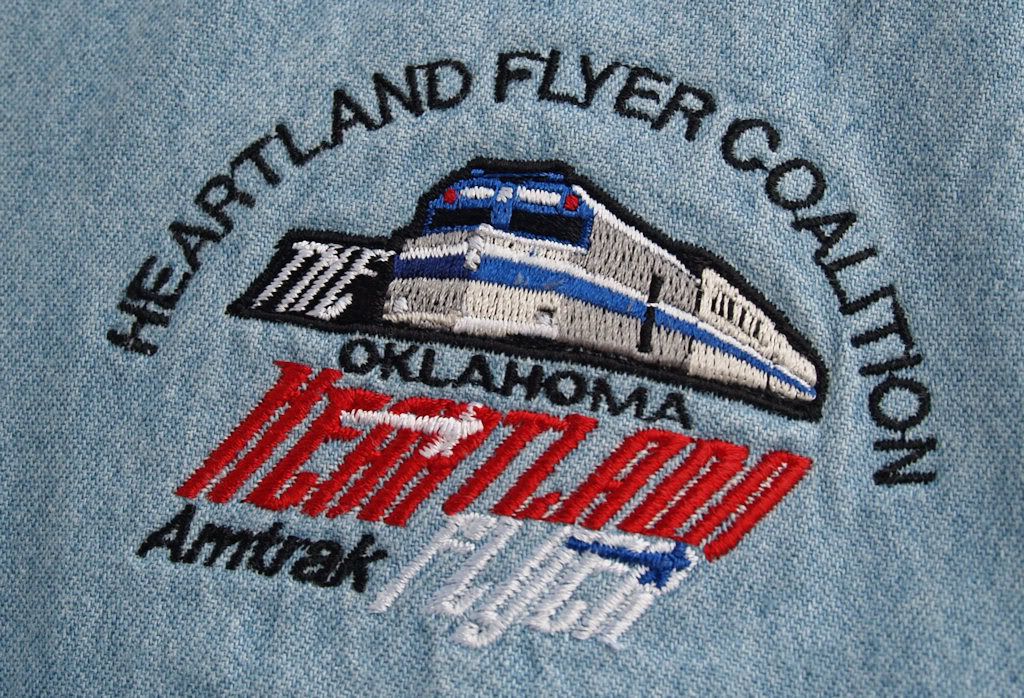
A Closeup of Dean's 10-year Old Shirt
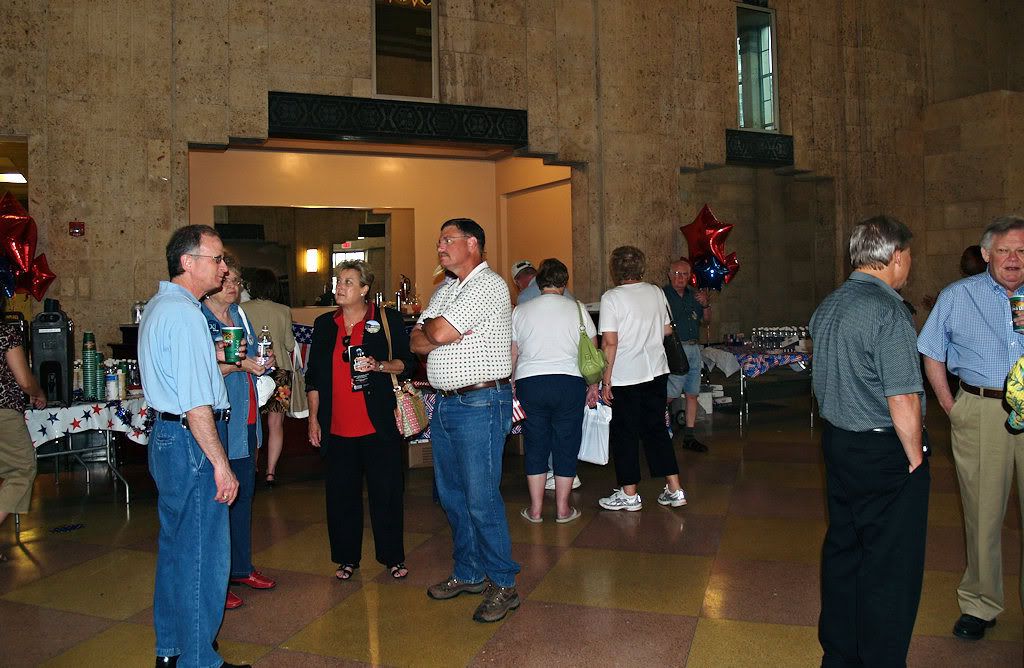
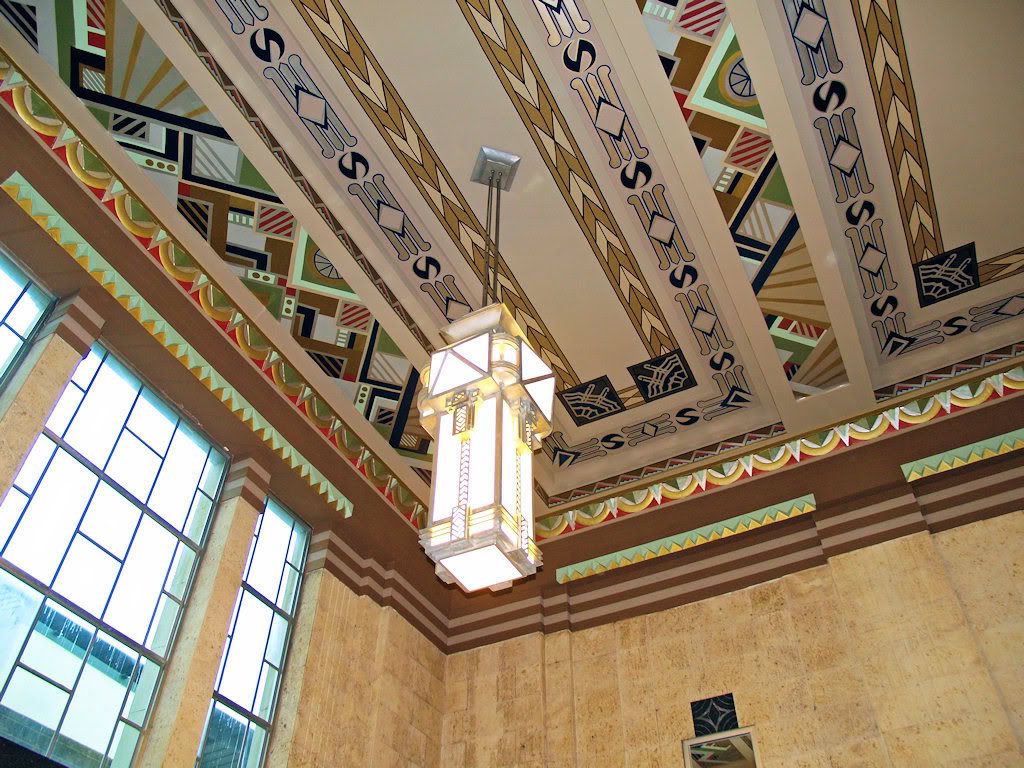
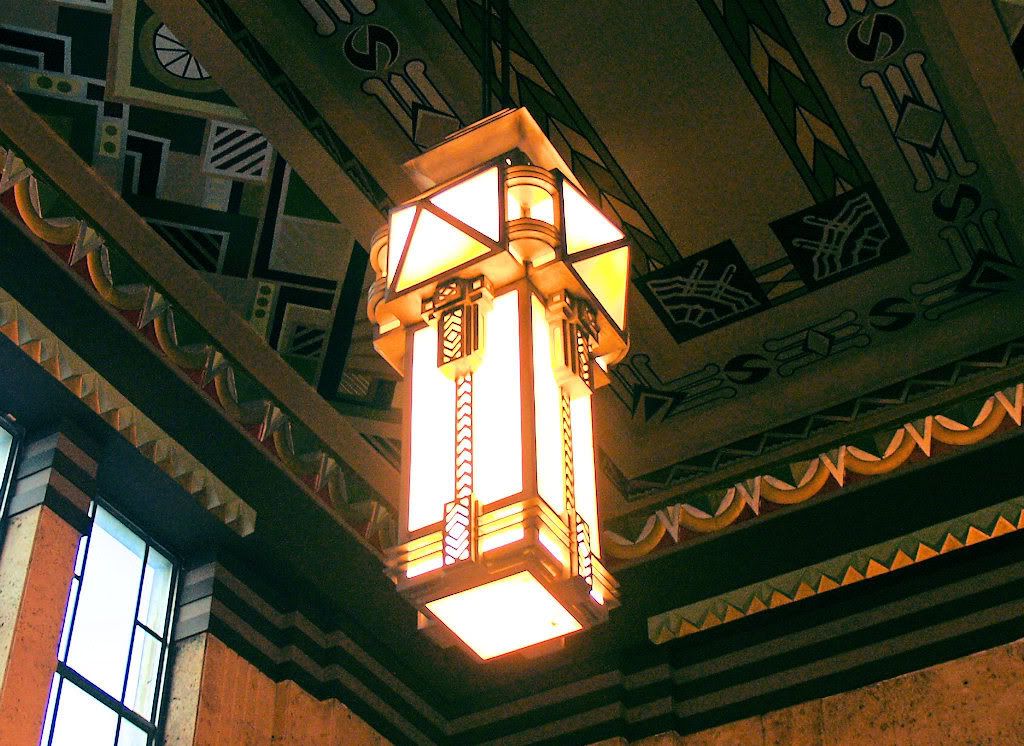
Inside Santa Fe Station
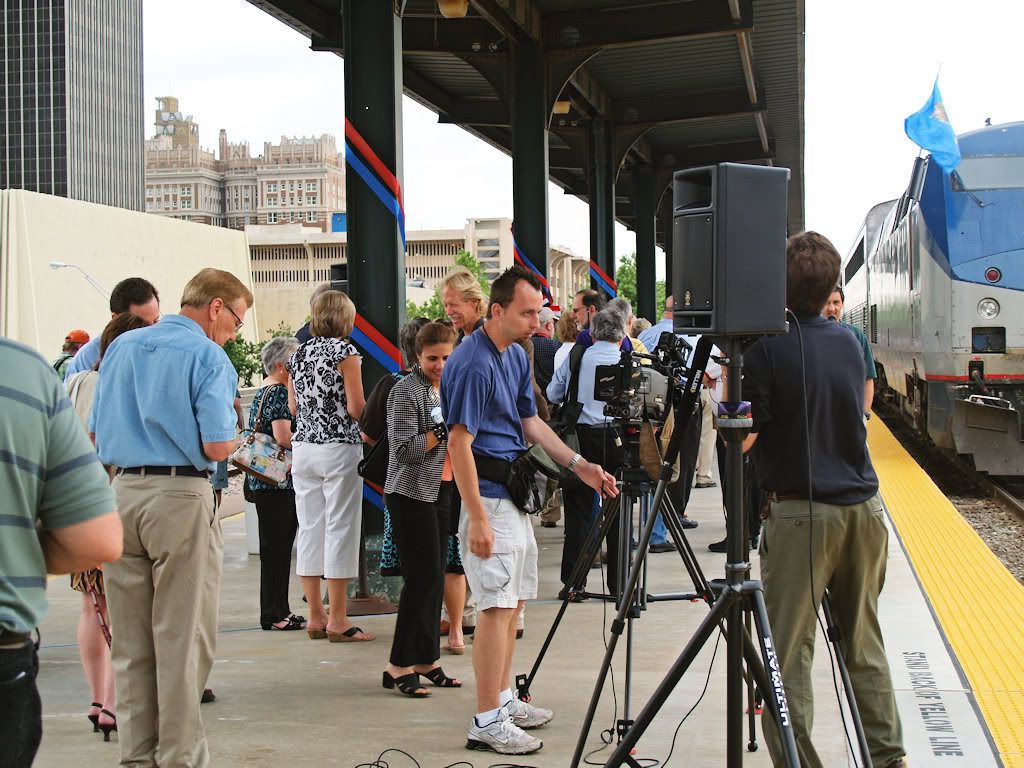
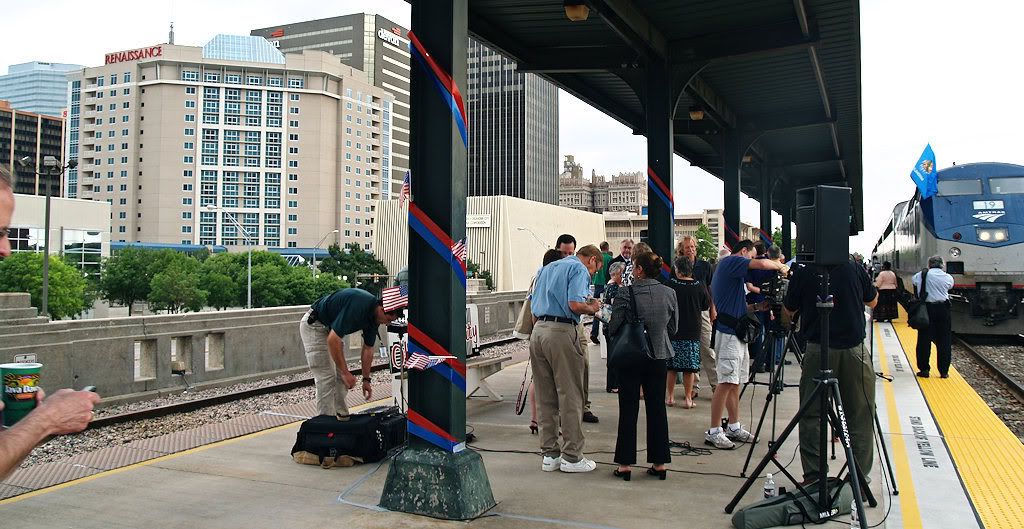
Random Shots Before The Speeches
Hmmm ... It Looks Like Brillo-Time To Me
Gary Ridley, Master of Ceremonies, Oklahoma Secretary of Transportation, Speaks
Joe Kyle, Rail Programs Division Manager, ODOT
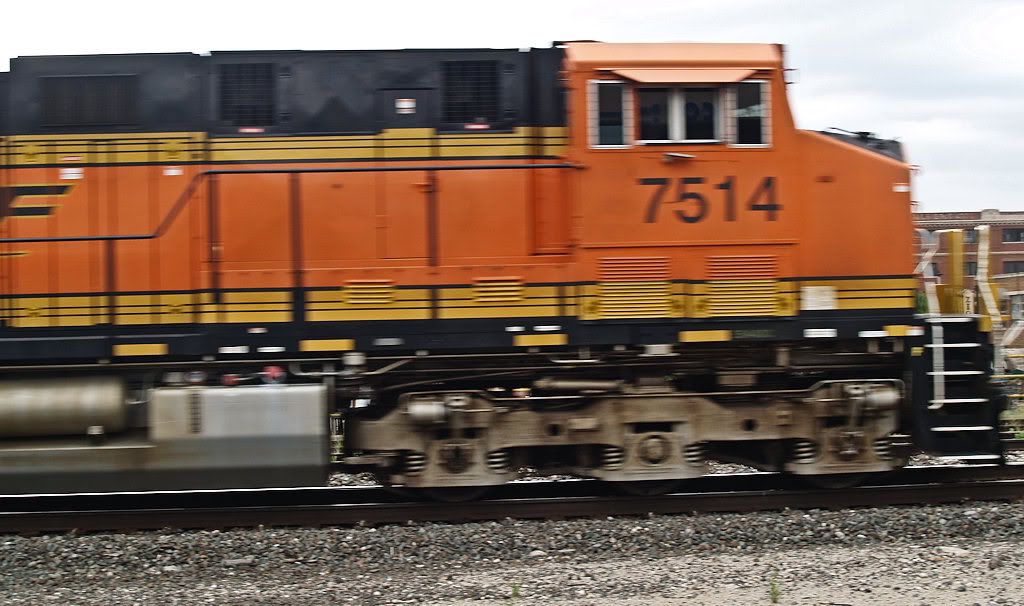
A Burlington Northern Train Passes By, Toots at Mr. Kyle's Remarks (Similar to a USAF Fly-Over, I Guess)
Back To The Speeches ...
Jennifer Moczygemba, Originally From Enid, Multimodal Section Director, Transportation & Programming Division, TX DOT
Richard Phelps Amtrak Vice President of Transportation
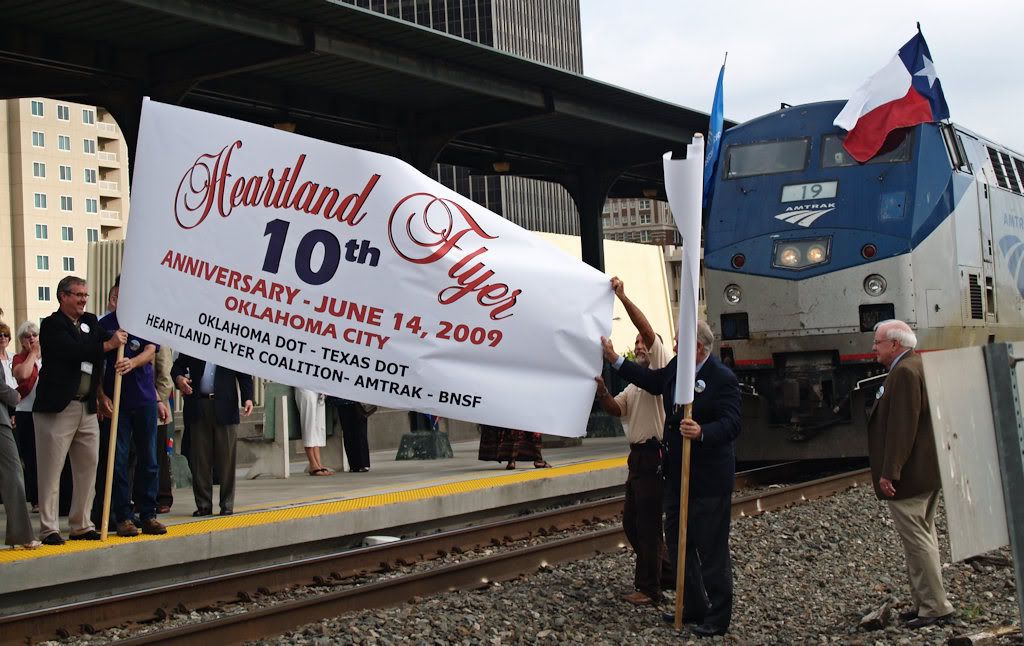
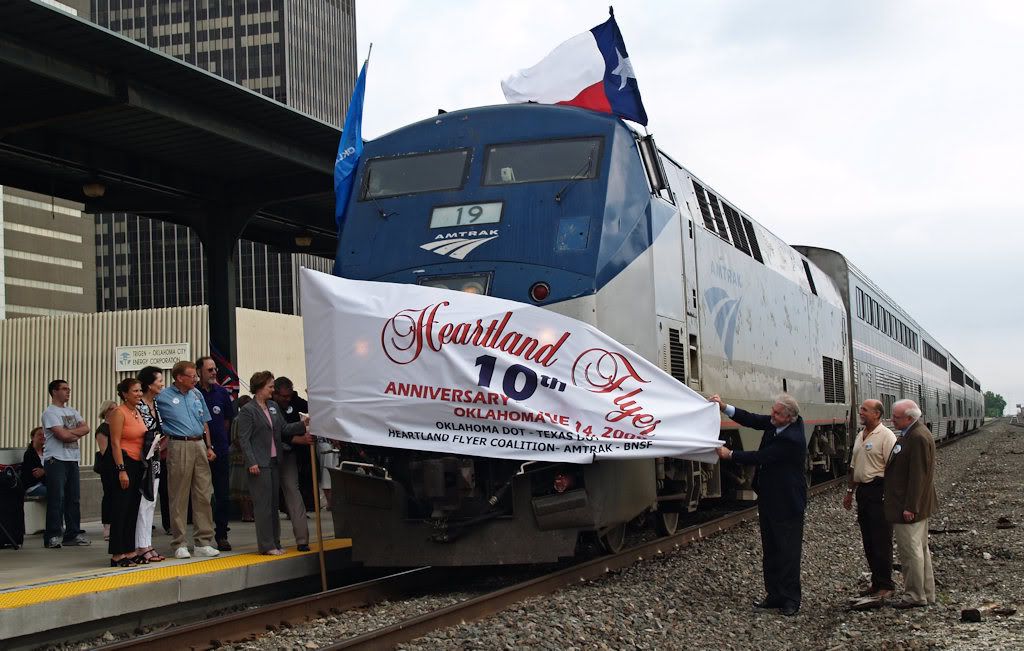
Time For The Paper-Breaking Ceremony Arrives
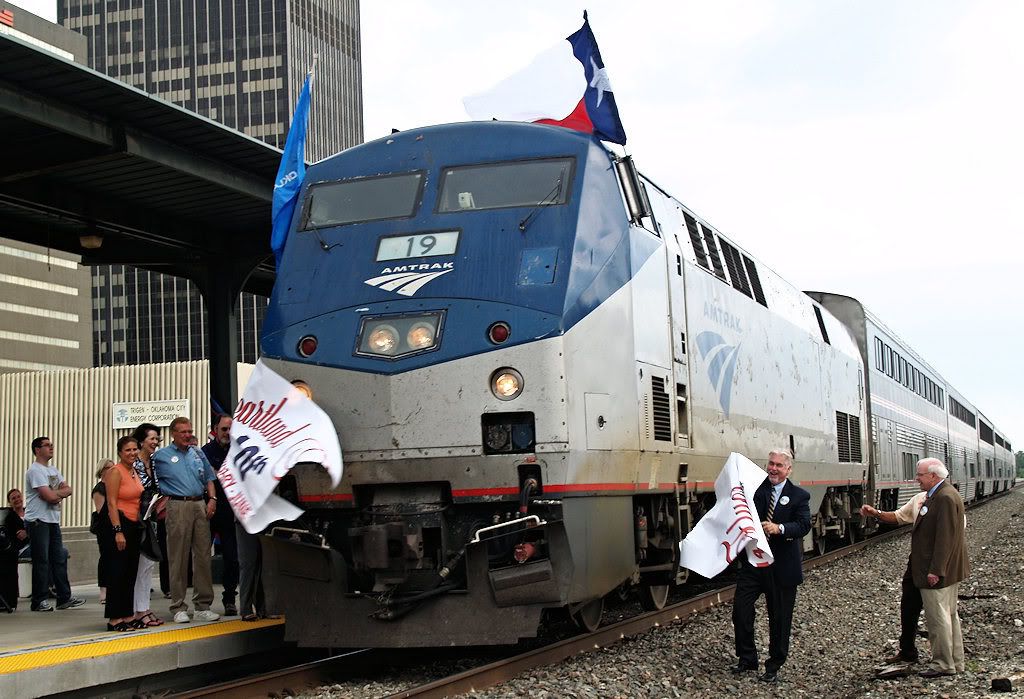
Oops! Premature Paper-Break The Paper Must Have Come From Texas
Not To Worry — Okie Enginuity (wink wink) Wins Again!
That Paper's Not So Tough! The Heartland Flyer Get Underway
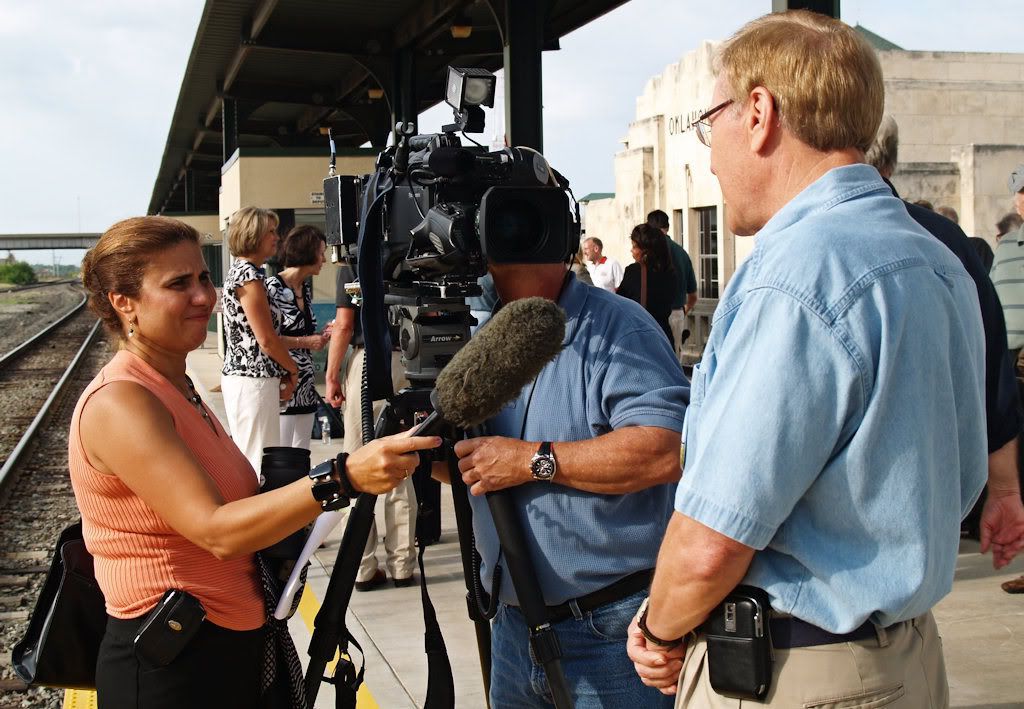
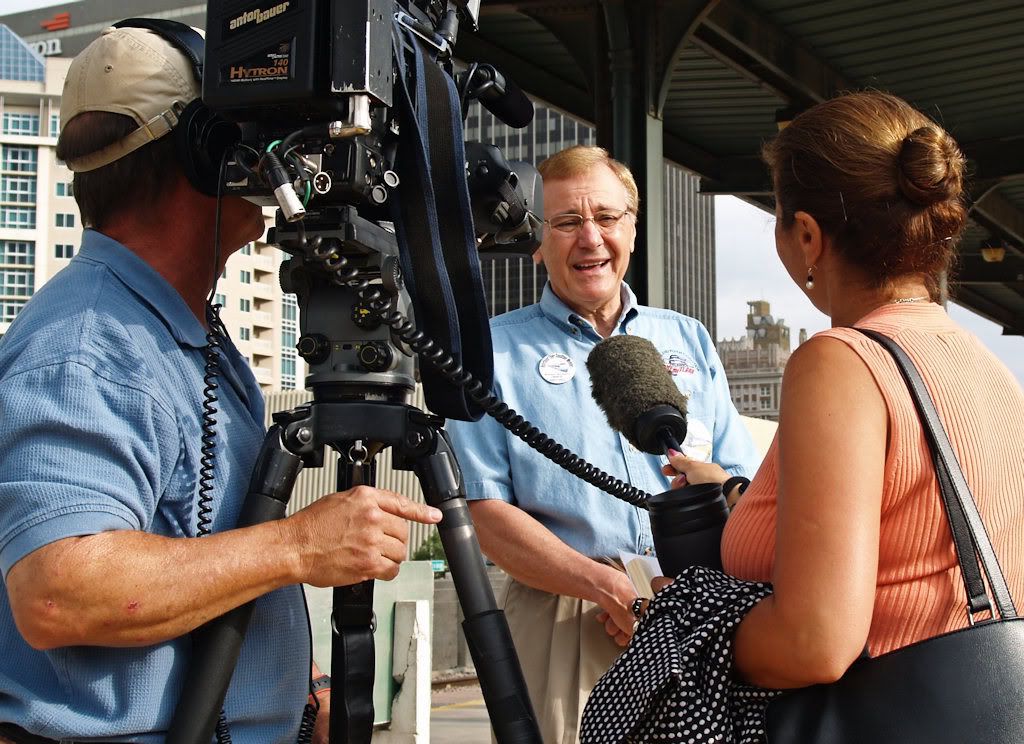
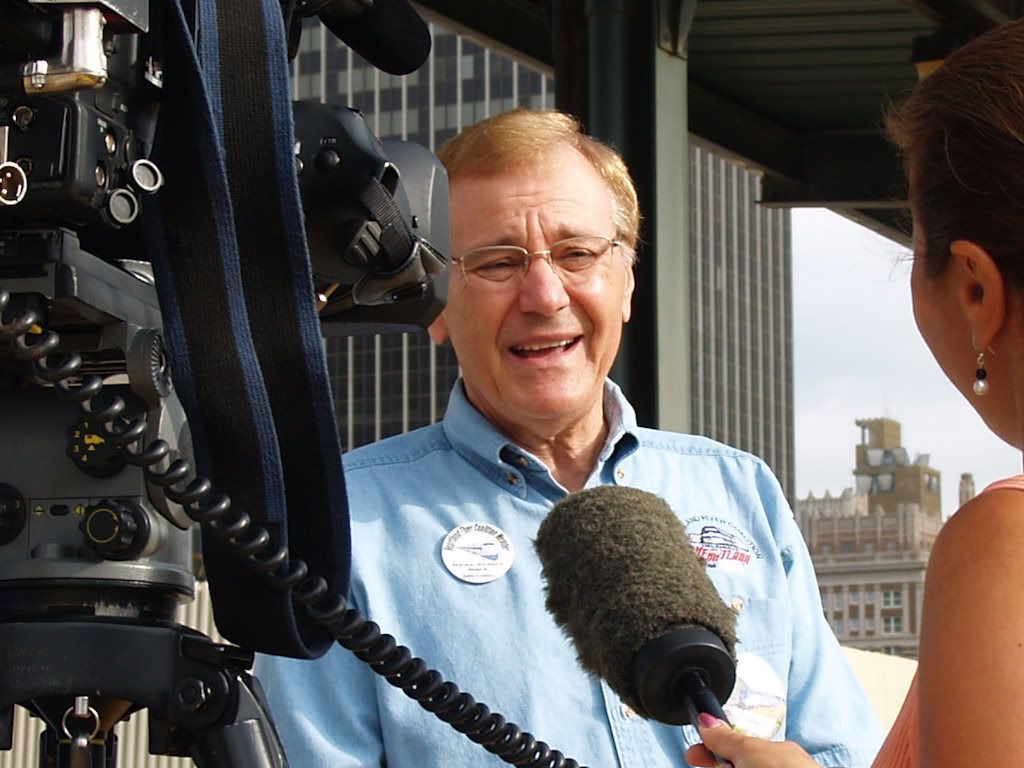
Afterward, people hung around for a while, savoring the morning's activities, thinking and talking about trains. Here, Dean Schirf, Corporate Secretary of the Greater Oklahoma City Chamber of Commerce, is interviewed by Channel 9 News ...
And well he should be. If Dean did not lead the fight to get Amtrak service to Oklahoma City back in the 1990s, he was certainly one of the principal locomotives who did. See my Trains 3 article for much more about that.
Sooo ... when the 1st Heartland Flyer paper-breaking ceremony was had way back on June 13, 1999, Dean was the guy at the left holding the banner ...
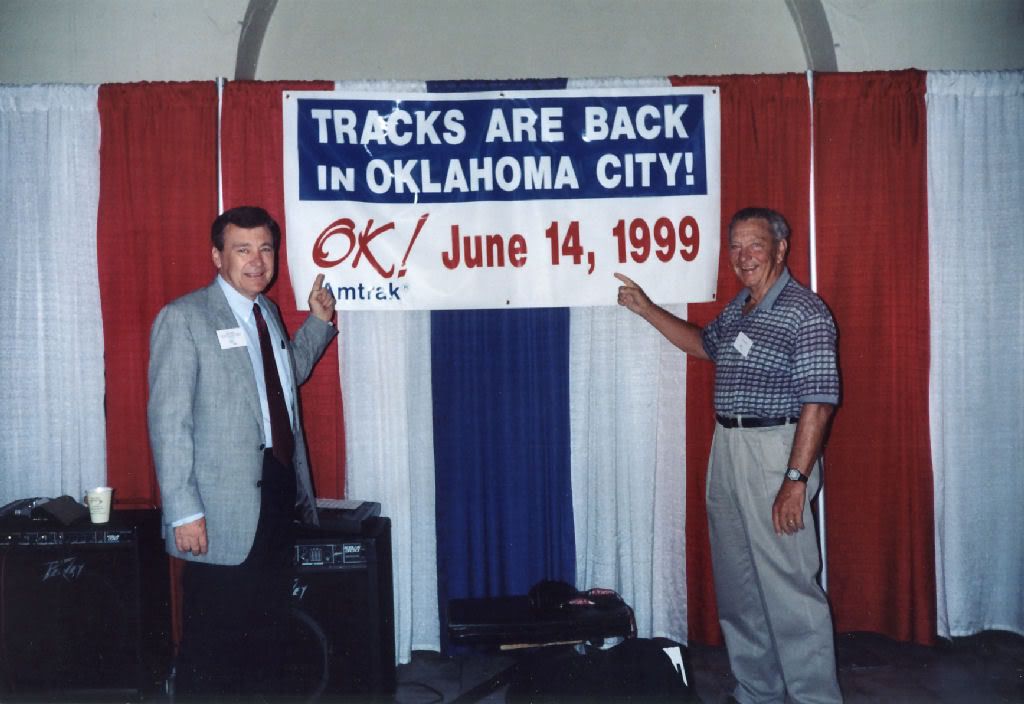
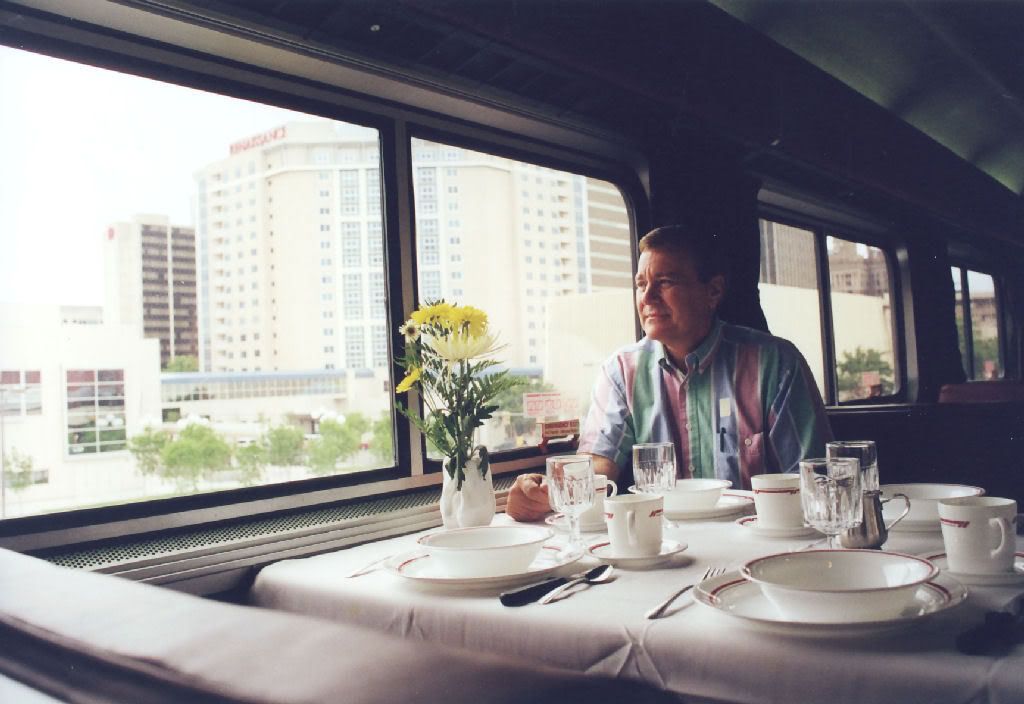
Dean At The Heartland Flyer's 1st Anniversary In A Demonstration Train Dining Car
After 31 years with the Greater Oklahoma City Chamber of Commerce, Dean is retiring this month, on June 24.
He Hasn't Aged A Bit
Thanks, Dean Schirf, For All You Did In Making Passenger Trains Again Possible In Oklahoma City, Oklahoma!
Future Expansion of the Heartland Flyer. Will the Heartland Flyer expand to include routes to (a) Kansas City and/or (b) Tulsa & St. Louis? These kinds of questions have been going round and round for many years and were discussed earlier in Trains Part II. Here, I'll take a brief fresh look at the questions since the August 2007 Trains II article was written.
To Tulsa. In the main, the Tulsa route expansion has been said to be (a) too expensive (given that the existing rail tracks between the cities are dilapidated or outmoded) and (b) too slow, i.e., connecting the cities by rail wouldn't shorten transportation time between the cities even if the rail alternative existed.
Keep in mind that, in this context, the 90-mile or so route would unlikely be "high speed" ala European 125 m.p.h. high-speed rail speeds or the faster 150 m.p.h. Amtrak high-speed standard. Even the Texas part of the existing Heartland Flyer route hasn't been upgraded like the Oklahoma part has — on the Oklahoma side, the train can clip along at 79 m.p.h. but it must slow to 59 m.p.h. when it hits the Texas border. The legal speed limit on the turnpike connecting Oklahoma City and Tulsa is 75 m.p.h. and we all know that you can go at least a little faster without getting smashed by the O.H.P.! The existing rail lines between Oklahoma City and Tulsa are much worse than those from the Texas border to Ft. Worth. Sooo ... where's the gain for such a route? The gain would have to come from an extension of the route beyond Tulsa to, say, St. Louis or Kansas City and that's a worthwhile factor and consideration. That said, I'm not aware that a Missouri initiative, like that described in the Kansas activity, below, has come to exist, and I don't sense that momentum exists for building for such a route within Oklahoma to the extent that the Newton/Wichita/Kansas City route does.
To Kansas City. The potential for this expansion may well be different. For at least two years now, Kansas and Amtrak have been seriously looking at an extension from Oklahoma City to Newton, a historic north/south east/west rail intersection, to Wichita, and on to Kansas City. As recently as when this June 12, 2009, Kansas City Tribune article was written, the Kansas City link seemed to be gaining momentum. Note: the link just made works today but I don't know how long it will, so I'll quote the article verbatim below.
Amtrak Heartland Flyer Would Link KC-Ok. City
An Amtrak study on a passenger rail link that would connect Oklahoma City and Kansas City’s Union Station is still on track and half way home. ¶ The study is looking at extending the Heartland Flyer which goes between Fort Worth, Texas, and Oklahoma City, to Newton, Kan. Newton is north of Wichita but on the east-west Burlington Northern Santa Fe mainline. The BNSF mainline is also the route used by the Southwest Chief passenger train which runs between Chicago and Los Angeles through Kansas City.
“It certainly makes a lot of sense to look at connecting Oklahoma City and the Southwest Chief,” said Ron Kaufman, spokesman for the Kansas Department of Transportation.
KDOT has contributed $200,000 to the study. Kaufman recently authored an update on rail passenger travel in Kansas including the Heartland Flyer study. ¶ “There’s a lot of interest in it,” he said.
Amtrak has said the study should be done by the end of the year, he said. It would be handy to have the study in hand by November, he said. ¶ “We would certainly want the time to be able to look over the study and prepare our recommendations to the 2010 Legislature,” Kaufman said.
The most likely route for the extension would use BNSF tracks between Oklahoma City and Newton. The study would examine the rails, how much money it would take to update and maintain the rail network and how much it would cost to operate the passenger trains.
Before KDOT makes any recommendations to legislators, the agency needs to know the costs because it’s virtually certain that the state would have to subsidize the route, Kaufman said. ¶ “We know there will be state subsidies,” he said. “We need to know how much that would be.” ¶ Legislators would have the final say on subsidies, he said. ¶ However, legislators have expressed strong interest in the proposed link, he said.
The Kansas Senate passed a “concurrent resolution” and the Kansas House drafted but didn’t act on its own concurrent resolution that urged KDOT to seek economic stimulus money to expand passenger rail service and to include passenger rail in any new transportation plans.
Although the legislators endorsed the proposal, they didn’t appropriate any money for it. Without the money, KDOT can’t apply for grants that would have the effect of committing the state to provide subsidies for passenger rail service, he said.
In the meantime, KDOT plans to apply for $10 million in federal economic stimulus grants to upgrade the highway-rail crossing-signal timing between Newton and the state line. Upgrading the timing signals would allow passenger trains to travel at speeds of 79 miles an hour on the track. Currently, the signal timing along the route is set for slower freight trains. Upgrading the signals will be essential for crossing safety if the track is to be used for passenger trains, according to Kaufman.
The economic stimulus grants don’t require the states to put up matching money and they don’t require a statewide or passenger rail plan, he said. ¶ The state needs to have a passenger rail plan to be able to apply for other federal passenger rail grants. ¶ KDOT will begin updating its state rail plan in July, Kaufman said. The state rail plan will include a section on passenger rail and the Amtrak study is likely to be incorporated in it, he said.
Also, see the Northern Flyer Alliance webpage for more and for those in Oklahoma and Kansas which have gone on record favoring the route.
So, between 2007 and 2009, Kansas and Amtrak have been moving forward. Nothing's done, of course, but at least the idea is progressing.
High Speed Rail. This topic sort of dove-tails into the last. President Obama's initiative with high speed rail is yet another new element since 2007. The "South Central High Speed Rail Corridor" has been around for several years, perhaps since as early as 1993 and certainly by the year 2000, and it, too, was mentioned in the August 2007 Trains II article. The route is shown below, from the Federal Railroad Administration website:
Thing is, that "route" has been sitting on the shelf since, as I said, at least by the year 2000. What's new is that the Obama administration, as part of its economic stimulus plan, seems to be saying, "OK, let's give serious thought about doing such a thing." This would, of course, require that the states involved "buy in" to such a plan, and that is less than certain at this point. We're talking "real" high-speed rail here, as in 125 m.p.h. or faster.
Oklahoma awaits high-speed rail corridor designation The Journal Record, Oct 31, 2000
It's just a matter of time now, before Oklahoma residents can hop a passenger train for a jaunt to just about anywhere on the Amtrak system.
The track running from Tulsa through Oklahoma City and Fort Worth to San Antonio has been designated as a high-speed rail corridor by the Federal Railway Administration.
That was then, and this is now. Almost 9 years passed by since the above article was written. "Now" is that the President is making a push for those old drawing-board high-speed routes to be opted for, much as was was done in FDR's Works Projects Administration days and it has been reported that $8 Billion has been devoted to this purpose.
Anyone's guess is good as another's as to whether the high-speed project will ever come to pass. My guess is that, Yes, it will, but that, no, it won't until after rigor mortis has long set into this body of mine. I'll be 66 in 2 weeks. Rather than unduly politicize this article (which I would really, really, and earnestly prefer to do), let me just say that, after I am dust, I have no prediction of the mindset of those who will then dominate the Oklahoma Legislature as they did during the recent "State Rock Song" national embarrassment which exposed our state to national and well-deserved ridicule, but for Governor Henry who stepped in and saved the day. Chances for Obama's high-speed corridor landing on the ground in Oklahoma while those who voted to bash the Flaming Lips remain in office are, I think, zero. Our Legislature is not putting a progressive face forward, to say the least. But, that's just me thinking out loud. I'd be glad to be proven wrong.
When you're at home And you want to make a bet You can always go — downtown. When you've got money And bookies take bets on games Seems to help, I know, downtown.
Just listen to the music of the traffic in the city Don't linger on the sidewalk where the neon signs are pretty — How can you lose?
Step into the Central and Forget all your troubles, forget all your cares and go Downtown, things'll be great when you're Downtown, no finer place for sure, Downtown, everything's waiting for you.
Downtown wasn't the only thing that Urban Renewal of the 1960s & 1970s killed — it killed all of the old domino parlors, pool halls, and bookie haunts which didn't discriminate as to economic status and the best of them were all — downtown.
In this, my focus is on one of them — the Central Club — although several others will be mentioned. I've chosen it because it is the only one that I have even a taste of first hand knowledge, naive and innocent though that taste was at the time. Before the 1967 Oklahoma County Office Building, and, more to the point, before the Metro Parking Garage at Robert S. Kerr & Hudson was built ...
On the same spot as that parking garage (though not as wide) was a much earlier and venerable public entertainment facility — domino, pool, and, yes, a betting facility. An October 19, 1950, ad announced its new opening ...
For those who think that downtown vice was a part of the city's lore which passed silently in the night with the passing of Big Anne's and the Southern Club around the turn of the last century, well, think again. At least by the 1940s, possibly during the 1930s or earlier, downtown Oklahoma City was the hub of bookie gambling which endured until all the old pool halls and domino parlors were torn down during the Urban Renewal era. If not chief among them, certainly the Central Club was the first among equals.
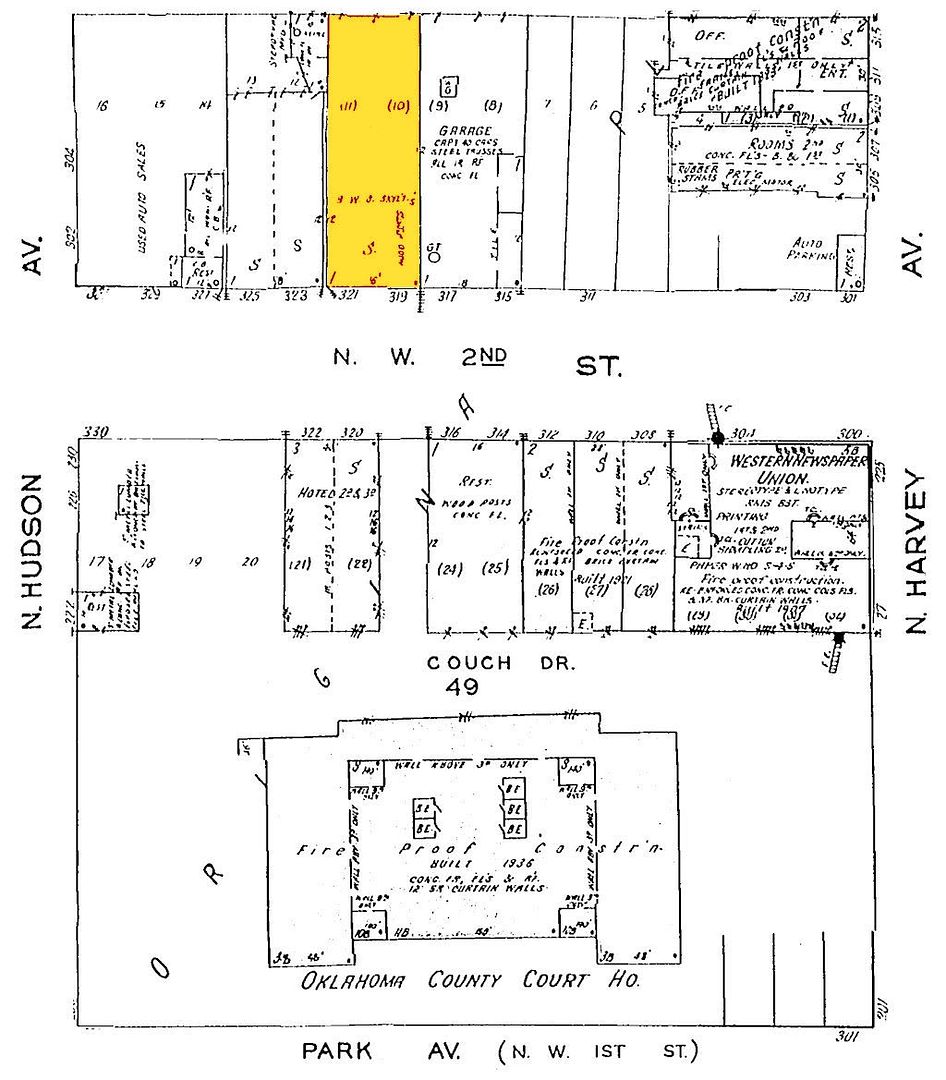
In its last location, 319 Robert S. Kerr (N.W. 2nd Street), it would have been located in the highlighted area shown in the Sanborn Map updated to 1955 shown below:
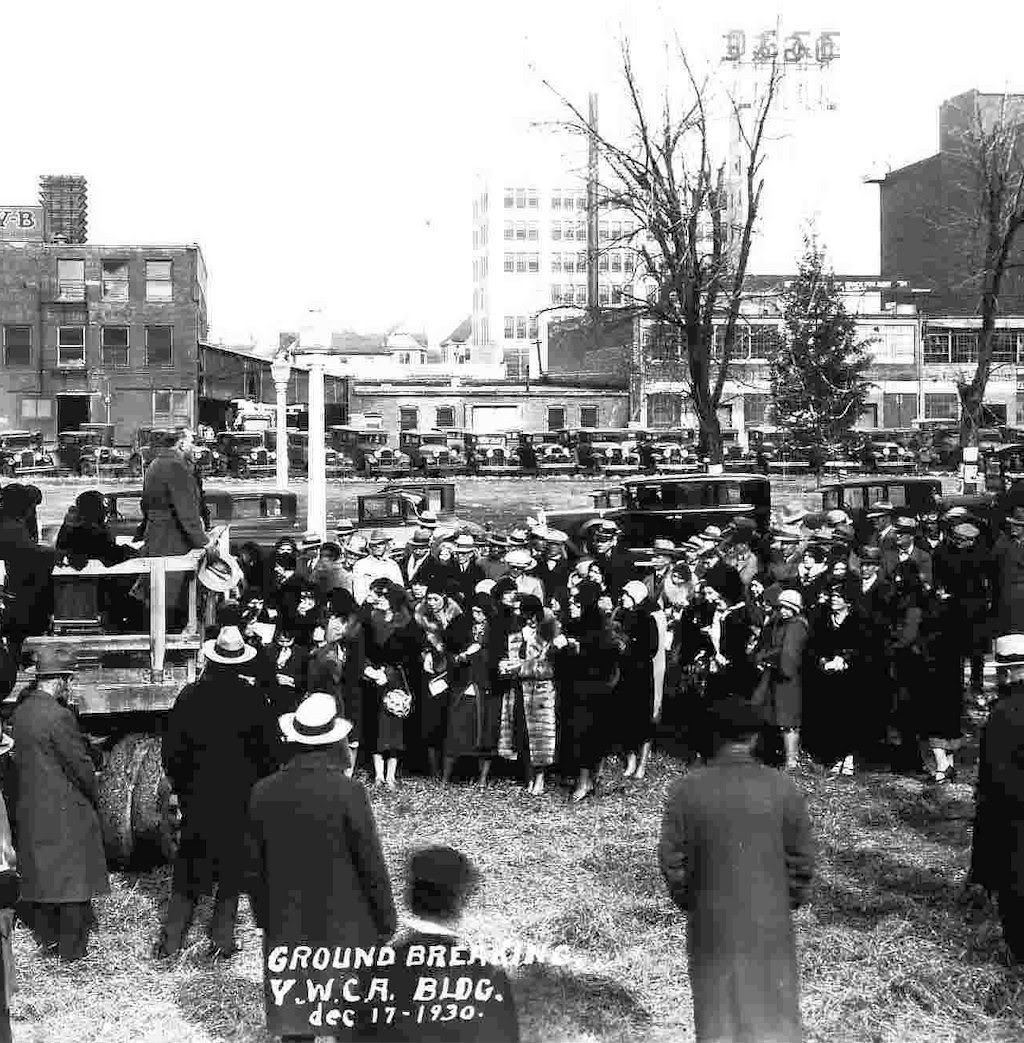
The spot served as a parking garage before the Central Club moved into it in 1950. So far, I've located no photographs of either the building or its immediate area, but the December 1930 photograph of the YWCA groundbreaking might give something of the flavor.
The view in the above picture looks north from Park Avenue over where the County Courthouse would be built six years later and northeasterly toward the OG&E Building at Dean A. McGee (N.W. 3rd Street) and Harvey. It's hard to tell the exact placement of the low level buildings in the foreground but they may be the row of buildings on N.W. 2nd or they may be the backside of buildings on the north side of Couch Drive.
In any event, the single-story parking garage that came to house the Central Club would have looked something like one of the buildings in the middle — nothing fancy, just something old and musty. A very excellent article in the May 9, 1976, Sunday Oklahoman's Orbit insert said,
The Central Club was Vestal's last old rival. It was located across the street north of the County Courthouse. With its dusty deer heads and blackboard baseball scoreboard, it made the transition to parking lot about five years ago.
The article was mainly about the Herman Vestal's Place at 225 W. Sheridan, and I'll say more about Vestal's at the end of this article.
My own acquaintance with the Central Club was when I was a law school student at the University of Oklahoma, more particularly during 1966-1968 when I clerked at an Oklahoma City firm located at the northwest corner of Hudson and Dean A. McGee. When trekking to the County Courthouse to file papers or what-not, I would pass near the Central Club, and, on occasion, went there for lunch. All that I recall with certainty is that it was a beat-up nothing fancy place with lots of smoke, domino and pool tables, and a lot of old guys hanging around shuffling dominoes. But, there were guys in shiny shoes and suits, too. I had no notion of its other and more interesting bookmaking function that I'm about to describe. I was just a naive young pup at the time.
But, first, a little history. The Central Club's origins apparently date back to around 1928, if I've done my math correctly based upon the June 15, 1945, obituary of Fred Ryser shown here. He apparently co-founded the Central Club around 1928.
I'm sure that I've not tracked down all its locations before winding up at its last, but here are a couple of others:
According to this July 3, 1947, article, it was located in the first floor of the Scott-Thompson Building at 134 N.W. 2nd Street until late June 1947. The article describes a fire which destroyed the building on July 2 and threatened the Petroleum Building, its next-door neighbor.
By the time of this March 25, 1949, article, the club was located at 223 N.W. 2nd Street, which would place it in the western part of the block where the Bank of Oklahoma Tower is today, perhaps at the location of the Plaza Parking garage.
It was doubtless at one or both of the above 1940s locations that Pody Poe began hanging out as a teenager, as described in a fascinating January 23, 2005, Oklahoman article by my good friend, ace Oklahoman reporter and Okc historian Steve Lackmeyer. A small part of that article is shown below, as is a photo of Minnesota Fats, who was at the Central Club sometime in the 1940s:
Pody Poe’s Colorful Life
● Nov. 29, 1932: Tracy Coy “Pody” Poe is born. ● 1934: Poe makes his first front page headline when he falls out of his family’s car while the vehicle was going 65 mph. ● 1935-1937: Poe’s father, Coy Poe, leaves Oklahoma City for Los Angeles, where he composes music and helps produce five movies. Pody Poe goes to school with John Drew Barrymore Jr. — the father of actress Drew Barrymore. ● 1940s: Pody Poe’s parents divorce, and he travels between his father in California and relatives in Oklahoma. As a teen, Poe begins to hang out at the Central Club, an Oklahoma City pool hall, where he watched pros, including “Minnesota Fats.” Poe begins his lifelong love of golf at Edgemere Golf Club. It’s there he meets some gamblers. They flip a coin to see who pays for lunch.
Apparently such a coin-flip was the beginning of gambler Poe's career.
Articles such as the above March 25, 1949, article appeared frequently in the time span of the late 1940s to late 1960s. See this July 22, 1955, article, for example. Others are noted below in the OCPD campaigns against the bookies.
As best as I could determine, neither the Central Club nor its owners or operators were ever charged with an offense — it was merely the business home of many of the city's bookies albeit with the consent and knowledge of the proprietors.
And it wasn't a best-kept secret. The bookies' apparatus — tickers and chalkboards — were apparently on display for all to see.
In something of a muckraking article, the Oklahoman's August 27, 1955, headline read as follows:
At least six bookie gambling establishments are operating openly in Oklahoma City with little or no police interference. ¶ The establishments also feature poker and domino games in which you can bet anything your purse will stand. ¶ Newsmen were able to place bets in or photograph gambling activities in the six places Thursday and Friday.
They included Jerry's Recreation Parlor, 314 NW 2; Central club, 319 NW 2; "21" club at 21 S Broadway; Palace Recreation club at 310 N. Broadway; Sportsman's Bar, NW 5 and Broadway, and the 24th Street Billiard Parlor at SW 24 and Robinson. * * * When informed of our findings, Roy Bergman, chief of police, said he was aware of the booking activities in Oklahoma City. ¶"There is not much we can do to stop them," Bergman said. "We try to harass them as much as possible. We try to check them every day and if a known bookie is around we arrest him and fine him $20, the maximum under our city ordinances." * * * In each of the bookie establishments reports found ticker tape machines which furnished gamblers and bookies with inning-by-inning developments in four baseball leagues. ¶ Beside the "tickers" were blackboards on which were posted results and pertinent information for gamblers about each game. * * * In only one establishment was a news photographer challenged with his camera. ¶ That was in Jerry's Recreation Parlor. A porter spotted the camera and notified the bookie. The photographer was immediately surrounded by angry employees of the club. When he complained, a bartender told him, "We got to be careful. You know these d---- reporters are always trying to cause trouble. We got that board in here and a lot of prominent people hang around. They don't want their pictures taken."
Despite occasional crackdowns, like that shown in this April 12, 1956, article and this one in a November 6, 1958, article, and this one in an October 6, 1961, article, it would apparently take the Pei Plan and Urban Renewal to rid downtown of the overt and blatant gambling going on right here in downtown Oklahoma City. Urban renewal, and not the police, made places like the Central Club just another memory of the downtown that was and is no more.
This brings me to the end of the story and I'll get back to where I said I would go in the beginning: Herman Vestal's Place. In an long urban renewal nostalgia article, the May 9, 1976, Oklahoman almost lamented the passing of the era which had room for places like the Central Club and Herman Vestal's place, and it's an article that is well worth the read. To read the full two and one-third page article in one piece, click here but you might find it easier to read one page at a time: click here for the 1st page, click here for the second, and here for the third. Here are a few excerpts:
Where Will All the Winos Go?
It never made the Diners Club list of Five Star restaurants. ¶ The chamber of commerce never recommended it as one of the must sites to visit in beautiful downtown Oklahoma City. ¶ It was a place called simply Herman Vestal's Place at 225 W Sheridan, and a lot of guys like PeeWee and Ernie and Shorty are sure gonna miss not having it around. * * * In name, Herman Vestal's was a combination pool hall, domino parlor, bar and greasy-spoon beanery where 45 cents could get you a game of moon and an hour's worth of cigar smoke and tobacco spit, and where twice that amount would buy a bowl of chili potent enough to startle your stomach and sour your breath.
In retrospect, Vestal's was the downtown's last genuine hangout for a cast of colorful characters — winos, moochers, bookmakers, transients, old men who had nothing to do and young men (including at least one erstwhile journalist) who darn well should have been doing something else.
Ain't it just like the newsmen — whack on the police for not enforcing gambling laws on one hand when it suits 'em, and later wax poetic when that era comes to an end!
Go figure! They, like me, just probably wanted to tell a good story.
Hope you had a good time down on this a-bit-different-downtown-Oklahoma City-underbelly memory lane.
I had occasion yesterday, June 3, 2009, to be in the vicinity of NW 10th & May Avenue, and that fact jogged a memory of a conversation I had with Generals64, one of the Capitol Hill Old Guys (CHOGs) who posts frequently at OkcTalk.com, largely in its Nostalgia & Memories area. The conversation occurred at a monthly meeting of the CHOGs on May 16 last, and I fuzzily remembered what he said when driving around the fairgrounds on June 3. Paraphrasing liberally, the conversation went something like this:
Generals64: Are you familiar with the seldom used road that runs from east of the fairgrounds into downtown Oklahoma City? Doug Dawg: Yes, I am. Generals64: Do you know what that road originally was? Doug Dawg: Well, no, I don't. What was it? Generals64: It was originally a canal built in the early days of Oklahoma City which was to be navigable but when it was filled with water the water all seeped into the sand, and the project was abandoned. Doug Dawg: Whoa! I need to check into that!
To myself, I wondered, "Is this another Urban Legend or what?" I made a mental note to check it out in the future.
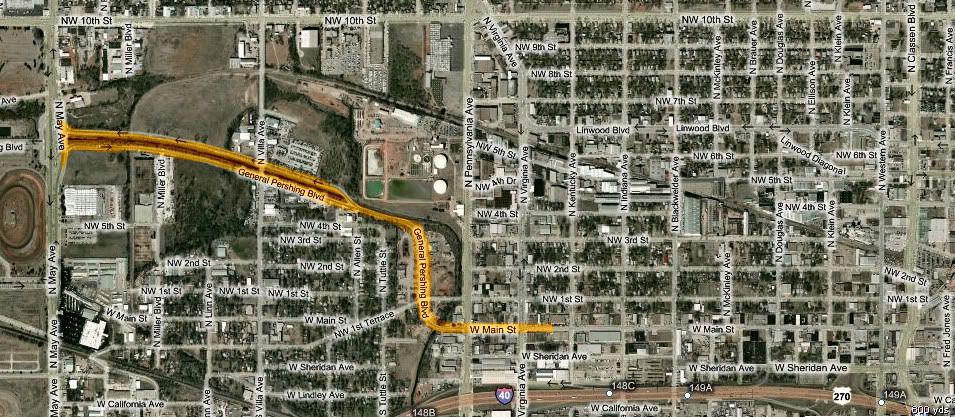
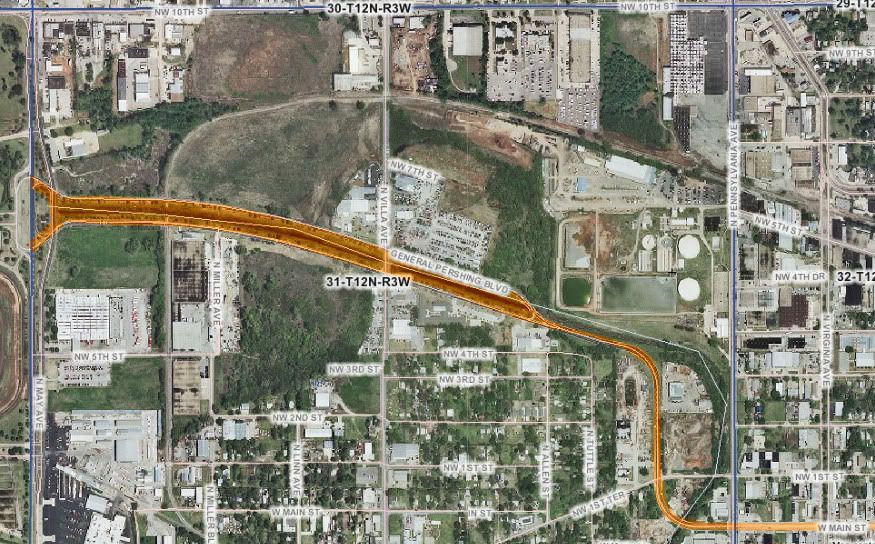
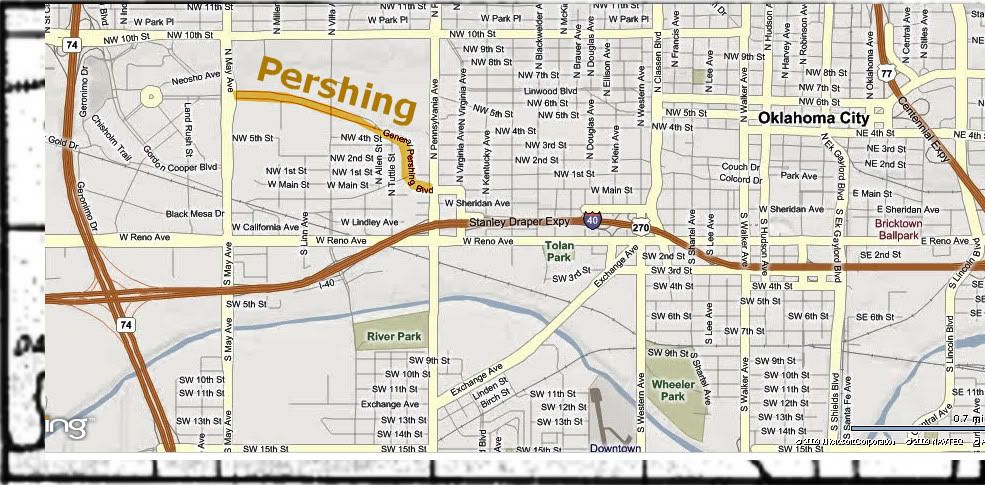
The future came more quickly than I expected. Recalling the conversation yesterday when in the vicinity, I took a drive down the road which we know today as General Pershing Boulevard which takes a meandering course from around NW 6th and May Avenue to Main Street and into downtown OKC at Main Street. The County Assessor's aerial maps, below, show the route — Pershing Boulevard is highlighted — click the images for larger views:
After driving the route, I got busy researching. This article presents the results. Urban Legends? Maybe so — but not just one. There are two.
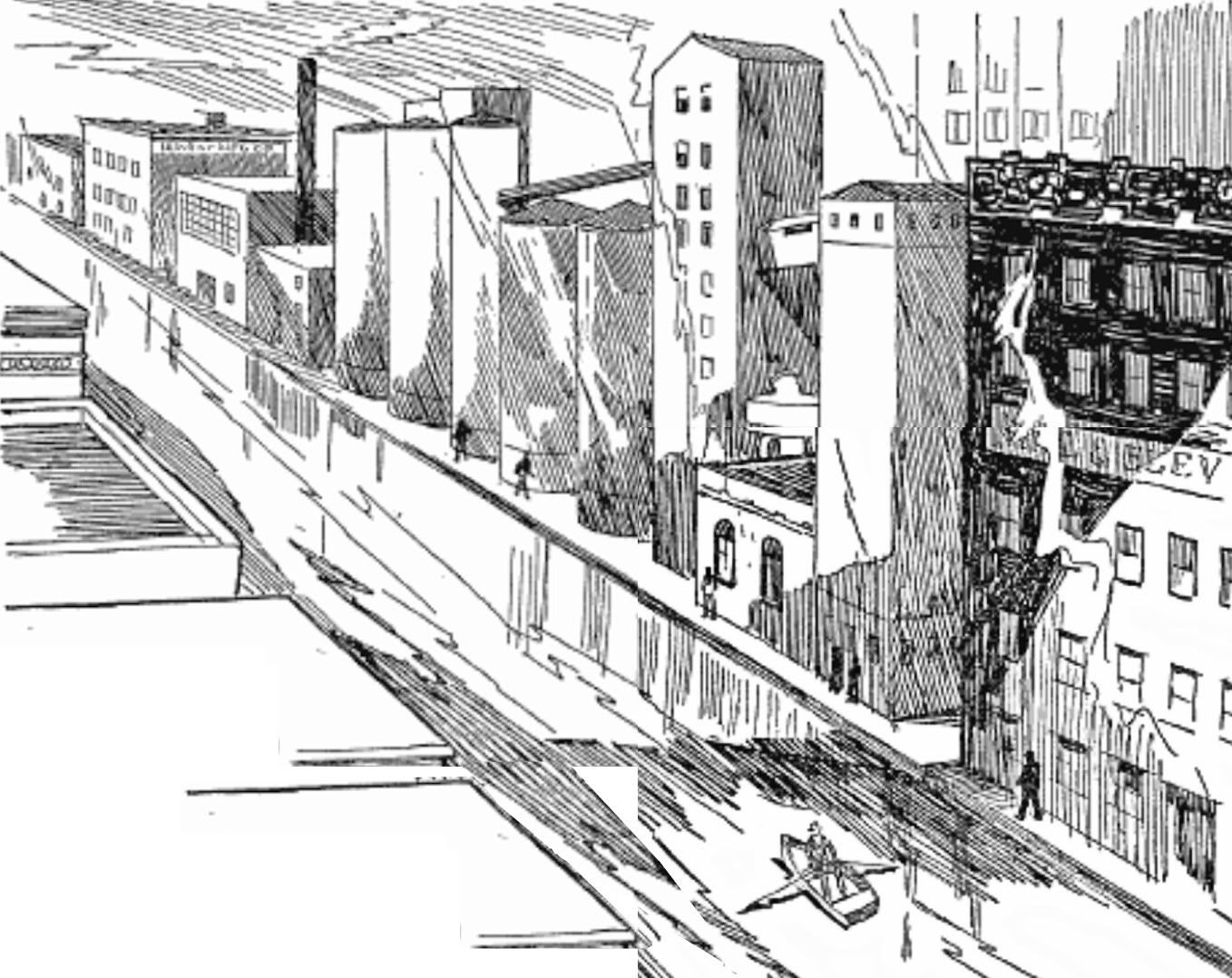
URBAN LEGEND #1: THE CANAL. In fact, the canal mentioned by the Capitol Hill Old Guy did occur. In a March 4, 1934, Daily Oklahoman article, it was described as ...
Before getting to that article, allow me to show you what I found in a marvelous little book, The Story of Oklahoma City by Angelo C. Scott (Times-Journal Publishing 1939), a book that before today I've paid little attention to. No more.
In his Preface, Scott wrote,
I have a more compelling reason for putting this record in permanent form than the hope of remuneration or the pleasure of seeing my writings in print, and this is my very deep conviction than an authentic story of Oklahoma City should be available not only to the readers of today but also to those of the future.
My sentiments exactly! And so to you, Angelo C. Scott, I say to you from the from the future, "Thank you so much for what you have done. Those in your future are reading and learning from what you had to say."
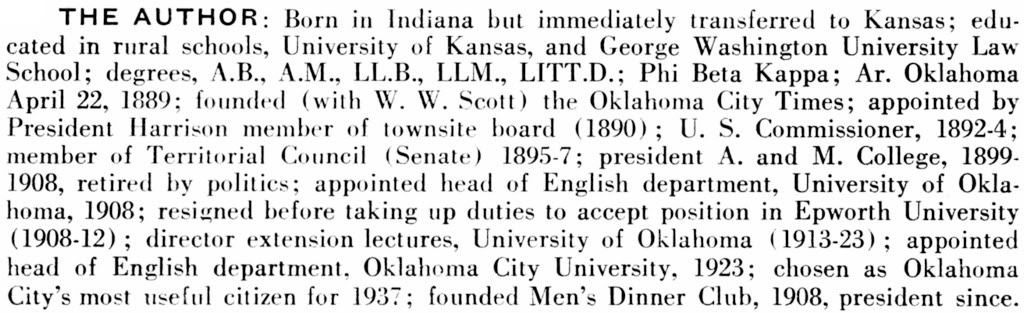
Scott's credentials are almost vulgarly impressive.
And, so, when reading what he said about the early-day canal, I take it as accurately and authoritatively spoken when he wrote:
SINCE we are now in South Oklahoma, where the canal, that grand illusion of those early days, was dug in the winter of 1889-90, 1 shall speak of it here. It is quite impossible to picture now the frenzy of anticipation we had about that ditch. One of our papers remarked that it alone was sufficient to "build a city." It was to be six miles and 320 feet in length, total fall 32.6 feet. The length of the river thus covered was about 15 miles. Captain Couch threw the first dirt on December 9, 1889. This canal was actually constructed. It was not inaccurately termed by "Bunky" of the Gazette, "the most gigantic undertaking in Oklahoma Territory." It employed hundreds of men during that first winter who but for this employment would have suffered for the very necessities of life. No wonder we anticipated its completion with enthusiasm. This came about in the spring, and there stood Jones's big new flour mill waiting for its waters. The Journal told in glowing words how the flood tide came and how the mill's machinery "functioned with perfect smoothness" and how the waiting electric lights "flashed forth." The next day the paper was still optimistic, but on the third day all the papers sank into silence. For the appalling fact was that the canal itself had sunk into silence. The sand, on bottom, sides, and top absorbed the water. This calamity seemed incredible, too cruel to be true. Was there not another canal at Arkansas City, Kansas, running through pure sand, and running brimming full? our people asked. What, then, was the matter with our sand? Nevertheless, the sickening fact remained that our canal, the very treasure of our hearts, would not function. You see, I speak of it still with emotion. It is often referred to with a laugh, but it was no joke to us. Every patriotic man in town had subscribed to it. I well remembered paying the final installment on my subscription after the last hope had vanished. For they did not give up at once. For six months or more they kept on, trying to harden and solidify the insatiable maw of the sand, but all in vain. The men who sought so earnestly to put this "gigantic undertaking" across and sank thousands of dollars in it—"sank" is the word—deserve all honor. C. P. Walker, the secretary of the company, stands first; but associated with him were C. W. Price (president), John Wallace (general manager), Robert Kincaid, B. N. Woodson, James B. Weaver, Frank A Weimar and W. H. Ebey.
A March 21, 1909, Daily Oklahoman ad by the Oklahoma Gas and Electric Company dittos much of the above in the following (click the article for a larger view, or read on for the article's content):
Part 1 of the article Part 2 of the article
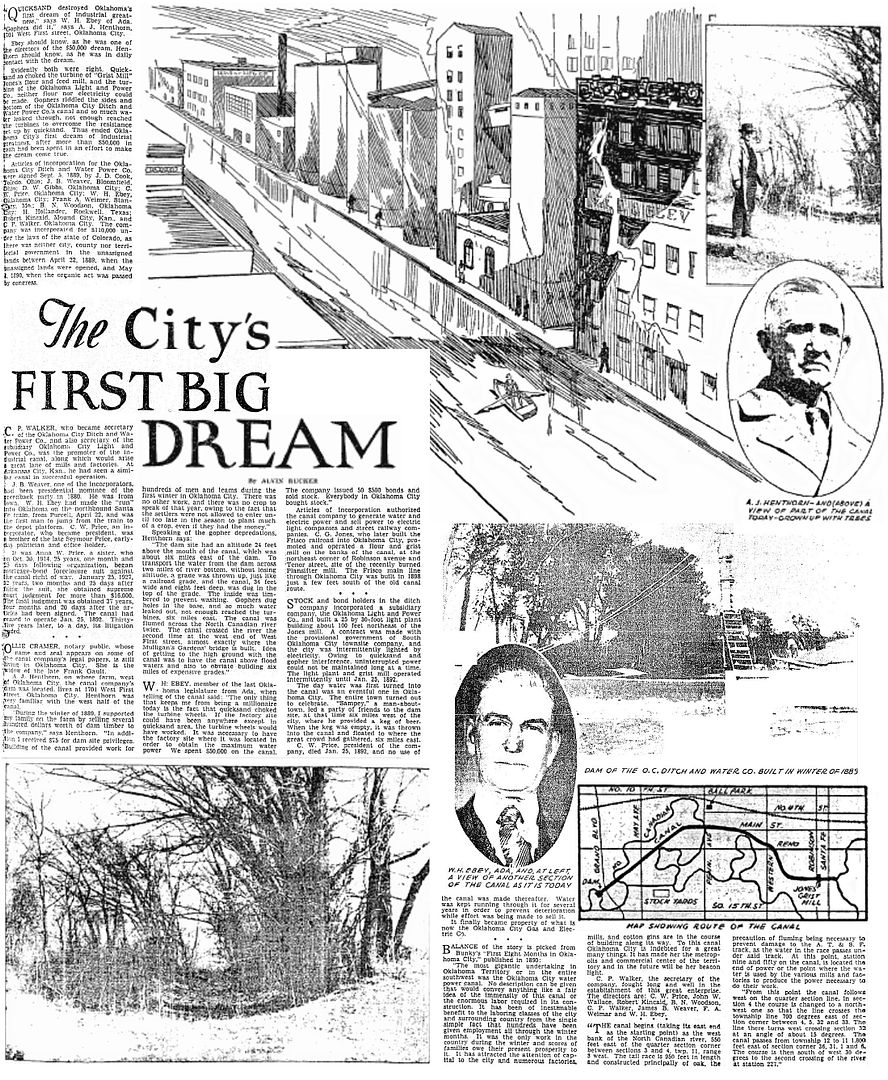
So, it is certain that the inland-downtown canal mentioned above was, in fact, built, tried, and failed during 1889-1890 — no urban legend at all. This gets me back to the 1933 Daily Oklahoman article which contains graphics and additional detail. The whole article appears below (click on the image for a readable version):
Close-up of the Concept Drawing
The article references a foreclosure action by Anna W. Price over non-payment of bonds which had a mortgage as security, decided in her favor by the Oklahoma Supreme Court. I've located that case and you can click here to read the decision on-line. Apparently a map was attached to the mortgage since part of the Supreme Court's opinion reads,
¶7 The exhibit "A", referred to in the above granting clause as being attached to and made part of the mortgage was a map consisting of lines showing the meanderings and course of the river and the course of the ditch and the various tracts of land which it crossed.
So, probably a better map is available in the Oklahoma County Clerk, Registrar of Deeds office.
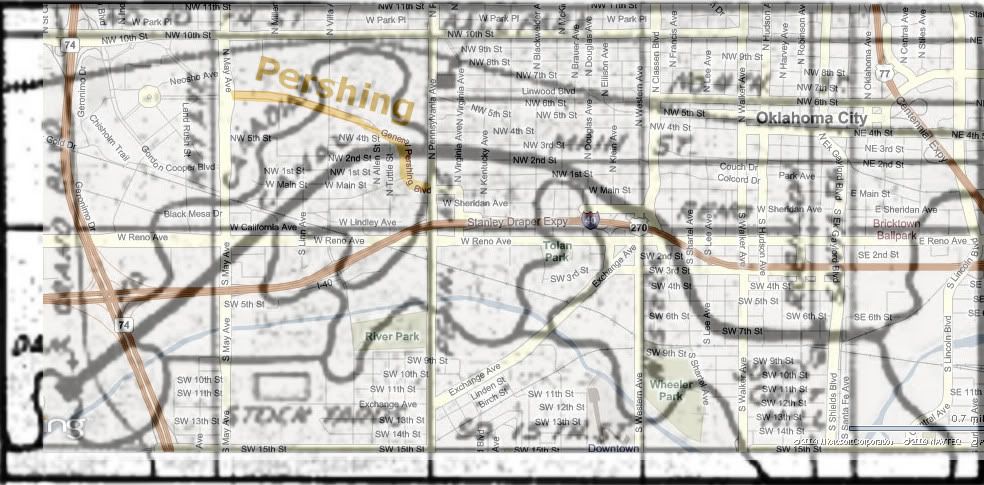
But, for now, I'll use the map contained in the above article which shows the canal's location:
The Same Area Today The Above Maps Superimposed
So, while the route of the canal and the path of General Pershing Boulevard do cross, they are not the same — but, hey, that's what urban legends are all about. URBAN LEGEND #2: OKC's WORLD'S FAIR. What? We had a World's Fair here — did you sleep through it? No, we didn't, but we thought that we would and that's where General Pershing Boulevard came from.
The time was the very early 1980s and the city was feeling good about the Urban Renewal that was going on downtown. The Oil Boom was on, Penn Square Bank hadn't collapsed, downtown was being rebuilt, and most everyone was giddy.
The Centennial of the Land Run would occur in 1989. So, why not have a World's Fair to call attention to our bright new city?
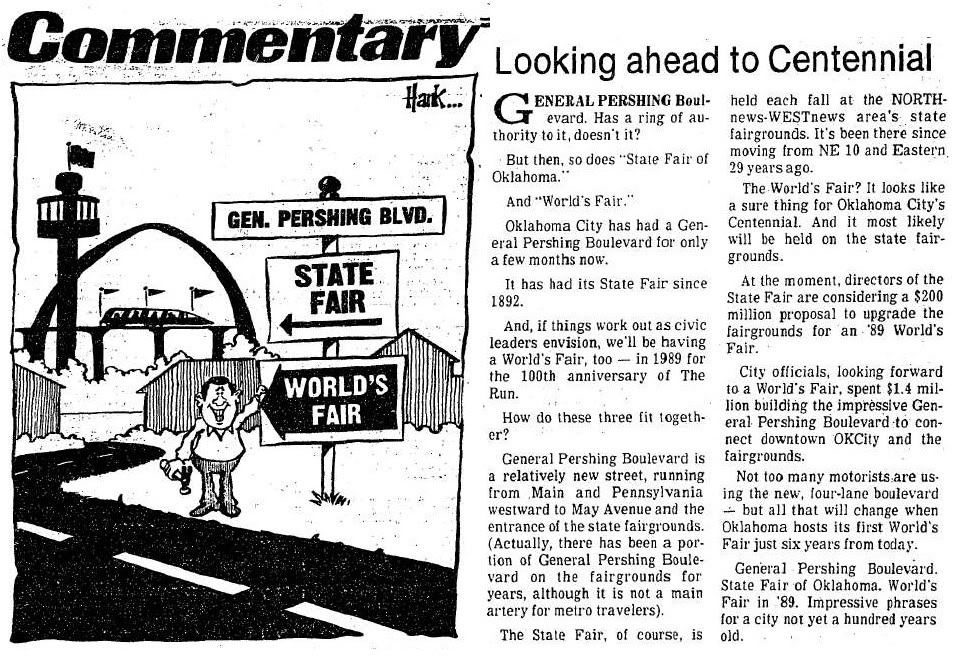
It was decided that the event would occur at an improved State Fairgrounds and, of course, a nice new boulevard would be needed to get all those visitors to our shiny new downtown being generated by Urban Renewal. AND THAT'S WHY the meandering road from the fairgrounds to downtown came to be. This March 22, 1982, article shows that the name of this fine new just-completed road would be General Pershing Boulevard.
In early 1982, the Oil Bust began; Penn Square Bank was declared insolvent on July 5, 1982; and before it was done 139 other Oklahoma Banks came to fail or be absorbed by other financial institutions, including, of course, the city's mainstay and pride and joy, the First National Bank.
Although the horizon was darkening, the downturn hadn't fully set in by the summer of 1983. A July 7, 1983, article sounded like our chances were good for landing the fair. The beautiful proposed hotel shown below appeared on the same page as the July 7 article ...
... and as late as the August 19, 1983, article below, and the World's Fair concept was still good to go — click on the image for a larger view.
But, the times, they were a-changing. Coupled with the economic downturn, the huge losses sustained by Knoxville and New Orleans from their World's Fairs came to light. In summer 1984 the planned World's Fair was trimmed from its theretofore standard six months to three months, and then down to one, per this August 15, 1984, article. But, shortly thereafter, the fair was nixed altogether, per the September 13, 1984, article shown below:
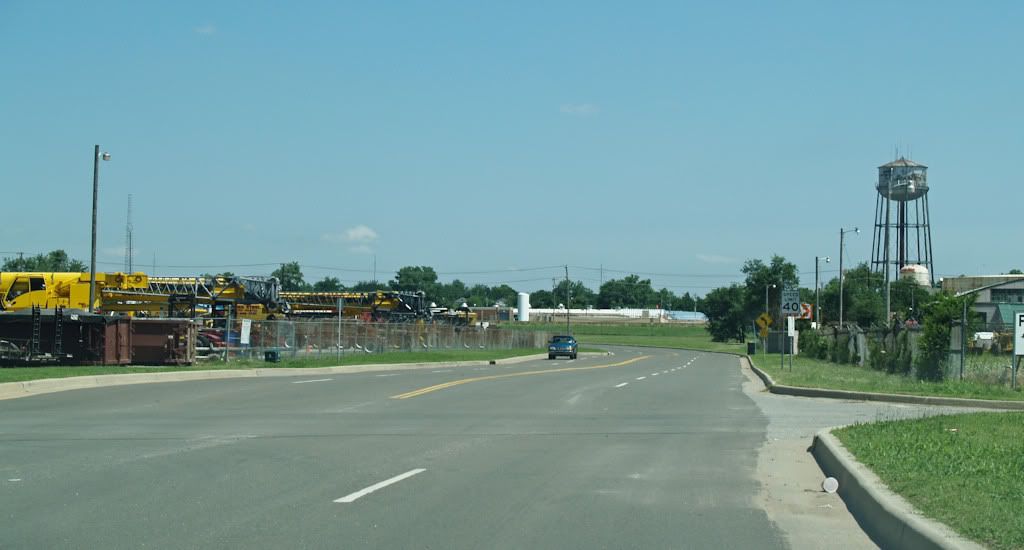
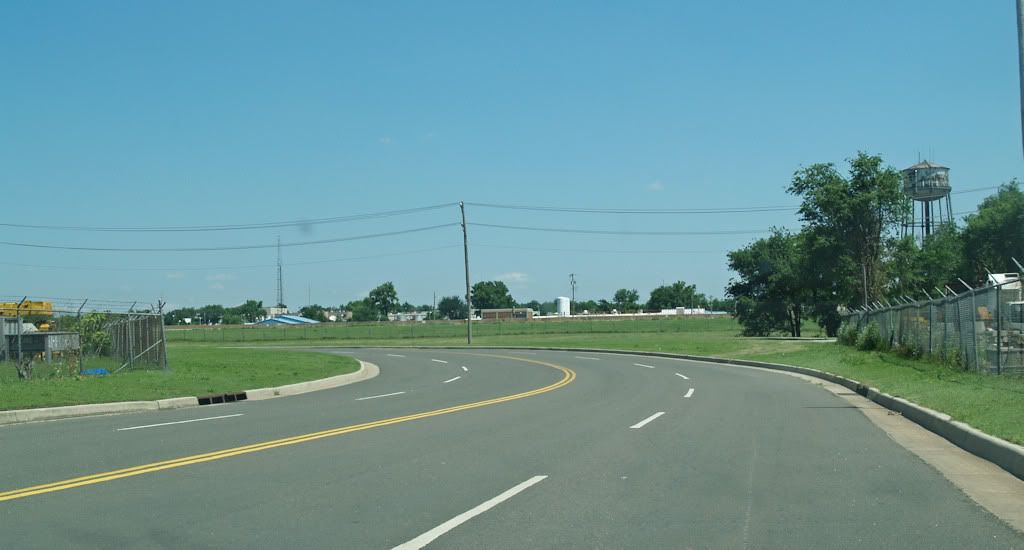
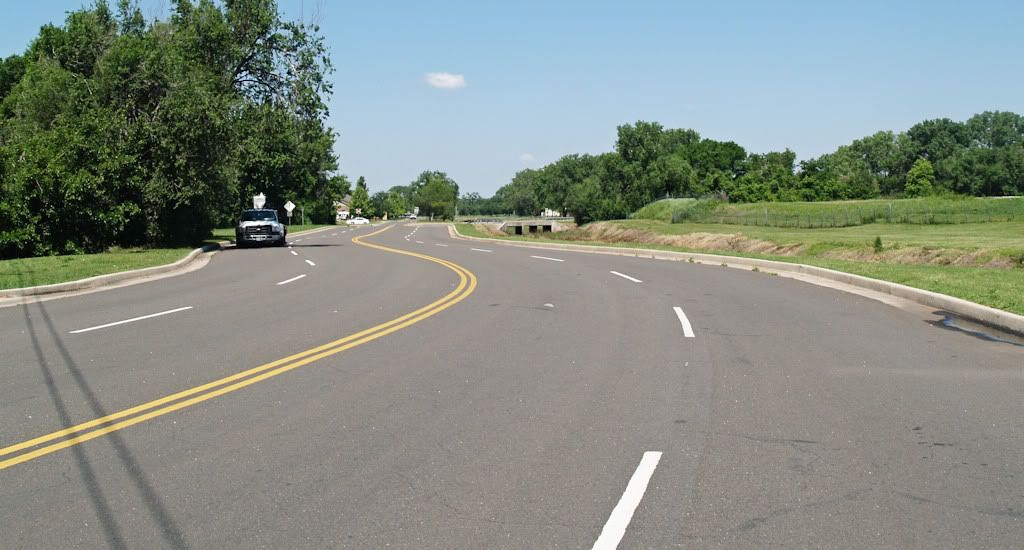
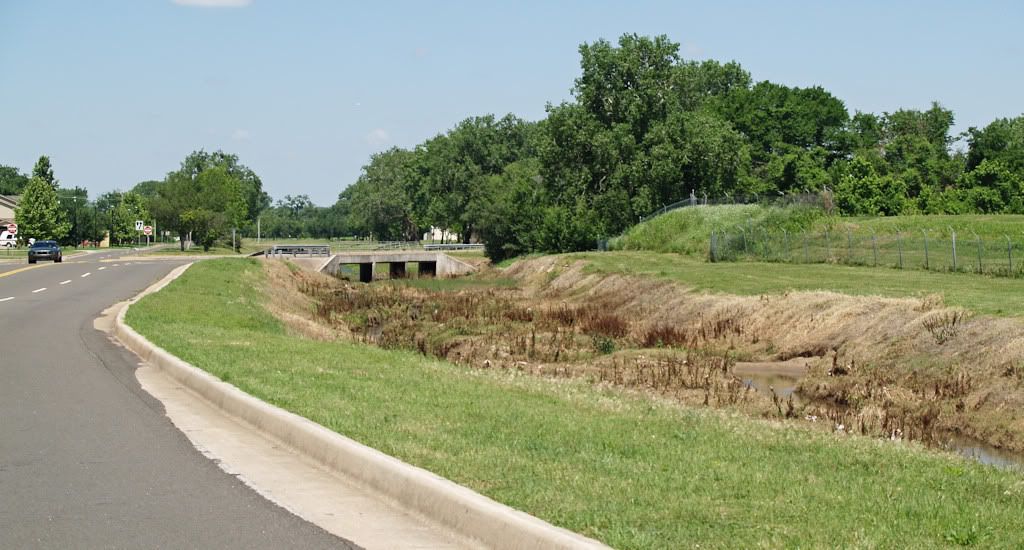
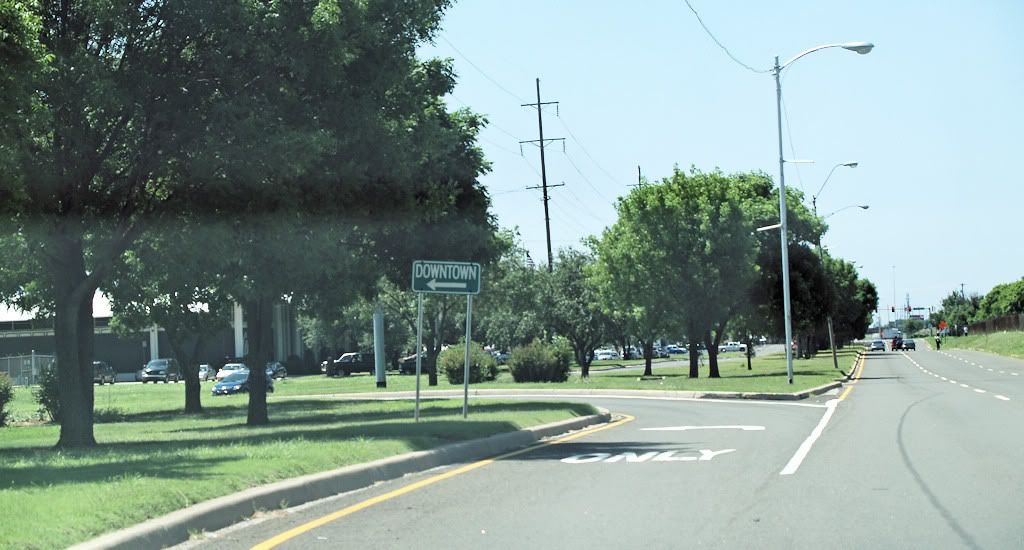
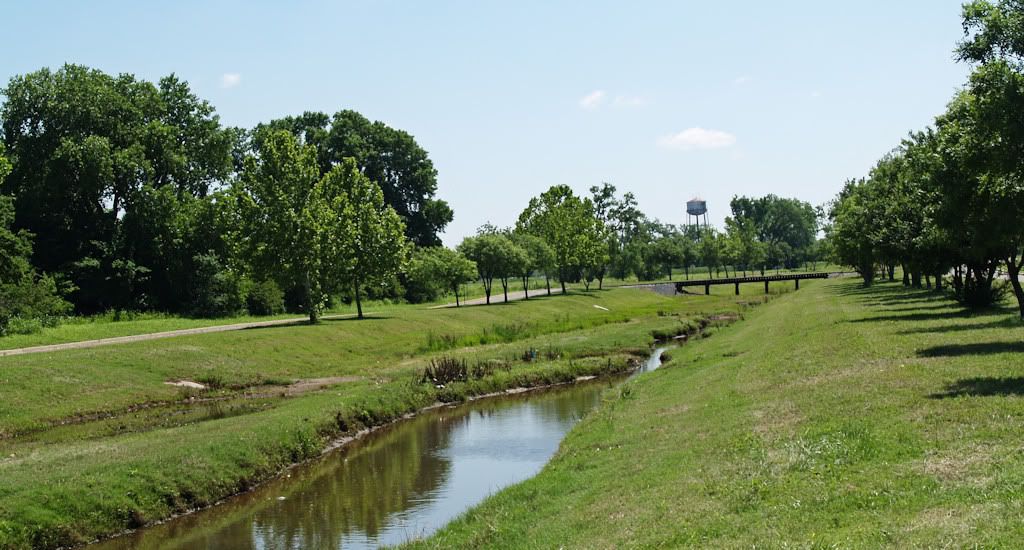
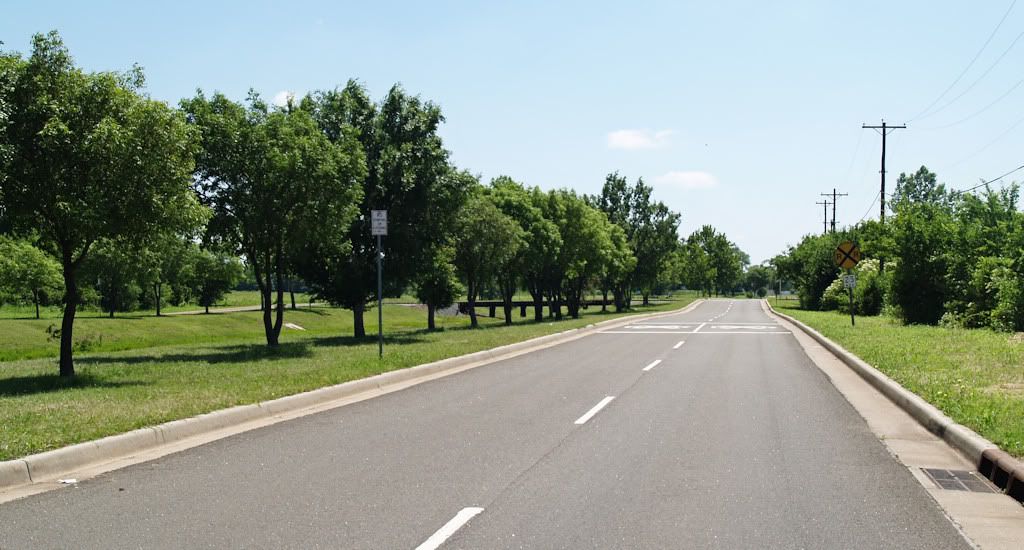
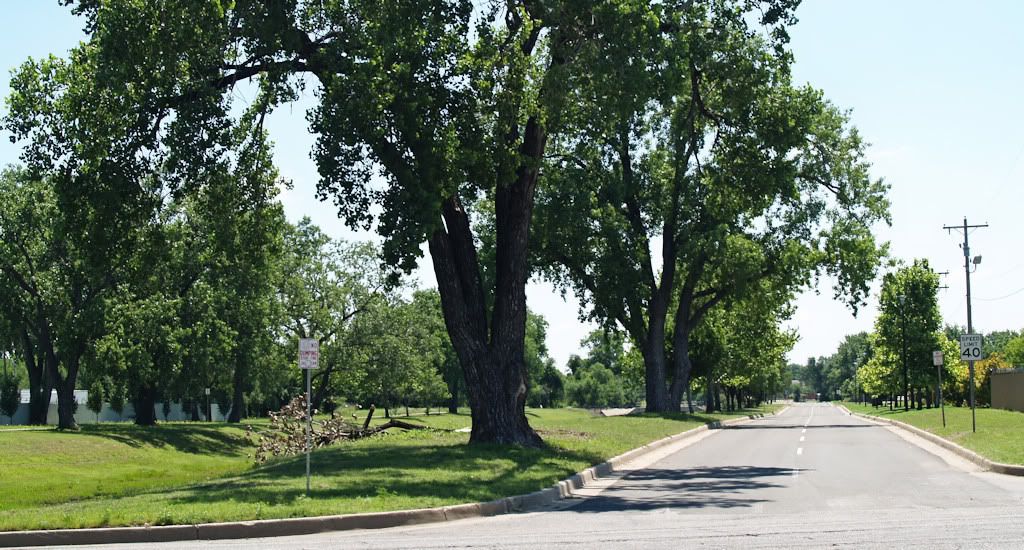
So, there you have it. Was Oklahoma City's World's Fair an Urban Legend? Not exactly ... we did get the $1.4 million General Pershing Boulevard that very few seem to drive on or even know about and it remains available for your use to prove the point. Have a drive, sometime, on one of the least used boulevards in Oklahoma City today, shown below by the photos I took on June 4, 2009. Click any image for a larger view.
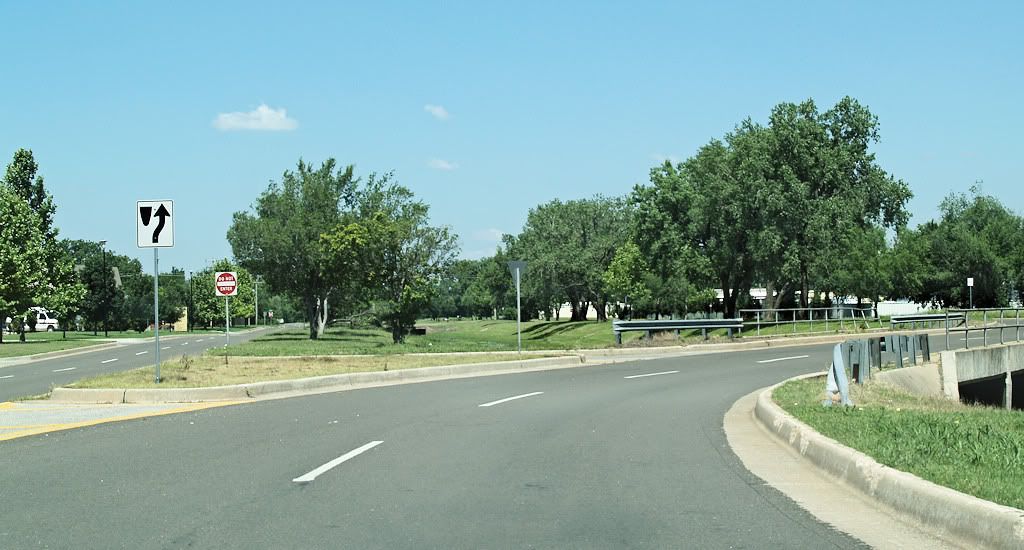
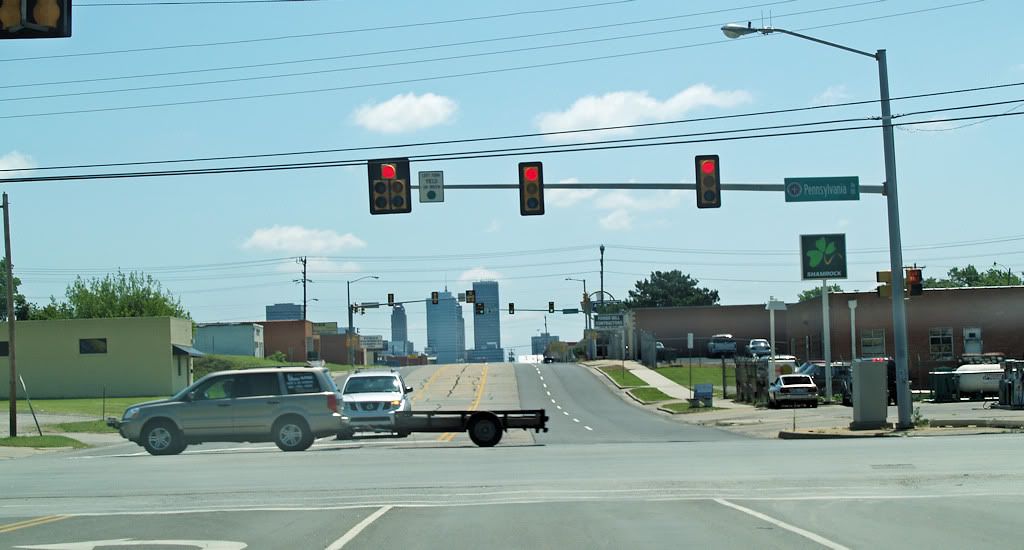
Approaching General Pershing Boulevard at Main & Pennsylvania
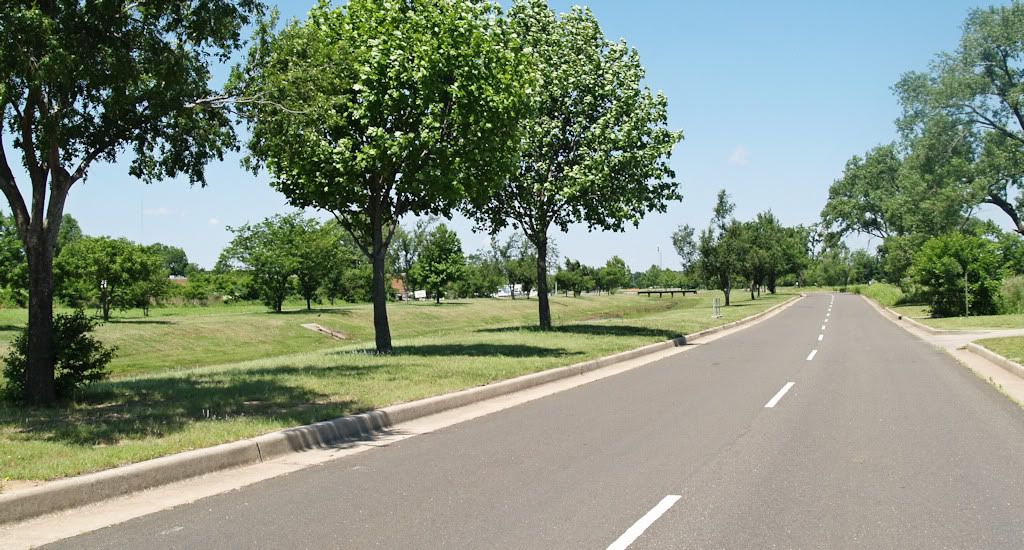
Following the meandering road toward the State Fair Grounds
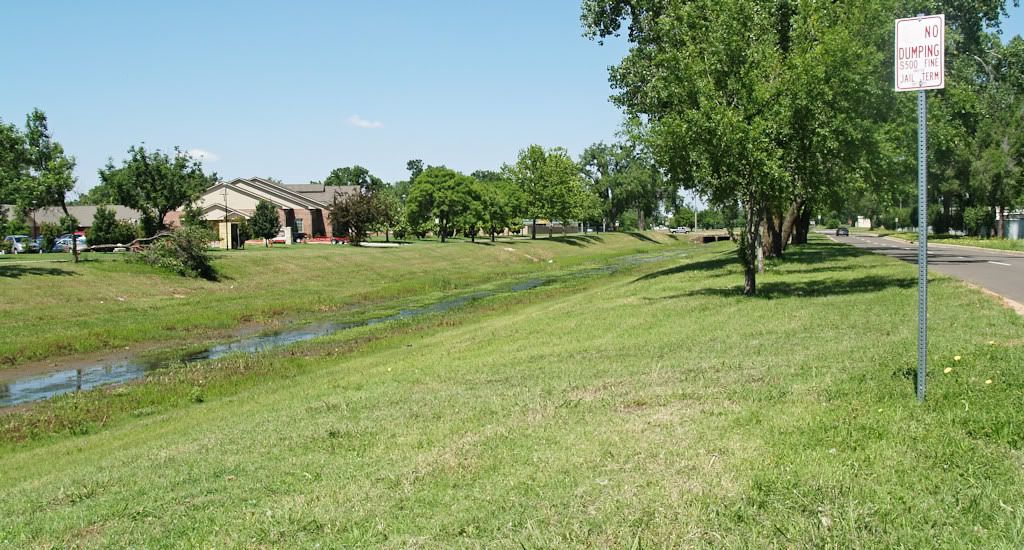
Ahh ... there's that Urban Legend Canal
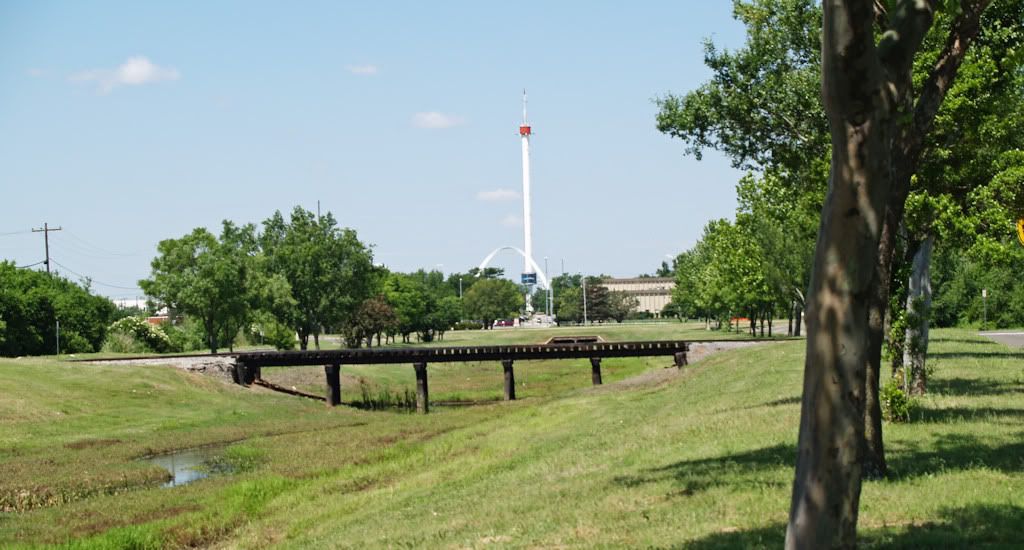
More of the Urban Legendary Canal
At May Avenue and the Turnaround To Downtown
Heading East Toward Downtown
At Villa
Here we are back at Pennsylvania & Main
Sooo .. one story by a Capitol Hill Old Guy led to all of this, a small study in Oklahoma City Urban Legends.
Operation Scissortail - Our Latest Book!
-
[image: devon book cover]
We are very happy to announce the release of our latest book, "Operation
Scissortail," a narative history of the construction o...
Saturday in the Park..on a 113 degree day
-
For those who don't know, there is a reason I've gone very quiet at such a
pivotal moment for Downtown OKC. I accepted a position in Cleveland, Ohio
and I...











 But, first, a little history. The Central Club's origins apparently date back to around 1928, if I've done my math correctly based upon the June 15, 1945, obituary of Fred Ryser shown here. He apparently co-founded the Central Club around 1928.
  By the time of this March 25, 1949, article, the club was located at 223 N.W. 2nd Street, which would place it in the western part of the block where the Bank of Oklahoma Tower is today, perhaps at the location of the Plaza Parking garage.












 Posts
Posts


