Originally posted on January 15, 2012. Updated on February 18, 2012.
Remember the $540,000 of nasty political ads expended by "Super PACs" in City Council elections last year? The Committee For Oklahoma City Momentum spent about $415,000 and Voice For Responsible Government spent $125,000.
Introduction. That outrageous blot on Oklahoma City democracy was made possible by the United States Supreme Court ruling in Citizens United v. The Federal Election Commission which was decided on January 21, 2010. In that 5-4 decision, the majority held that corporations are "people" and are therefore entitled to the 1st Amendment protection of free speech, and the upshot has been that corporations can make unlimited contributions into Super PACs without ever once saying who they are.
Some might call Super PACs "educational" but I'll call them big big money trying to buy our votes. I call them a threat to democracy.
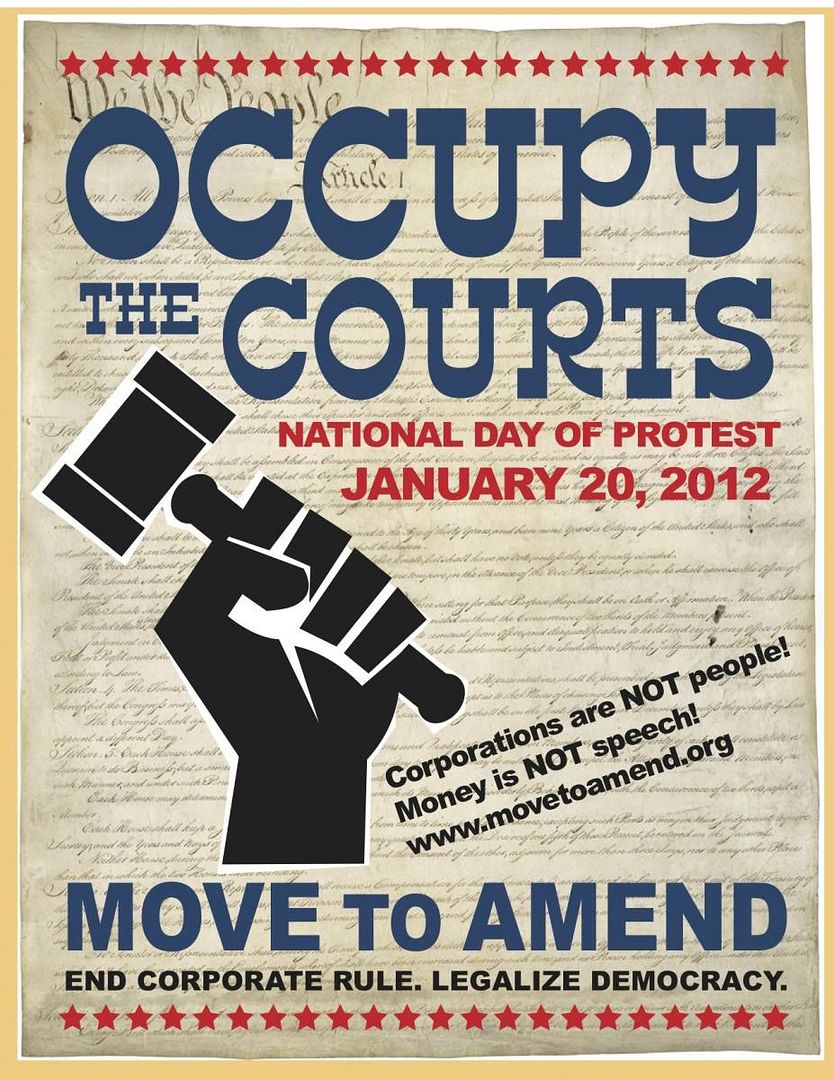
Various movements have sprung up around the country to attempt to undo the Citizens United decision, one being MoveToAmend.org, it advocating an amendment to the federal Constitution which, at its core, would declare that corporations are NOT people and effectively overturn the Citizens United decision.
Taking a cue from "Occupy Wall Street," "Occupy The Courts" rallies are planned around the country this Friday, January 20, 2012. In Oklahoma City, the rally is spearheaded by these ladies, Susan McCann (left) and Rena Guay (right), and I'll get back to writing about their activities shortly.
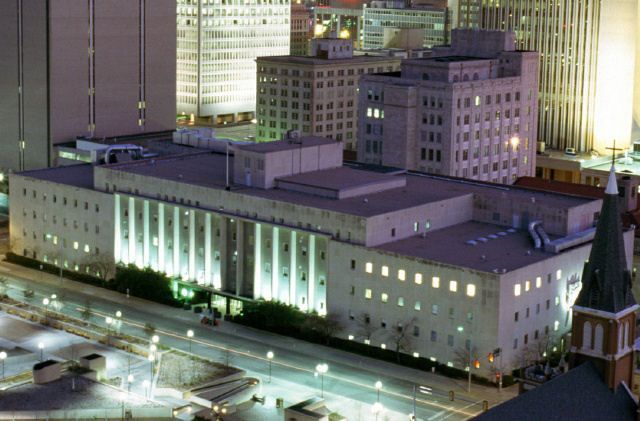
The Oklahoma City rally will be in front of the Federal Courthouse, 200 NW 4th, between 12 noon until 1 pm.
I'll have more to say about the Citizens United decision and rallies around the country shortly.
The Silly/Funny Background. However, before I get serious, it is an indeed ironic coincidence (?) that yesterday, January 15, the Super Pac Americans for a Better Tomorrow, Tomorrow launched a juicilloushly (if that's not a word, it should be) sarcastic ad in the South Carolina Republican primary — the Super PAC was formed by Comedy Central's Stephen Colbert and is also known as "The Definitely Not Coordinating With Stephen Colbert Super PAC" — Colbert transferred control of the PAC to Jon Stewart of "The Daily Show" last week so he could form an exploratory committee to consider a run for "President of the United States of South Carolina." Since that initial TV ad, Comedy Central has done more, and I'll show a pair of their videos here.
This 1st video is simply too good not to watch ... over and over again! The narration is by John Lithgow ...
This ongoing political satire at Comedy Central has captured the nation's print, television, and internet media fancy. Here are excerpts from an opinion piece by Linda P. Campbell on January 19 in the Ft. Worth Star Telegram:
Commentary: Will Colbert Nation make its point about super PACs in S.C. primary?
What's more likely to call attention to the outrage that is the super PAC: a bunch of Occupiers showing up at federal courthouses Friday — or Colbert Nation upending Saturday's South Carolina Republican primary by voting for Herman Cain? Two years ago Saturday, the U.S. Supreme Court unleashed super PAC funding on American voters by ruling that key restrictions on campaign spending amounted to censorship of corporations and labor unions that wanted to pour big money into electing candidates. In Citizens United v. Federal Election Commission, the court said corporations, which are created strictly by the laws that shield them, have the same free speech rights as people, who are created by a power greater than the state. * * * Colbert has made a running parody of the absurd depths to which campaign funding has fallen. It's brilliant, skewering satire. His super PAC, funded by viewer donations, started as Americans for a Better Tomorrow, Tomorrow and ran an ad in which low-profile GOP candidate Buddy Roemer got around the "coordination" rule by saying it was an issue ad he wished he weren't in. Because Colbert wanted to run in the Republican presidential primary of his home state of South Carolina, he handed his super PAC to fellow late-night comic Jon Stewart and renamed it The Definitely Not Coordinating with Stephen Colbert Super PAC -- all under the grinning eye of his lawyer, Trevor Potter, a former FEC chairman who advised George H.W. Bush and John McCain. Colbert couldn't get on the ballot, but former candidate Herman Cain is still listed. So Colbert has been mischievously pumping his viewers who are registered South Carolina voters to support him by marking their ballots for Cain. It's a deliciously devious scheme with the potential to mobilize real political action. A group called Move to Amend is protesting Citizens United in a more conventional way, organizing an Occupy the Courts day for Friday and promoting the idea of a constitutional amendment declaring that corporations and labor unions don't have the same rights as human beings. It seems like a sincere exercise of the time-honored right to free assembly, with events planned for federal courthouses in more than 130 cities, from Dallas and San Antonio to Missoula, Mont., Central Islip, N.Y., and Dothan, Ala. But forgive me for doubting they'll rock the system. For goodness' sake, their New York City march is planned for the height of rush hour, with an evening rally after the courthouse has closed for the day. I'm expecting more impact from Colbert's subversives.
The Serious Background. Both before and after the Citizens United decision, a number of items are present to consider. "Who is a person?" "When does a person come to exist?" "How — does it matter how a person was conceived — in other words, can a person be conceived in one or more ways than the ordinary human reproductive means to do so?"
Early National Background. Although not mentioned in the United States Constitution, corporations have been around since before the American Revolution, they picking up steam in England during the Industrial Revolution. In the States, the so-called Second Industrial Revolution gained momentum with the steam engine and transcontinental railroads, among many other good things, and the corporations served such interests. But, at the time, and to use a term that would probably be called "collateral damage" today, many were harmed by the virtually unrestrained corporate capitalism which flourished during the 19th and the early part of the 20th centuries.
Put differently, are the rights of a person different if they are human or if they are a person formed by the law of a state or the United States?" I mean, we are seriously having to look at Star Trek's fictional Borg when considering this topic, aren't we? If you disagree, please explain in a comment.
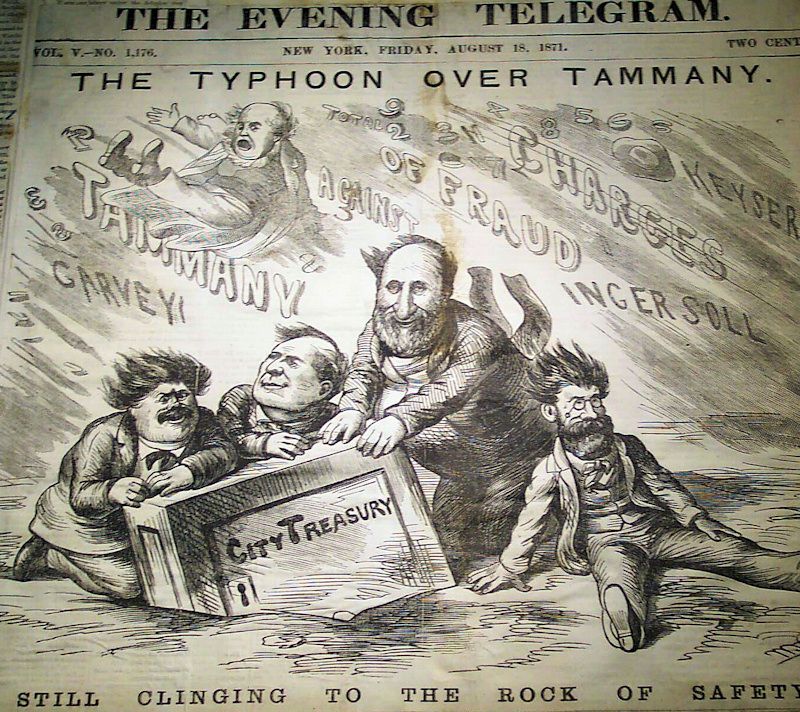
In our civics and history classes in secondary school we learned about the Standard Oil monopoly and we learned about Boss Tweed and other political corruption which was influenced by unbridled corporate greed during that time — well, to qualify that statement, at age 69 I really have no clue what is taught in secondary schools in Oklahoma or elsewhere these days — heck, I don't really know if American history is even taught in schools any more although I hope that it is a required subject.
Click on the images below for larger views.
Standard Oil Monopoly
Boss Tweed, 1871
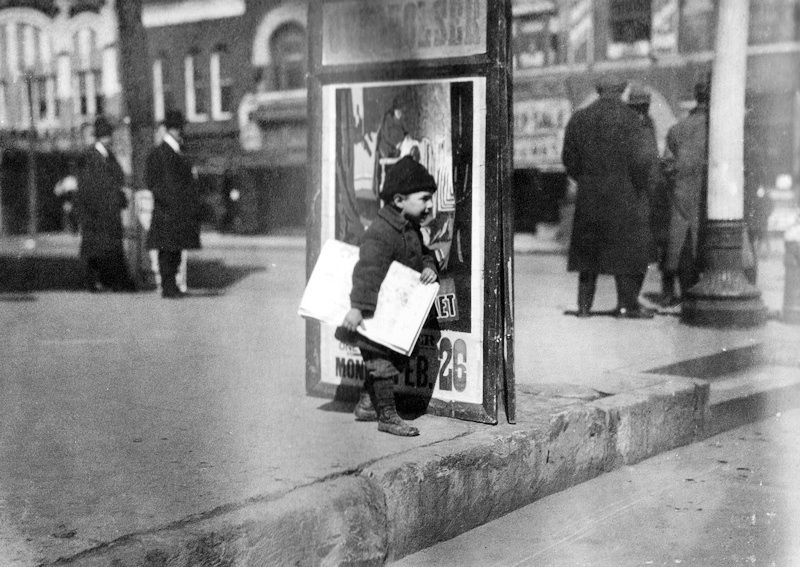
The above newspaper editorial cartoons reflect the time of the late 1800s. Not to mention the working conditions of adult laborers which were often life-threatening and horrible at best, many corporations hired child labor in their workforce — which is precisely why child labor laws began to develop in the 20th century. Corporations were the reason that child labor laws came to exist in the first place — such laws did not merely pop into place for no reason.
1900s Coal Miner Children
1912 Child Labor
5 Year Old Hymie Miller Selling Newspapers in Oklahoma City
5 Year Old Ernest Chester Selling Newspapers in Oklahoma City
The above pair of images are credited to Larry Johnson, Historic Photos of Oklahoma City (Turner Publishing Co. 2007). In the text, Johnson notes, "In 1917, the National Child Labor Committee investigated conditions of child workers in Oklahoma. Noted Photographer Lewis W. Hine documented the committee's work." The kids were called, "newsies," Johnson says, and in another picture not shown here of a 9 year old child selling papers downtown, the child was quoted as admitting to his truancy saying, "I dunno where the school is."
Oklahoma City. National economic calamity can be another byproduct of unrestrained poorly regulated corporate capitalism. The Wall Street Crash of October 1929 marked the beginning of the 10-year long Great Depression. In Oklahoma City, though, downtown construction continued full-steam into 1930 with the construction of the 1st National Building and Ramsey Tower (City Place today), as well as the YWCA on NW 1st (Park Avenue) and many others, and some opined that Oklahoma would not necessarily be hit by the Wall Street Crash as hard as some places. By 1931-32, it became evident that any such hope was merely wishful thinking.
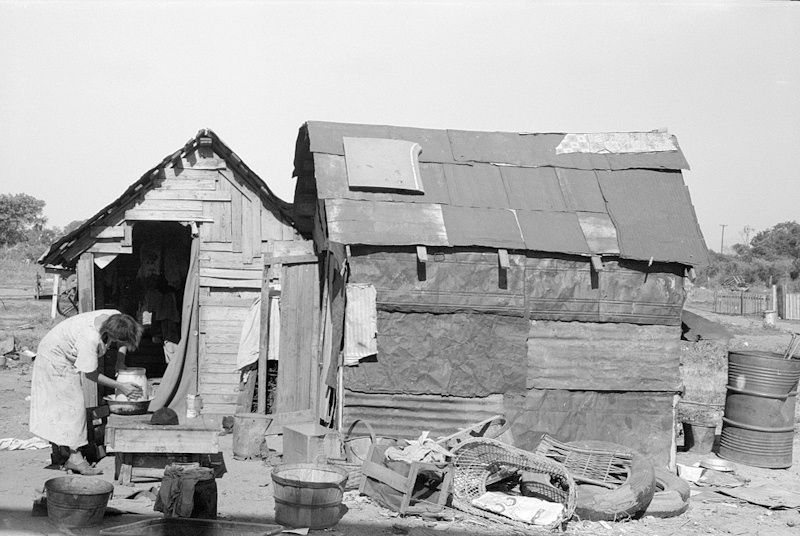
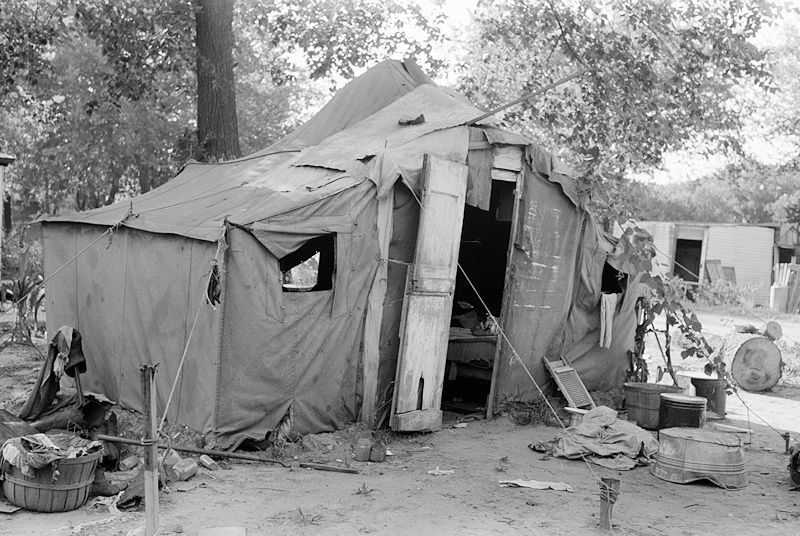
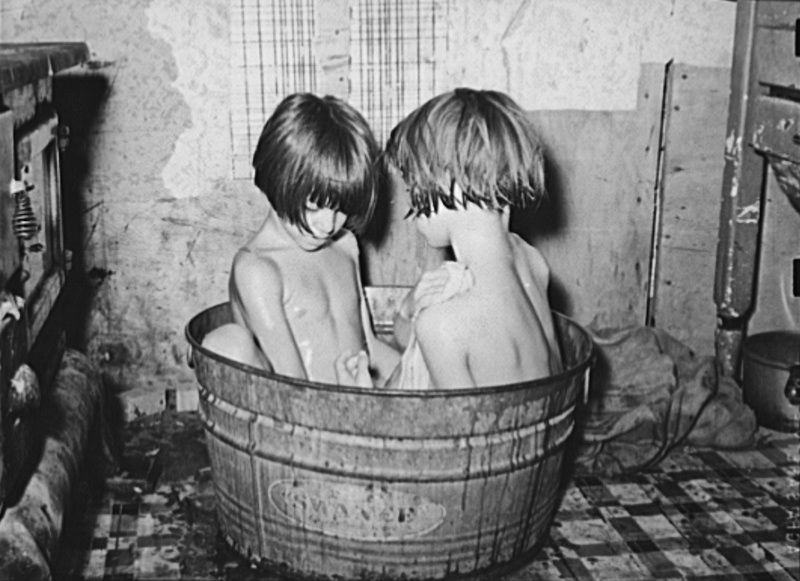
During the 1930s, Oklahoma City came to have some of the most populated "Hoovervilles" in the nation. Mostly located on the river-bottom of the North Canadian River between Byers and Pennsylvania, but also Mays Camp at the May Avenue bridge crossing of the river, these camps were home to thousands in Oklahoma City. According to William H. Mullins, writing for the Oklahoma Historical Society's Encyclopedia of Oklahoma History & Culture,
By the end of 1930 Tulsa and Oklahoma City formed unemployment committees. The economy reached bottom in the winter of 1932-33. Joblessness probably exceeded three hundred thousand, out of an urban population of around eight hundred thousand.
The May Avenue Camp became famous/infamous via photographs taken by Russell Lee, a photographer with the U.S. Farm Security Administration, and just a few of them are shown below.
Click on any image for a larger view.
The April 26, 1938, Oklahoman article below paints a dismal picture of the city:
As to Oklahoma City, he [author Stuart Chase] said, "I went on to Oklahoma City where oil wells spout on the grounds of the state capitol and perhaps the most extensive Hooverville in the nation lies spread along the flood plain of the river — a tarpaper, barrel stave, tincan slum that would disgrace any town in Mexico. Here congregate thousands of Americans who have lost their homes and everything else except possibly a battered Ford. Here they congregate at one of the great crossroads of the nation, wondering where a job can be found, north, south, east, west, striving to exist in a hovel from which a self-respecting dog would run yelping."
By saying the above, I don't mean to say that unbridled and unregulated corporate capitalism was the sole cause of the Great Depression or of Oklahoma's share of it, and I'm not forgetting the Dust Bowl days of the 1930s contributed largely to Oklahoma's woes during the 1930s-early 1940s. And I'm not ignoring that during the same period of time corporations did a lot of good for the economy.
Just the same, it would be difficult to argue that corporations did not contribute largely to the Great Depression itself. It would be even more difficult to argue, I would suppose, that corporations place national or local well-being in as high a priority as they do their own bottom line — profit. That's natural and fair — but the plain fact is that corporate expenditures to political campaigns directly or as Super PACs indirectly are made for the same reason — their own profits. At least, that's my opinion.
I'm probably not too far off base to speculate that laws which existed prior to the Citizens United decision were made for substantial reasons, and that those reasons were something along the lines of what I've discussed above.
Oklahoma Law. Oklahoma is one of many states which either prohibited or restricted corporate funds being spent on political elections. See this article at the National Conference of State Legislatures website. In Oklahoma, corporations are created under the authority of state or federal law which fact is universally true in the United States.
No corporation organized or doing business in this State shall be permitted to influence elections or official duty by contributions of money or anything of value.
That constitutional provision has not been repealed and remains the constitutional law of our state. Even in the present Oklahoma era of what I will call extreme moral conservatism, in which the state Senate just approved a bill which, if enacted into law, would declare human life to begin at conception, corporate "personhood," which could by analogy be seen to be the point of conception of a — incorporation of the corporation — was ignored.
Credit The Who for background audio, "Who Are You," in the video, above, and Swedish author Stieg Larrson for the concept — his Dragon Tatoo trilogy is almost certainly the finest political/crime/suspense literature of this century and the Swedish movie versions of his work are simply extraordinary and follow the books true to form (unlike the recently released US Girl With The Dragon Tatoo which takes more license than the Swedish counterpart). The books, the movies, and the aftermath of the Citizens United vs. F.E.C. United States Supreme Court decision are not for the timid or feint of heart. They are all rock-hard sobering stuff.
If Pete White and Ed Shadid have any dragon tattoos on them, they are probably figurative and not literal, but there can be no doubt that the pair has aggressively pursued their common cause of kicking the Citizens United hornets nest as much as can be done at the municipal level of government. They began kicking it up a notch at the January 17, 2012, city council meeting, and "bully pulpited" municipal campaign disclosure again on January 24 and February 7, our last three council meetings, each of which is fully reported on below. Background For The Current Discussion. On March 1, 2011, outgoing Ward 2 council member Sam Bowman became the 1st councilman to become vocal about the huge amounts of money being spent anonymously in the spring 2011 City Council elections. He said,
And then, in these last few weeks, big money has gotten involved to the extent, my opinion, it has just made a mockery of our city elections. * * * The people, I think, need to know who's behind the money...
His Ward 2 successor, Ed Shadid, railed about the Super PAC expenditures of in excess of $500,000 during the Oklahoma City Council elections, Oklahoma City having been one of, if not the, first battlegrounds which came face to face the practical consequences and reality of the Citizens United decision by the United States Supreme Court in 2010. It is recalled that the anonymous Super PAC Committee For Oklahoma City Momentum called labeled him "Too Extreme For Oklahoma City," among one if its kinder observations about Ed Shadid the candidate.
After his election, it is a fair and safe thing to say that several existing council members were discourteous of, if not downright disrespectful to, councilman Shadid during the first months following his taking office. See this post here, for example.
But at least some measure of thawing and cooler heads became evident in the November 15, 2011, council meeting when Shadid's resolution to prohibit discrimination based upon sexual orientation of city employees was adopted by a 7-2 vote with only Skip Kelly and Larry McAtee voting no.
... more coming shortly ...
Recent Comments In City Council. During each of the last three meetings of City Council the topic of doing something about the Citizens United decision was brought to the floor in the "Comments By Members of Council" section of the council's agenda. That discussion is shown in its entirety and is briefly commented upon, as follows.
January 17, 2012, City Council Excerpts
January 17 - Part A
January 17 - Part B
Part A Notes.Ed Shadid noted that during the previous week by a 3-2 vote the State Ethics Commission declined decided not to make recommendations to the Legislature for revisions to the Political Subdivision Ethics Act despite the general recognition that the ethics commission doesn't have the manpower, will, or even the jurisdiction to oversee municipal elections. Shadid described Pete White's comments to the commission as "chilling and powerful" and he noted that in the spring 2010 elections that 12 entities did even not file campaign finance reports with the City Clerk. He said, "Democracy is slipping away." "I would hope that we as group can maybe vet this and try and work toward other solutions," he said, opining that the city needs to "do something." He characterized the political consultants who attended the commission meeting as "very cynical" and "licking their chops" concerning the 2013 city council elections for Wards 1, 3, 4, and 7 in a circumstance in which no ethics commission overlooks city elections and there is no enforcement. Pete White said that the system before Citizens United worked well and that the Citizens United decision does allow for disclosure and sanctions if state and/or local organizations implement the same. "I don't think that we can afford to not have a system that requires people to report money that's contributed to campaigns," he said and added, "We should know who they are." He further opined that cities have the ability to act independently of the Legislature and cited the City of Norman's establishment of a city election commission as evidence.
Part B Notes.David Greenwell said that his impression was that the commission merely wanted to wait until the Legislature acted. White responded that the commission missed the opportunity to be a "bully pulpit" and, as to the commission revisiting the matter in February, he said, "Well, I'm certainly not holding my breath." White noted that two election cycles will likely occur before any state legislation might be implemented, the 2013 council elections and the 2014 mayoral election. "We're going to have to do something ourselves," he said. "I want to know who you are. If you're going to say bad things about me, I want to know who you are cause I may want to say bad things about you," he said. He noted that political consultants Pat Hall and Pat McFerran told the commission that disclosure rules may "dampen" election activity. To that, White said, "Well it sure as hell might dampen some of the activity, some of it that might be dampened if they had to tell who their names were," and he added, "What it really dampen is people getting in. Who's going to want to get in," adding, "Nobody's going to want to run against that." He asked the mayor's office to determine "what's out there for us." Mayor Cornett said he thought the matter might be for the city's Legislative Committee to consider. Meg Salyer passingly said that she pretty much agrees with White "across the board," but that she wanted it to be clear that what happened last spring was the result of the US Supreme Court and not the fault of any on the city council. Patrick Ryan's brief comments at the end are somewhat garbled but he sounded generally friendly to what White had said.
January 24, 2012, City Council Excerpts
At this meeting, only Pete White spoke on the topic. It is evident, though, that he and councilman Larry McAtee had previously discussed the matter, McAtee wanting it to be made clear that White's comments did not represent city council position, nor perhaps his own. White obliged and made that clear, but, more, he used the opportunity to forcefully talk about the topic.
February 7, 2012, City Council Excerpts
February 7 - Part A
February 7 - Part B
Part A Notes: Pete White began by saying that it appeared likely that the state is going to make a major step to require disclosure and do something with regard to something with regard to what he said was "a serious ethics problem" and with regard to municipal elections. "I believe they will be willing to give the cities the authority to manage that themselves," he said. "That's kind of good news and bad news. The good news is that we may be able to find a way to manage it ourselves. The bad news is there are many many pitfalls in my opinion in forming our own ethics commission," he said and explained. Patrick Ryan said, "Pete, do we need an ethics commission to require reporting?" and White answered, "Perhaps we don't." He wanted the mayor to appoint a small study group. Municipal Counselor Kenneth Jordan opined that the state has preempted the field and that what Norman did in forming its Election Commission wasn't legal. However, no one seemed to know exactly what Norman has done. Jordan said that he sent council a legal opinion a couple of weeks ago — to my knowledge, that memo has not been made public. Ryan said we need to wait for the state to act. White agreed but said, "We need to be ready to do something as soon as we possibly can." White commented upon the current national Republican primary noting, "They're not running positive ads with this money. And the reason they're not is because they don't have to put their name on it. If you have to be identified as they guy that's throwing the garbage then you're much less likely to do it." Ryan again said that we should to wait for the Legislature. Mayor Mick Cornett said, "Why don't we ask staff to look into what legislation might be introduced, or about to be introduced, that we can put our 2¢ into." White stressed the need to work with our local legislators. Gary Marrs said he wanted a report from (presumably legal) staff as to what we can and cannot do. "We all know what the bottom line is — and that is you want people to put their name down as donor on the PAC that they're doing it," he said. But, he didn't want to spend time trying to do something which would result in time being spent uselessly, he saying, "I don't want to get down to the very end and all of the sudden we're all throwing up our hands saying, 'Why did we go through this whole mess if they're not going to have to report anyway?'"
Part B Notes:White agreed. He also noted the District Attorney's suggestion of making remedies civil instead of criminal since proving a civil case carries an easier burden of proof. David Greenwell said that adoption of the federal election rules for state and city elections would satisfy much of the problem. But, he added, "One thing you won't be able to do is that 501C4 organizations do not have to disclose who contributes to them and as long as they don't make independent expenditures their primary activity, keep it below 50% of expenditures, then they fall within the Internal Revenue Service guidelines." White then said that the political consultants at the State Ethics Commission were "self-serving for the most part — about, well, that the reporting requirement would be burdensome — that if you put reporting requirements on people that will cause fewer people to run for office. To me that is so disingenuous it's hard to hold in my head." He said, "All these little barriers are being thrown in the way and not by this group but by others that are trying to find a way to delay disclosure, to avoid disclosure, and Citizens United does not say that you can't have disclosure, it says you can't put caps on money," he apparently disagreeing with Greenwell's above opinion. White continued, "I want their names. I want to know who they are. And, to the extent we can do that, that's what I think we ought to be trying to do because I think you'll stop some of this goofiness if your name has to be on it." Shadid said he thought it was too late to get laws on the books before the next election but said, "I'd like to see all of the candidates who are running for city council to just come right out and say, 'We're not OK with this.'" "If the candidates all in unison lock arms and say, 'This is not OK, it's not tolerable. If you do it we're going to call you out, I think that's possibly the deterrent that we need." Ryan said such an approach was overly simplistic, "it might sound good but it wouldn't work." He did acknowledge the "opportunity for mischief" as might occur were an undisclosed PAC secretly wanting to build a city casino. White countered, saying, "It would work if you did it." Shadid added that the approaches "are not mutually exclusive, you can do both." Larry McAtee closed the discussion by implying that it might be better to have discussion in the council's Legislation Committee instead of during council meetings. He did not explain why.
My intention is to update THIS post with additional city council clips and/or later information when they become available.
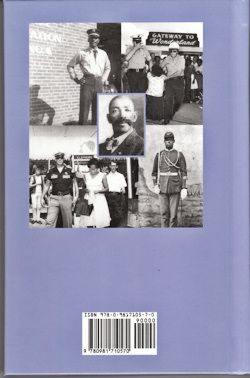
It is all the more fitting, then, to review a book by ON African American history written by Rochelle Stephney-Roberson, IMPACT — Blacks in Oklahoma History (Forty-Sixth Star Press 2011).
Front Cover
Back Cover
Both the publisher, Forty-Sixth Star Press, and the author, Rochelle Stephney-Roberson, are local to Oklahoma City, and, as an owner and reader of that book, it gives me pleasure to review this fine contribution to Oklahoma, and Oklahoma City, history which was published in late 2011. About The Author. Ms. Rochelle Stephney-Roberson describes herself as having been born and raised in Oklahoma City and says that she grew up in a large family in northeast Oklahoma City. After being graduated from Douglass High School, she received a bachelor of science degree in Education and a master's degree in Library Science from the University of Central Oklahoma in Edmond. She says that she "began working in the Oklahoma City Public Schools system in 1981 and again in 1986," and that she "has worked with and educated youth for over 25 years."
Scope of Book. This 5.75" x 8.75" 198-page hardback book is of the survey type and is NOT a college-level or academia type of book — nor is it intended to be. Instead, it is primarily intended for Oklahoma secondary school audiences and adult generalists. That is made fairly clear in the Preface, where the author states:
The reader should know that this resource book is nowhere near a complete history of black history in the State of Oklahoma. It is only the tip of the iceberg. There are many important African Americans who have made a huge impact on this state who are not included. This is not because of their lack of importance or the amount or type of their contribution, but due to the fact that I simply had to have a cutoff point for my research. ¶ Throughout my many years of working in the public school system, I found that a large number of youth are not educated about the wonderful impact many African Americans have had on the state of Oklahoma as well as the nation. This is not because students are not interested, but because there has simply not been a tool of this kind available.
The book's publisher noted to me that the book was written to state public school standards for history and that it has been accepted as a textbook by the state committee and, in fact, a second soft-cover book, a student's activities workbook, was simultaneously published. The book's website says that, "The Activities Edition contains multiple choice, T/F, fill-in-the blank, and word finder puzzles useful to school teachers and homeschoolers." The "activities" book is not covered by this review.
Book Content Overview. As a survey book, the main book presents a significant review of a substantial amount the history of Afro-Americans in Oklahoma. It proceeds chronologically time-wise beginning with Indian Removal to Indian Territory through the end of 2011. Although the Land Run and earlier period is covered rather superficially, much greater detail is presented after the Land Run period.
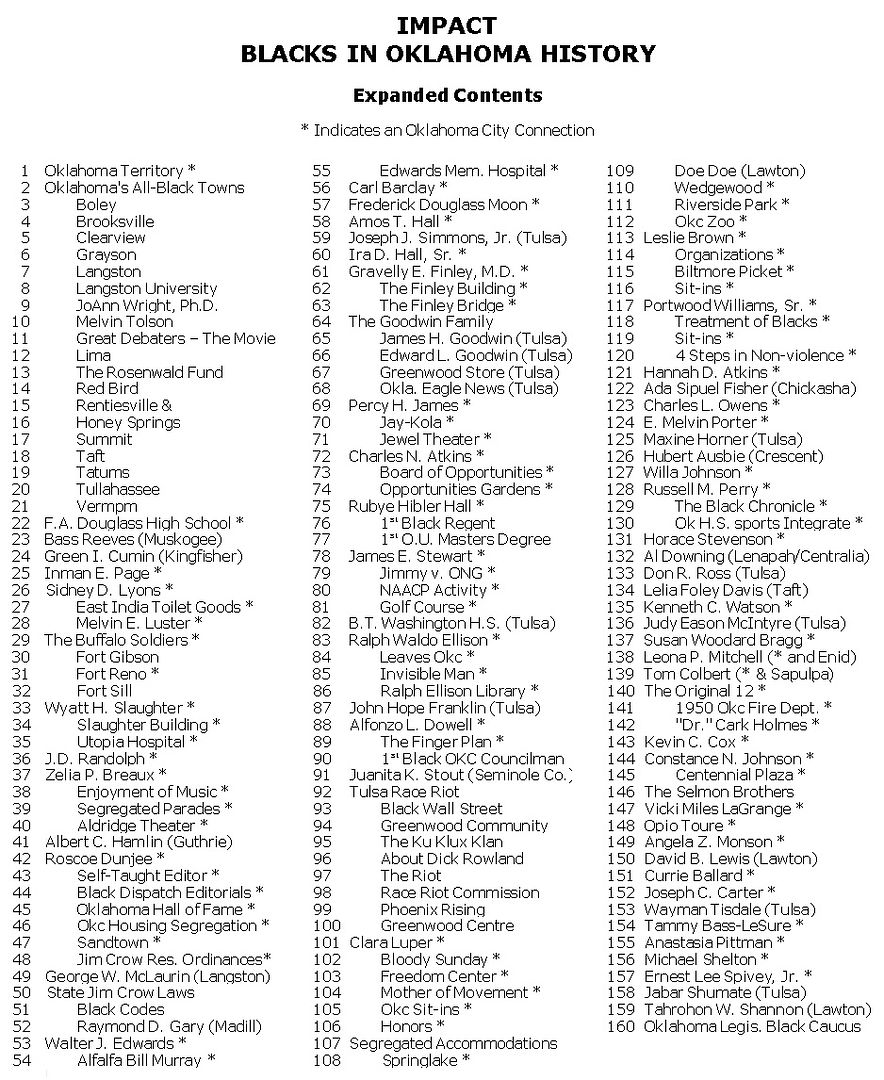
Book Content Detail. Below, I've expanded the book's Table of Contents to include many of each item's components so that the breadth of topics covered is plainly evident. Click on the image below for a more readable view. Note that items I've marked with with an asterisk relate to Oklahoma City — for others, I've added a parenthetical city or county which is the primary focus of those items. I've numbered items to better show the breadth of the number of subjects actually covered by my numbering system, that's 160 topics within the space of a 198-page book and that's pretty impressive.
Introductory Items. Only three pages cover the time leading up to and inclusive of the April 22, 1889, Land Run into the "Unassigned Lands," inclusive of where Oklahoma City is today. This period begins with removal of the of the Five Civilized Tribes — Cherokee, Creek, Choctaw, Seminole and Chickasaw — into Indian Territory during the 1830s.
Each of these tribes were located in southeast portions of the United States where members of those tribes owned properties, plantations, and slaves — just as their white counterparts did. When those tribes were coerced to leave their homelands and remove into Indian Territory, their black slaves came with them. The Civil War resulted in those slaves being "freed" — hence the name "Freedmen" came to describe the former black slaves of the five tribes.
As to the April 22, 1889, Land Run, the author's description of "Boomers" and "Sooners" is an oversimplification. Boomers were not only those who advocated opening the Unassigned Lands for white settlement and participated in that Land Run, some Boomers also laid claim to property by virtue of their prior claims based upon presence upon it before the Land Run. And, not all "Sooners" were people who illegally entered the area before the Land Run began — there were plenty of "legal" Sooners, as well (e.g., law enforcement officials, railroad employees, and others who were legally present before the Land Run) who tried to make their claims to Land Run properties.
Detailed Black History Items. In this section which comprises the vast majority of the book, the author is much more fact specific and this is where she shines.
Here, beginning with All-Black Towns and individual people, particular topics, and events, the author does a much better job than she did in the initial section. Although the author uses no footnotes or endnotes to credit her various statements, she does give an itemized description of "Selected Sources" at the end of the book which include five books, twelve newspapers, thirty-two personal interviews, and many other internet and sources. Were the author to have included footnotes or endnotes, however, the book's resource status would have been much enhanced.
Aside from that criticism, the text reads easily and smoothly and presents much more information on the history of blacks in Oklahoma than I've personally seen anywhere else. There is something to learn in this book for everyone.
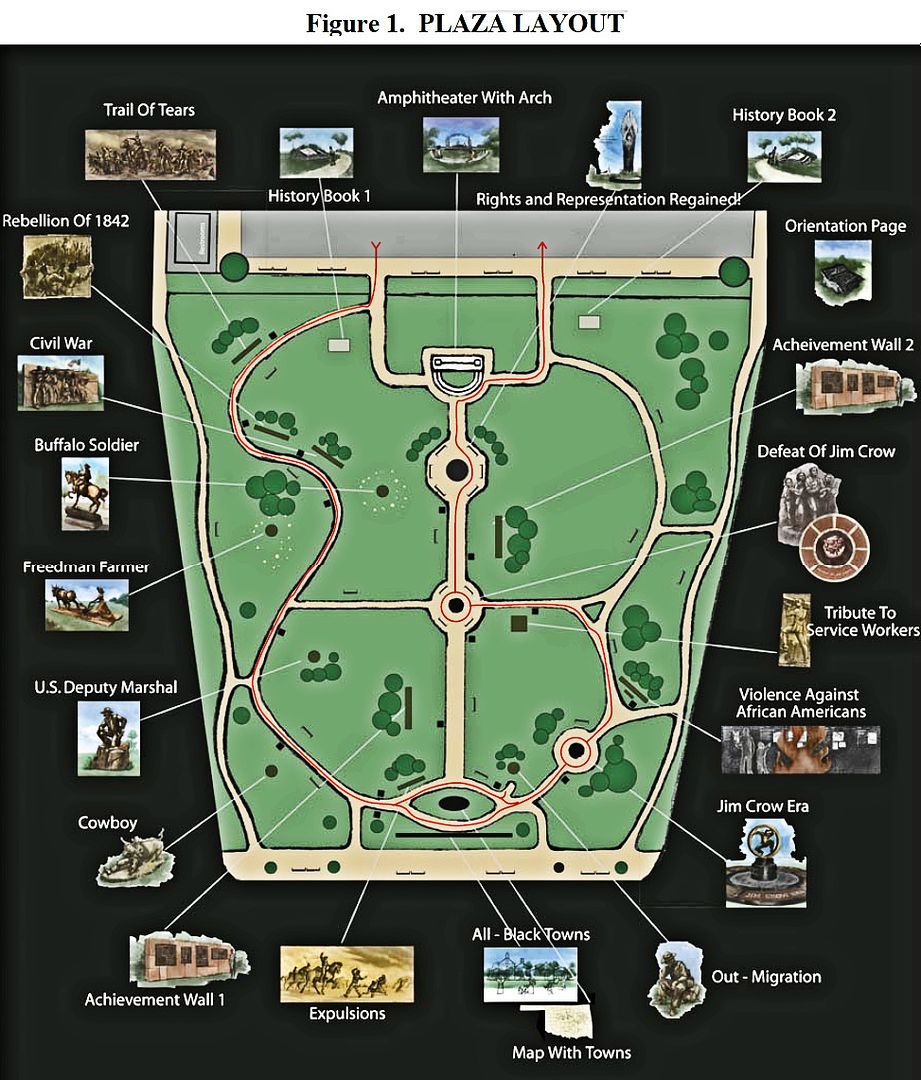
For example, in the author's description of Oklahoma State Senator Constance N. Johnson from Oklahoma City, she gives a description of the "African American Centennial Plaza" which is intended to be around the State Capitol Building in the areas shown below. The source of the map is a PDF file at www.ok.gov/DCS/documents, a source not mentioned in the author's book.
The bill approving this project was signed into law by Gov. Brad Henry on October 27, 2006, but the project's funding has thus far not been approved by Oklahoma's Republican-controlled Legislature. Hopefully, that will change and this project will get done.
Oops! There is one biography that the author might have been prudent to avoid, Oklahoma County District Court Judge Tammy Bass-LeSure.
In January 2011, Ms. Bass-LeSure was charged in District Court, Oklahoma County, with fraud in connection with adoption and related matters which were personal to her and her husband, and at least that much information was known to the author before this book came to publication in late 2011. A year after charges were filed, in January 2012, it was reported that Judge Bass-LeSure was negotiating a plea agreement on those charges with the District Attorney. Perhaps the author was intending to give a vote of confidence to the judge well after charges were filed, I don't know. But, if that was the intention by including the judge's biography, it appears to have been misplaced.
Additional Features. To the author's credit, the book contains a 3-4 page Index, even if it is not as detailed as I would have liked. For example, at page 79 a section describing Percy H. James notes that one of his projects was the Jewel Theater (which, although the author doesn't say so, was located at 904 NE 4th Street in Oklahoma City), saying that it was the first movie theater for blacks and opened in 1931; however, the Index does not mention the Jewel Theater. (Incidentally, the Aldridge Theater built in 1919 predated the Jewel, as the author notes at page 46). Following the index, three pages of "Selected Sources" identifies five books, twelve newspapers by name (but not particularly identified by issue and/or article), five periodicals (ditto the previous comment), and the names of thirty-two people who were interviewed by the author, and twenty-six websites that the author used as resources.
My Rating. Using the same bases that I have used for other Oklahoma History Books, these are my conclusions.
Content: 4 Stars. My opinion is that the author has very substantially succeeded in her dual goals of providing a book which could "educate youth" and "enhance the knowledge of adults" as to the contributions of American Americans in the State of Oklahoma. However, a few glaring omissions are important, most notably the Deep Deuce musicians such as Jimmy Rushing and Charlie Christian, who are not mentioned. I understand that the author had cost and spatial limitations, but there is simply no way that these musicians should not have been given a prominent place in any survey of the history of the contributions of African Americans in and to Oklahoma. Another notable omission is that several Oklahoma towns had informal "Sunset Laws" which would have been good to note in the "Black Codes" section of the book. Two central Oklahoma examples were the all-white towns of Norman and the former town of Britton, now a part of Oklahoma City, where posted roadway signs read something like this: "Nigger, Don't Let The Sun Set On YOU." See this New York Times book review, a portion of which reads,
For almost three decades beginning in 1936, many African-American travelers relied on a booklet to help them decide where they could comfortably eat, sleep, buy gas, find a tailor or beauty parlor, shop on a honeymoon to Niagara Falls, or go out at night. * * * ¶ Historians of travel have recognized that the great American road trip — seen as an ultimate sign of freedom — was not that free for many Americans, including those who had to worry about “sunset laws” in towns where black visitors had to be out by day’s end.
A last criticism is occasional oversimplification, e.g., at page 60 it would have been worthy to note that Gov. Alfalfa Bill Murray imposed martial law on Oklahoma City in 1933 concerning where blacks and everyone else could live, and at page 48 the author included a newspaper clipping but did not identify the newspaper.
Images: 4 Stars. All are black and white and I understand that cost is a factor and I don't fault the author for that.
But there are not enough of them to suit me, at least. For example, inclusion of the overall map of the African American Centennial Plaza, shown in this review, would have better shown the breadth of this project than the one image which the author did include, shown at right. An abundance of images are available which would have made this book more attractive to those who like to "see" elements of history that an author is discussing, and I'd suppose that to be particularly true for secondary school students, one of the author's main audiences. It's true for an old geezer like me, as well.
Quality of Production: 5 Stars. Paper quality is good and the black and white images are crisp. Of course, color would have been good but would have bumped the cost of the book considerably. Given that this book is primarily intended for education and not coffee table usage, I have no criticism of the production.
Worth the Money: 5 Stars. Absolutely. Although I bought my copy for $25 at Charlie's Books & Records, 5114 Classen Circle, Oklahoma City, other local locations are marketing the book. It can also be purchased at the seller's website or at Amazon for a slightly smaller price (plus shipping and handling). If you want to purchase locally, call before you go. For example, the copy I bought at Charlie's was the last copy he had, at the time.
Overall Rating: 4 ½ Stars. All criticisms aside, I know of no Oklahoma survey of black history which approaches its level of completeness, and I do heartily recommend it.
Additional Oklahoma City References. Here are a few additional references appropriate to Black History Month with an Oklahoma City emphasis:
Ultimate Deep Deuce Collection (Doug April 20, 2009) — this reference includes an interactive Deep Deuce map and 34 mini-articles (some are less "mini" than others) on Deep Deuce history
Additional Internet Resources. Additional resources having Deep Deuce relevance are:
This year's downtown celebration of New Year's Eve has its usual flair, with some pluses and a bit of rearrangement. Called "Opening Night," this event sponsored by the Oklahoma City Arts Council first occurred in 1987 and has progressively grown since then and transverses most all of downtown Oklahoma City from 7 pm through and after midnight. This year, the lighted ball will rise from the rejuvenated Myriad Gardens Grand Lawn at 11:30-midnight capped with a glorious array of fireworks instead of that activity's long-standing location on Broadway south of NW 4th Street, near Kerr Park, shown in the top image. See this Oklahoman article for more information about Opening Night events. For sure, the 4-0 Thunder (currently tied with Miami for best in the NBA at this time) will be playing Phoenix at 7:00 at the Chesapeake Arena and will almost certainly extend their record to 5-0. For sure, Wayne Coyne and the Flaming Lips will perform at the Bricktown Coca Cola Events Center on December 30 and December 31, augmented by Yoko Ono and Sean Lennon, son of John. (The post-concert party for the December 31 Flaming Lips concert has now been relocated to the Okc Public Farmers Market, 311 S. Klein, due to Fire Marshall issues.) And much much more will transpire on New Year's Eve in downtown Oklahoma City.
But, this post is not about Opening Night 2011-2012 events in Oklahoma City. It is about what to EAT on New Years Day — it is about "New Years EATS."
Whatever you do on New Year's Eve, consider this to be Doug Dawgz contribution to your New Year's DAY ... but remember that grocery stores seem to run out of black-eyed peas before December 31 ... so ... buy them early! No, my recipe is not yet "historical," but, trust me, it's damn good and, one day, it will be!
It is rumored that unless you eat black-eyed peas on January 1, January 2 ~ December 31 will not bring good fortune. Why take such a chance? This recipe provides one way to avoid such calamity.
This recipe provides more such risk avoidance than you may want. But, why not just go ahead and make plenty ... share with your family, friends, and office-mates ... excess portions may be frozen for later consumption, like at such time(s) that you may feel you need a boost of good luck!
WHAT YOU NEED
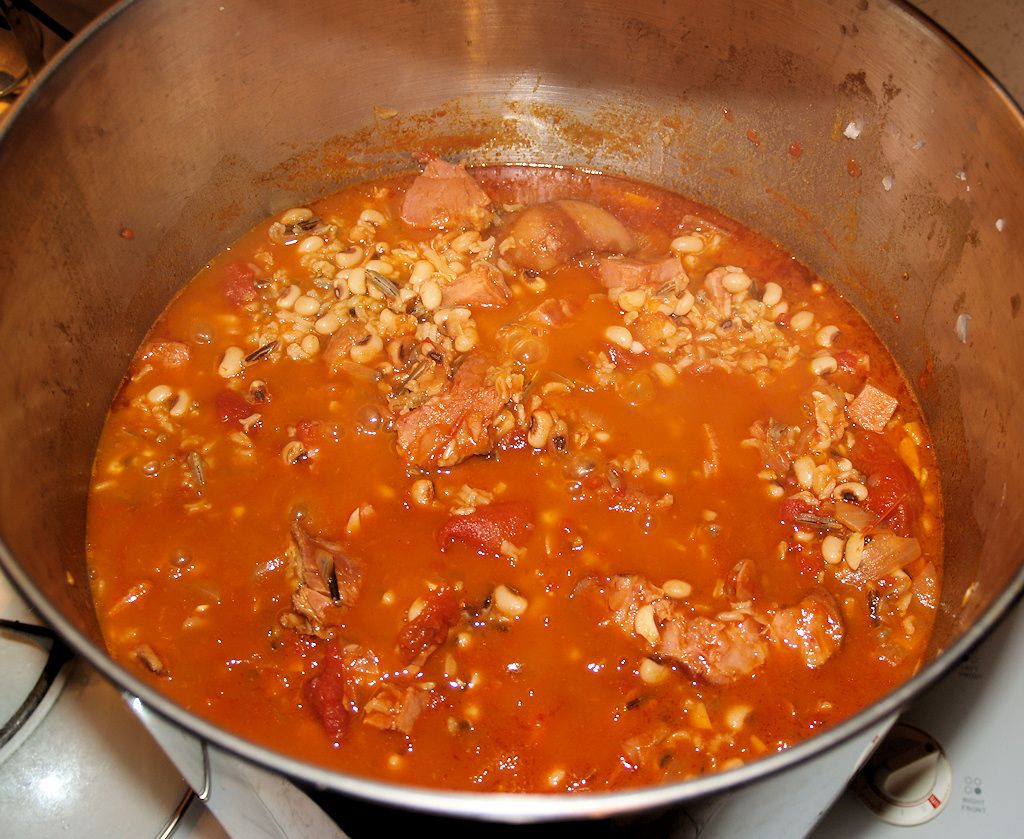
A giant pot ... large enough to put a small beagle in ... a pot at least 12-14" in diameter and 12" or more high, with a lid
2 pounds of dried black-eyed peas
3 pounds ham (it doesn't really matter what kind, but if fatty,cut out the fat)
3-4 ham hocks
3-4 large (18-19 oz) cans of tomatoes (depending on how "tomatoey" you want the mix to be — I use 3)
2 15 oz. cans of tomato sauce
3-4 medium yellow onions
4-10 Tabasco peppers (see General Tip — I use 10)
½ -1 tsp. salt (see General Tip)
3-6 tsp. chili powder (see General Tip — I use 5)
2 small or 1 large package of sliced almonds — this is for "crunch"
2 cups of rice(s) of choice (I like to use a mix of white, wild, and brown)
WHAT YOU DO
1.Soak dried black-eyed peas in water as directed on the bag (usually overnight), or at least 2-3 hours prior to cooking (if you like "crunchy" beans). Be sure to drain the beans in a strainer else you may get more "crunch" (and broken teeth) than you desire! (Years back, small rocks were present but less so now.) 2.Mix into the giant pot all ingredients except the rice ... mix the beans, the ham (diced into dimensions that suit you, e.g., about 3/4" square), the ham hocks, the canned tomatoes (including the water, and slicing the tomatoes in the pot), the tomato sauce, the onions (chopped), the Tabasco peppers (finely chopped), the salt, chili powder, and the almonds 3.Stir and add water as needed to cover the mixture 4.Cover & cook on low-medium heat for about 1 hour 5.Add the rice of your choice and continue cooking on low heat until the rice is done ... around 1 hour; if needed, add more water 6. Eat (at least some on January 1) and/or Freeze ... the mixture freezes and saves nicely 7. Other Things ... cornbread is good but not required for good luck.
GENERAL TIP:Seasonings can be added as the mixture cooks ... so, you might want to add less or more than what I've suggested before it's all done ... but, remember that it's easier to add seasonings than it is to get rid of them. This is particularly true for (1) salt, (2) chili powder, and (3) Tabasco peppers! It's quite OK to add as you go, to suit your personal palate!
MY MOM'S APPLE PUDDING. This has nothing to do with good fortune, other than for your taste buds. Once you try this recipe, you may become addicted — it is that good!
The Background Story. During many of the years after my 1961 high school graduation, I have yearned for some of what my mom simply called "apple pudding" but it's a recipe that she didn't pass along except in my memories. From time to time, I've looked for a recipe that would make this tasty dessert but all my attempts at mimicry failed. On December 26, 2011, I Googled again and found the recipe below (slightly modified here) at Carolyn T.'s http://tastingspoons.com/ archives/92 for her own mom's "Crisp Apple Pudding." Here's why I'm so bold to say that Carolyn T.'s mom's recipe is also my own mom's recipe for the same apple pudding — that and the fact that I've now cooked it and it's just as good as I remembered.
In her own blog page about this recipe, Carolyn T. said:
I would be ever so negligent if I didn’t post one of my favorite recipes, my mother’s Crisp Apple Pudding. I’ve been making this for as long as I’ve been cooking (that began in 1962). It was written out in my mother’s small recipe journal, something she began when SHE got married in the 1930's, a recipe from her mother. And she passed this recipe on to me when I got married. * * * I believe — but I’m not sure — that this recipe came from a vintage (probably 1930's version) Betty Crocker Cookbook. Or maybe it was a Better Homes & Gardens. Did they publish cookbooks back in the 1930's? I think one time in a used book store I saw a very old, stained copy of one of those books and glanced in it, and sure enough, it looked like this recipe.
My mom, Elizabeth, was also a devotee of one or both of those cookbooks in the 1930s and 1940s and that was the clincher since she probably didn't get recipes from any other cookbooks as far as I'm aware. I'm completely confident that this is the identical recipe used by my mom who would have had one or both cookbooks in the 1930s when my older brothers were born, and, of course, on and after I was born in Oklahoma City 1943 and during my childhood years. Many years later, at the end of 2011, I thank Carolyn T. not only for the taste but for providing another remembrance of my mom via a recipe which both of our moms had in common.
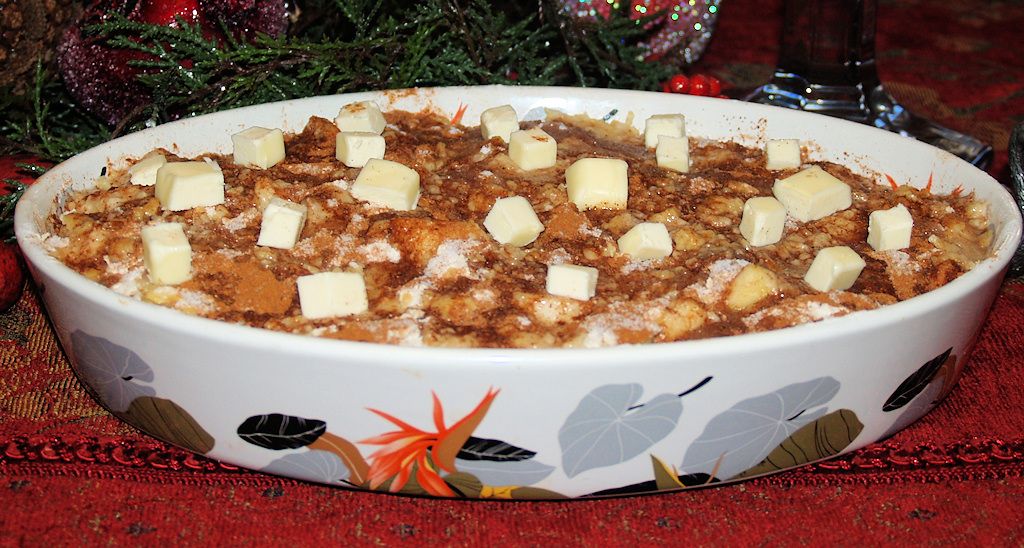
2. Spread sliced apples into an 8×8 or similar baking dish (here, a 5 x 9 oval baking dish is used).
3. Sift together the flour, sugar and baking powder. Add the egg and mix well. Spread this mixture over the top of the apples, spreading evenly. Sprinkle the top with the spices and the 2 tablespoons of sugar. Very important step: Use your fingers to sprinkle the water over the top as evenly as possible (this step makes the top crusty and crisp). Dab the butter on top in small squares, as shown above.
4. Bake for 35-45 minutes or until the top is brown. Cool for about an hour or until the pudding is at or near room temperature. Servings can be topped with milk, half & half, heavy cream, or other dairy topping. My mom could only afford milk, so that is what she used. And I loved it.
Originally posted 12/20/2011; updated 12/24 to include the closing video portion of It's A Wonderful Life, Frank Capra's 1946 best Christmas movie ever.
Has Doug Dawg become a religious person in his aging years? Maybe ... I once was, and maybe still am, and/or may yet come to be ... the position continues to perplex me as to where I stand in the religious cycle of things to this date.
But, if one sets aside the commercial aspects of Christmas and the politically correct names of the season, one winds up with only one thing — Christmas, that being the world calendar's date (even if historically incorrect) for the birth of Jesus the Christ Child.
Literally, "Christmas" is a truncated form of "Christ Mass," a decidedly religious date on Christian and civil calendars for the birth of the Christ Child. While you probably won't find "Christ Mass" mentioned on religious calendars on many church calendars in Oklahoma (perhaps other than Catholic, Orthodox, and Episcopalian), that's what the conjoined word "Christmas" means ... the Mass (aka Eucharist or Holy Communion) associated with the birth of Jesus.
Listen, watch, and enjoy the sweet haunting sounds of Enya ... O Come O Come Emmanuel. Click the full screen icon at the lower right for full screen or click the YouTube icon for the original size.
As beautiful as the master painters' classic works of art are for this occasion, in this video I've avoided those images, favoring instead the less deified and simpler human images which reflect better upon the humility, humanity, and intimacy associated with the birth of the infant Jesus, the Christ Child. Here's more Christmas music for you to enjoy.
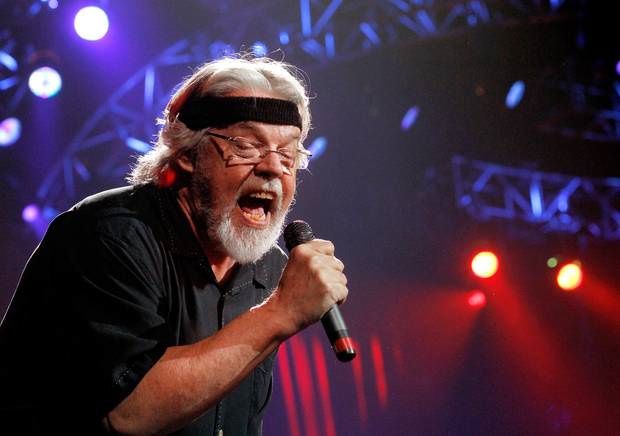
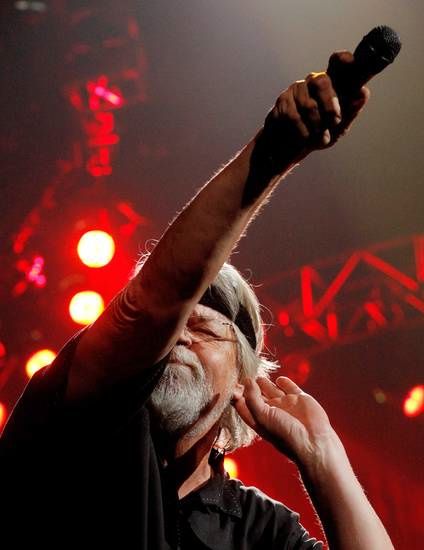
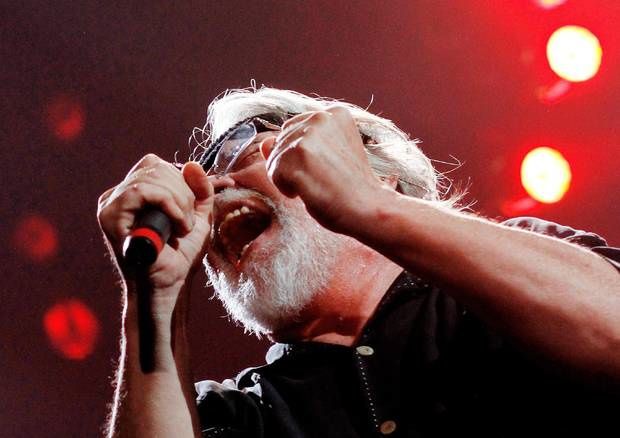
Bob Seger. I'll start with Bob Seger & The Silver Bullet Band which performed on December 15 in the Chesapeake Energy Arena to a wholly grateful crowd. A fine review of the performance appeared in the December 16 Oklahoman. Credit the photos below to The Oklahoman.
Below, two videos showcase Seger's rendition of The Little Drummer Boy, a tune originally written by Katherine Kennicott Davis in 1942 as "Carol of the Drum." The left video is a November 17, 2011, performance by Seger in his 2011 tour in Louisville, Kentucky, about a month before his Oklahoma City performance; the right video was done much earlier when Seger's hair was still brown, with background video from the popular "Little Drummer Boy" animation. Click the full screen icon at the lower right corner of each video for a full screen display, or watch them in their original size by clicking the YouTube icon.
Yusuf Islam. "Who's that," you say? That would be the person you know as Cat Stevens. Born in England as Steven Demetre Georgiou in 1948, in his prominent professional carrier he was known as Cat Stevens until he converted to Islam in 1977 ... he assumed his new name in 1979. Now, fairly elusive, his "Morning Is Broken" remains associated with Christmas and also, perhaps, presents the Christian world's present greatest challenge to acceptance of someone outside their Christian sphere ... shall we accept Yusuf Islam, a Muslim, whether he accepts US or not? What a Christian might ask is, "What would the Christ Child Jesus have done?"
I'd originally intended to post a few more tunes, but, I instead changed my mind to conclude that nothing better could end this Christmas 2011 post than to include a video of the closing sequence of the 1946 Frank Capra movie, It's a Wonderful Life staring James Stewart and Donna Reed, in my mind the very best Christmas movie ever made. Thanks to FilmFTW1 for this video.
No, Potter never got his come-uppins, but that's really not what Christmas is about, is it? Enjoy, and Merry Christmas to you all!
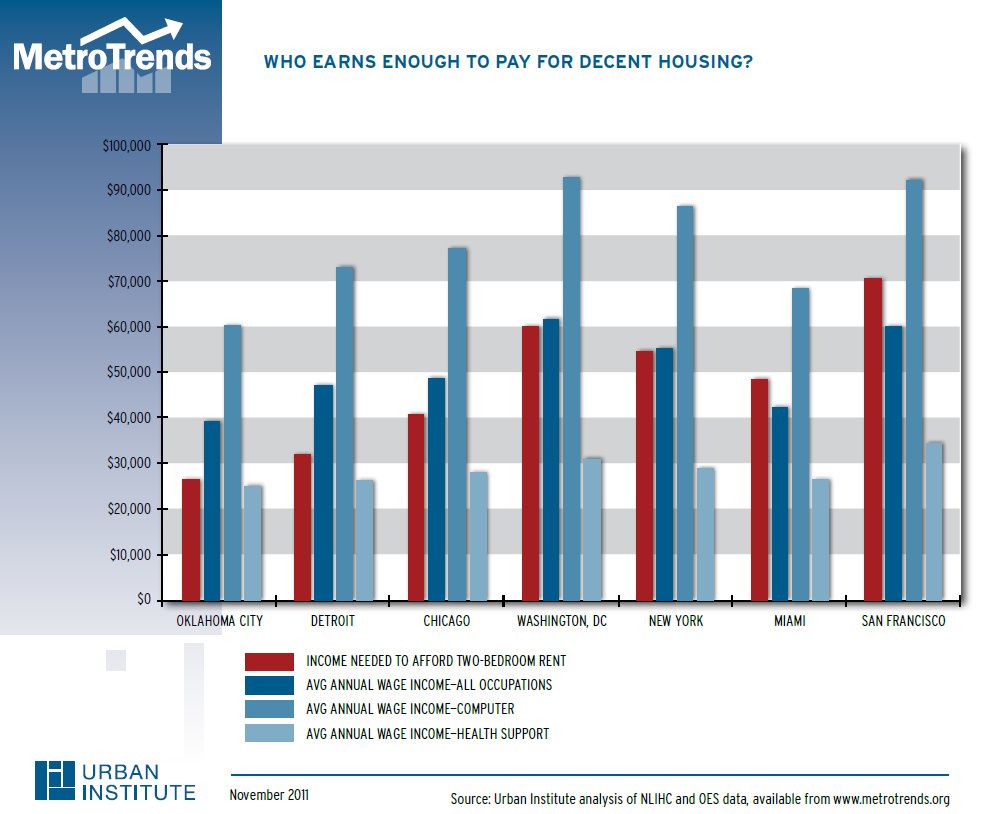
The Metro Trends element of the Urban Institute says that it's Oklahoma City. In an article named, "Are Some Metros Better for the 99%?" on December 5, 2011, Margery Turner of Metro Trends gave a hint that Oklahoma City might fare well in an answer to that question in the tantalizing chart below (click on the chart and most other images in this post for a larger image):
On December 6, I received an email from Andrew Maddocks, a representative of Metro Trends/Urban Institute with this kindly message:
Hello from from a think tank in Washington D.C.! I hope all's well with you on this fine Tuesday.
We just published a blog mentioning Oklahoma City as one of the best cities in the country for low unemployment and affordable housing. Here's the key: "Somehow, it avoided the excesses of the boom years, and its economy has weathered the downturn better than most."
I wondered if you thought your readers might be interested in how their city compares to others around the country. If you're at all interested in linking to the post or re-posting, please let me know. You've clearly got a substantial readership there, and I'd love to share what the people at Urban are writing!
Well, it doesn't take all that much for me to get wholly puffed up, but the initial article didn't give much detail about Oklahoma City, simply saying that,
One region that looks good on these metrics is Oklahoma City. Somehow, it avoided the excesses of the boom years, and its economy has weathered the downturn better than most. Housing costs are low, and though wages are too, a personal service worker can almost afford the rent for a two-bedroom apartment. And at 5 percent, Oklahoma City’s unemployment rate is among the lowest in the country.
What can we learn from the Oklahoma City metro about keeping wages and housing costs in better balance through both good times and bad? For my next blog, I’ll track down some possible answers.
With those tantalizing remarks, I replied that I would but only after more detail was presented about Oklahoma City. Today, December 14, that additional detail was provided in a follow-up article, and it has some pretty darn cool things to say about our city and includes a great interactive map reflecting that our city just doesn't do well in comparative scores in the top 100 metro markets, IT SCORES #1, BEST OF ALL.
PRELIMINARY REMARKS. Before getting to the heart of the matter, it's probably best to know a bit about who's doing the analysis and original reporting so we'll get a measure of how seriously that analysis and reporting should be taken. Here's that bit.
About Urban Institute & Metro Trends. According to Wikipedia, the Urban Institute was established in 1968 by President Lyndon Johnson as "a Washington, D.C. based think tank that carries out nonpartisan economic and social policy research, collects data, evaluates social programs, educates the public on key domestic issues, and provides advice and technical assistance to developing governments abroad." The article says that it has a staff of about 350 and that its president is Robert D. Reischauer, former head of the Congressional Budget Office. There's more, but that's enough for me to take the organization seriously. According to this page at MetroTrends, MetroTrends is "the Urban Institute's report card on how metropolitan America is faring."
About Margery Turner.Metro Trends identifies her as Vice President for Research at the Urban Institute and says,
A nationally recognized expert on urban policy and neighborhood issues, Ms. Turner has analyzed issues of residential location, racial and ethnic discrimination and its contribution to neighborhood segregation and inequality, and the role of housing policies in promoting residential mobility and location choice. She served as Deputy Assistant Secretary for Research at the Department of Housing and Urban Development from 1993 through 1996, and is co-author of Public Housing and the Legacy of Segregation.
Her Facebook page says that she is from New York (Ithaca HS 1973) and has degrees from Cornell University (1977, Government) and George Washington University (1983, Urban and Regional Planning). And she plays the flute. That's good enough for me.
About The Study. It's best to keep in mind that this survey is solely about economics — it's not about quality of life or other urban pleasantries (or unpleasantries). It's about cities that have fared well and poorly through what the article calls the Great Recession (2nd quarter of 2007 through the 3rd quarter of 2011) and its focus is to identify cities that have fared well and poorly as measured by 4 criteria during that study period: (1) change in housing prices; (2) unemployment; (3) affordable housing for low wage workers; and (4) mortgage delinquency. Remember, this series of articles has to do with the 99%, not the 1%. If you are in the 99%, then these articles are about you.
The December 14 Report Card. Ms. Turner's December 14 article is titled, "Best and Worst Metros ... A Report Card on Economic Security." Among other things, Ms. Turner writes:
Metropolitan Oklahoma City’s diverse economy – including government, universities, energy, and high-tech firms -- has held up well in the Great Recession. It didn’t fall victim to the housing boom and bust (2000 to 2007), so rents and house prices today are remarkably affordable and few homeowners are facing foreclosure. And the region scores high on lots of “top ten” lists -- most affordable (Forbes), most recession-proof (Forbes), and best to start a small business (Fortune Small Business).
So I decided to grade all of the nation’s 100 biggest metros: which are best and which are worst for family economic security?
Unlike me, she appears to be a person of few words — she didn't name all of those "best" lists which have come out strongly for the city over the past couple of years in various categories, but that's a good enough start.
The Cool Interactive Map. This is the fun part. Without reading a thing in the article, scrolling down a bit presents this map of the country ...
Why does only Oklahoma City have that big blue dot? If that isn't enough to catch the attention of an Oklahoma Citian, what would be?
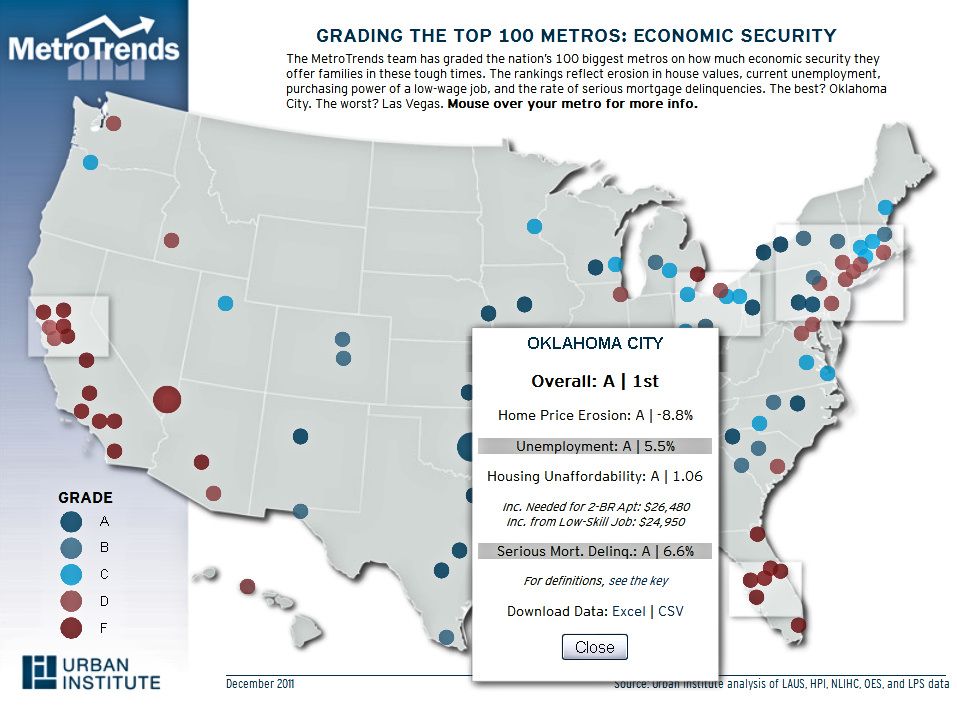
By clicking on that graphic, an exceptionally cool interactive map appears in which one can mouse-over a city to get snapshot of the study results:
Although you can click on any of the charts and maps shown in this post to get a larger view, here's the crop of the Oklahoma City summary shown in the above map. Note that one can download a much more detailed spreadsheet (Excel or comma delimited) file which I've done and will get back to shortly.
But for those who mainly want to play with that map, it is very easily done. The map also gives a reader the ability to change the weight given the 4 factors previously mentioned, if one doesn't like the equal (25%) weight given by the Urban Institute to the 4 factors used in reaching the conclusions that it did.
OK OK. If you've read my blog for very long, you already know that I'm a "map person." So let's play with the map. To play with the map in MetroTrends, click here. Or, you can play with it below, although you'll have to do more scrolling than in the MetroTrends location ... use the horizontal scroll bar at the bottom or the vertical scroll bar at the right.
Study Summaries. As said previously (and see Additional Resources, below), I've downloaded the Excel spreadsheet which gives much greater detail than the interactive map summaries do. The following table presents a summary of the spreadsheet data combined with the interactive map A-F scores which the spreadsheet does not reflect. About the latter, I've mouse-overed each of the 100 cities in the map to get city scores, A-F, which scores are not contained in the spreadsheet. I've truncated metropolitan area names to show only the 1st city name for metropolitan areas that have more than one city name in the metropolitan area name and have substituted an abbreviated form of "et al." (meaning and others) to be simply "etal." For example, in the Excel spreadsheet, the Nashville metro area is "Nashville-Davidson-Murfreesboro-Franklin, TN" but I've abbreviated that below to be "Nashville etal, TN." The top 50 metro areas are in the left column and the last 50 are in the right.
Metropolitan Area
Rank
Score
Metropolitan Area
Rank
Score
Oklahoma City, OK
1
A
New Orleans etal, LA
51
C
Omaha etal, IA
2
A
Richmond, VA
52
C
Wichita, KS
3
A
Akron, OH
53
C
Tulsa, OK
4
A
Lansing etal, MI
54
C
Des Moines, IA
5
A
Springfield, MA
55
C
Pittsburgh, PA
6
A
Salt Lake City, UT
56
C
Madison, WI
7
A
Virginia Beach etal, VA-NC
57
C
Austin etal, TX
8
A
Charlotte etal, NC-SC
58
C
Baton Rouge, LA
9
A
Youngstown etal, OH-PA
59
C
Buffalo etal, NY
10
A
Worcester, MA
60
C
Little Rock etal, AR
11
A
Allentown etal, PA-NJ
61
C
Lancaster, PA
12
A
Cleveland etal, OH
62
D
San Antonio, TX
13
A
Honolulu, HI
63
D
Harrisburg etal, PA
14
A
Philadelphia etal, PA-NJ-DE-MD
64
D
Rochester, NY
15
A
Charleston etal, SC
65
D
Greenville etal, SC
16
A
Bridgeport etal,CT
66
D
Houston etal, TX
17
A
Baltimore etal, MD
67
D
Dallas etal, TX
18
A
New Haven etal, CT
68
D
Albuquerque, NM
19
A
Providence etal, RI-MA
69
D
Raleigh et al, NC
20
A
Seattle etal, WA
70
D
El Paso, TX
21
B
Atlanta etal, GA
71
D
Denver etal, CO
22
B
Tuscon, AZ
72
D
Knoxville, TN
23
B
Boise City etal, ID
73
D
Syracuse, NY
24
B
New York etal, NY-NJ-PA
74
D
Scranton etal, PA
25
B
Memphis, TN-MS-AR
75
D
Colorado Springs, CO
26
B
Washington etal, DC-VA-MD-WV
76
D
Nashville etal, TN
27
B
Poughkeepsie etal, NY
77
D
Augusta etal, GA-SC
28
B
Chicago etal, IL-IN-WI
78
D
Louisville etal, TN-KY
29
B
San Francisco etal, CA
79
D
Albany etal, NY
30
B
San Jose etal, CA
80
D
Grand Rapids etal, MI
31
B
Detroit etal, MI
81
F
Columbia, SC
32
B
Santa Rosa etal, CA
82
F
Columbus, OH
33
B
San Deigo etal, CA
83
F
St. Louis, MO-IL
34
B
Phoenix etal, AZ
84
F
Indianapolis etal, IN
35
B
Oxnard etal, CA
85
F
Kansas City, MO-IL
36
B
Jacksonville, FL
86
F
McAllen etal, TX
37
B
Los Angeles etal, CA
87
F
Boston etal, MA-NH
38
B
Sacrameto etal, CA
88
F
Cincinnati et al, OH-KY-IN
39
B
Fresno, CA
89
F
Greensboro etal, NCMA-NH
40
B
Bakersfield, CA
90
F
Minneapolis et al, MN-WI
41
C
Palm Bay etal, FL
91
F
Chatanooga, TN-GA
42
C
Tampa etal, FL
92
F
Birgmingham etal, AL
43
C
Lakeland etal, FL
93
F
Jackson, MS
44
C
Bradenton etal, FL
94
F
Hartford etal, CT
45
C
Riverside etal, CA
95
F
Toldeo, OH
46
C
Orlando, FL
96
F
Portland etal, OR-WA
47
C
Modesto, CA
97
F
Milwaukee etal, WI
48
C
Stocton, CA
98
F
Dayton, OH
49
C
Miami et al, FL
99
F
Portland etal, ME
50
C
Las Vegas etal, NV
100
F
Additional Resources: Steve Lackmeyer published a brief article about this in the December 15, Oklahoman. I've also modified the original Excel file for it to be a bit more readable, and to add a tab/page in the file for the summary shown above. Click here to download that file. Or, click here for the original Excel file without my tampering.
On April 22, 1957, the "Arrows to Atoms" two-hundred-foot-tall tower at the state fairgrounds in Oklahoma City was dedicated and lighted as part of the state's Semi-Centennial.
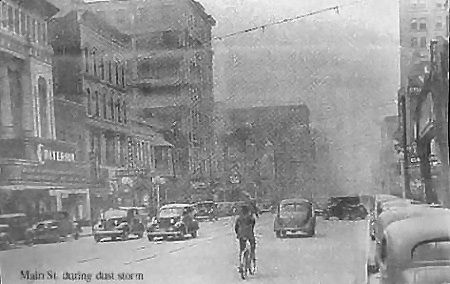
The days of the Dust Bowl were then well within the memories of most in the city and state even if most who are alive today will not have a personal recollection of that time. Although Oklahoma City was only on the edge of the Dust Bowl area, it affected us and our city's image greatly.
During the days of the Dust Bowl and drought, badly parched Lake Overholser looked like this, in 1935 (looking north to the US 66 bridge around NW 39th today).
The "Arrows to Atoms" theme avoided the negative images of the 1930s and focused on the city's present and hoped for future.
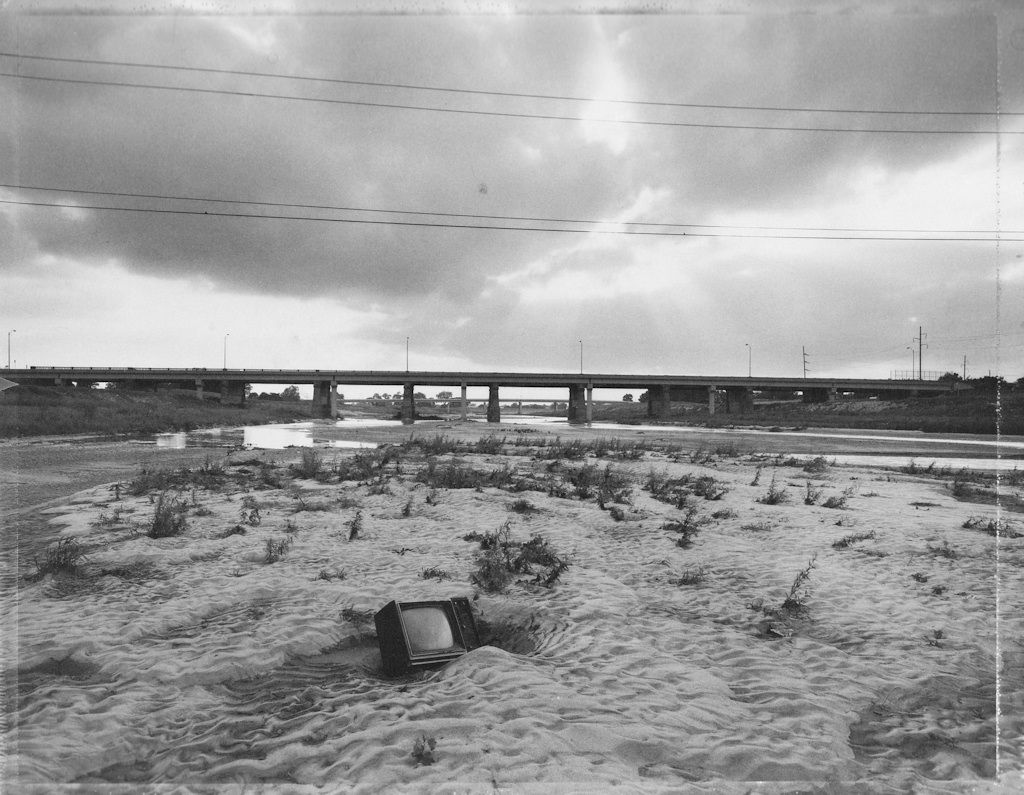
But, by as late as 1991, the North Canadian River passing south of downtown still looked like this (credit Mark Klett in his Photographing Oklahoma 1889/1991 (Oklahoma City Art Museum 1991):
How could THAT turn into this?
Arrows to Atoms, circa 1957, marked a break with the 1930s Dust Bowl. The city's original (1993) MAPS program would radically change the North Canadian and see a part of it renamed "The Oklahoma River." By the time 2007 rolled around, the city's river hosted its first Olympic trials during the Centennial Regatta.
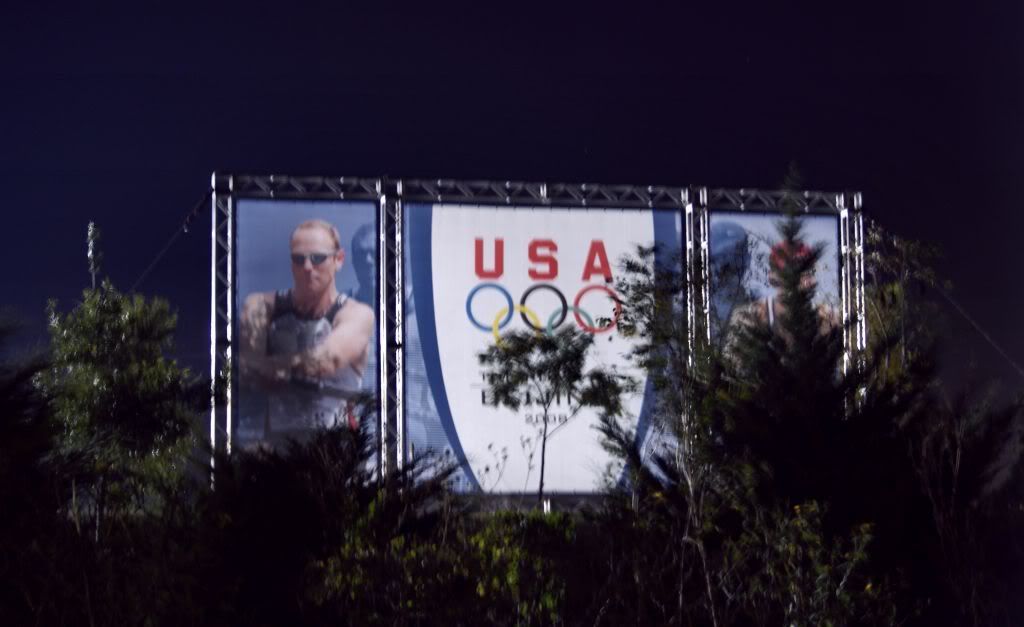
Now, in December 2011, Oklahoma City is embarking on its 2nd version based of Arrows To Atoms, with an analogous theme, the Formerly Crappy North Canadian River To A Water Olympics Headquarters — the river that needed to be mowed twice a year is now the address of a major water sport U.S. Olympic organization. Steve Lackmeyer wrote the story about this today in the December 13, 2011, Oklahoman:
USA Canoe/Kayak will relocate headquarters to Oklahoma City USA Canoe/Kayak, a member of the United States Olympic Committee, announced Tuesday the relocation of the organization's headquarters to Oklahoma City.
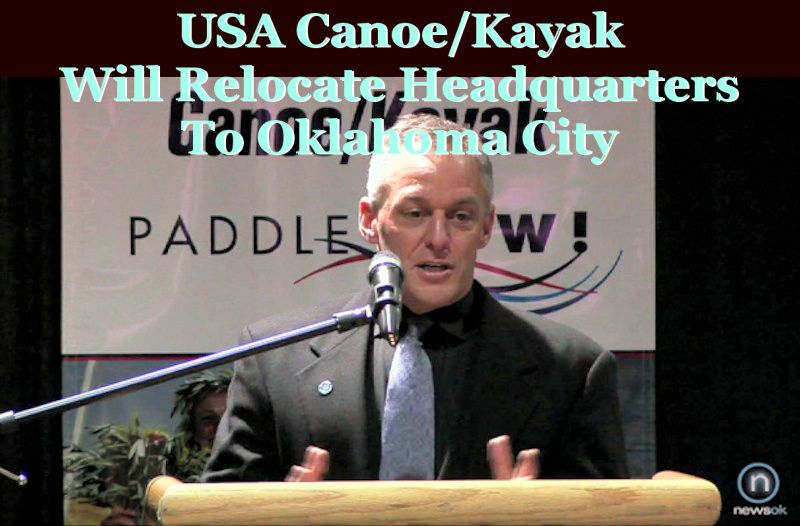
Both USA Canoe/Kayak Chief Executive Officer Joe Jacobi and Mayor Mick Cornett attributed the move to development of the boathouse district along the river and ongoing transformation of the waterway thanks to the original Metropolitan Area Projects. Jacobi said his office, which first opened in Oklahoma City along the Oklahoma River in 2009, will work closely with the city in developing a white water rapids venue included in the 2009 MAPS 3 ballot. The Oklahoma City office will replace Charlotte, N.C. as the organization's national headquarters as the group begins its first ever promotional campaign for paddle sports. "This is a perfect illustration of how MAPS 3 was an attempt to build on the success of the original MAPS," Cornett said. "I don't know what this is going to lead to, but I'm sure there are many opportunities ahead."
Lackmeyer's story at NewsOK was enhanced by this video featuring Joe Jacobi and Mayor Cornett:
The development wasn't just reported locally. Similar Associated Press and other reports were carried by ESPN, Sports Illustrated, CNBC, Washington Post, and, of course, Charlotte, the organization's previous home, among others.
USA Canoe/Kayak Announces Relocation of its Headquarters to Oklahoma City
OKLAHOMA CITY – December 13, 2011 USA Canoe/Kayak, the national governing body (NGB) for the Olympic sports of flatwater sprint and whitewater slalom and a member of the United States Olympic Committee, announced today the relocation of its headquarters to the city of Oklahoma City. USA Canoe/Kayak will office with the Oklahoma City Boathouse Foundation, allowing the two organizations to collaborate and build on the inherent synergy of shared values and objectives. A panel consisting of Joe Jacobi, OKCBF Executive Director Mike Knopp, USA Canoe/Kayak Board Chairman Bob Lally, and other leaders in the paddlesports industry will discuss USA Canoe/Kayak’s commitment to the future of paddle sports in America during a live stream broadcast scheduled to air on paddling web sites across the country and around the world. Watch live at oklahomariverevents.org/live-video. A panel consisting of Joe Jacobi, OKCBF Executive Director Mike Knopp, USA Canoe/Kayak Board Chairman Bob Lally, and other leaders in the paddlesports industry will discuss USA Canoe/Kayak’s commitment to the future of paddle sports in America during a live stream broadcast scheduled to air on paddling web sites across the country and around the world. Watch live at oklahomariverevents.org/live-video.
Joe Jacobi, USA Canoe/Kayak CEO: "USA Canoe/Kayak is launching a new era in paddlesports in the United States, with a focus on enabling U.S. athletes to achieve sustained competitive excellence in Olympic, Paralympic and other international competition. With the tremendous momentum taking place at the Oklahoma River – from the National High Performance Center for kayaking and rowing to the MAPS 3 OKC citizen-voted sales tax initiative to fund quality of life projects which include the construction of a whitewater center and race course improvements to the Oklahoma River – Oklahoma City is the ideal location for the epicenter of our efforts and initiatives to grow paddlesports. A central component to USA Canoe/Kayak’s growth is the “Paddle Now!” program, which encourages families across America to explore our nation’s waterways in kayaks, canoes, dragon boats and stand up paddle boards. USA Canoe/Kayak has teamed up with canoe/kayak clubs across the country to promote paddlesports; learn more at usack.org/paddlenow. Jacobi: "This nation has intrinsic ties to waterways – from the days of early explorers and Native Americans who paddled and portaged across the country to today's active adventurers. We truly believe Oklahoma City, a place whose citizens have supported the Oklahoma River and whitewater initiatives, is the place to rekindle our nation’s passion for paddlesports."
Quotes:
Alan Ashley, U.S. Olympic Committee Chief of Sport Performance: "Mike Knopp and his team at the Oklahoma City Boathouse Foundation have created a model that places elite training in the heart of the community, building synergy between the elite athletes, local youth and adults, and the local business community. We’re hopeful that this approach will help USA Canoe/Kayak continue to build their talent pipeline and develop top athletes to represent Team USA." William Irving, USA Canoe/Kayak National Teams Director: "We couldn’t be more happy to be working even closer with our partners at the Oklahoma City Boathouse Foundation, who are providing our NGB with the ability to better serve our membership through a variety of resources that are focused on high performing athletes. Having our NGB based in Oklahoma City, will make a huge impact on the way in which we serve all of our constituents and infuse our sport with the 'can do' attitude that Oklahoma City exhibits. Looking into the future, once the Whitewater Course is in place, we will have a unique opportunity to bring our two Olympic sports together and for the first time in our sports history and be able to train Sprint and Slalom athletes alongside each other." Kaitlyn McElroy, Sprint Kayaker: "Personally, moving to Oklahoma City to train was by far the right choice for me. The facilities are amazing. The boathouse district has everything you need to train at a high level. All that's really left for you to do is work hard and go fast. Over the past two years there has been an influx of local children becoming involved with paddlesports on the Oklahoma River as well as an increasing number of athletes from all over the country coming to train. I think this creates a unique environment for everyone because you have kids who are just learning the 'tricks of the trade' mingling with world class athletes. I think this gives the kids great role models while keeping the older athletes honest and attached to why they started paddlesports in the first place." Oklahoma City Mayor Mick Cornett: "The significance of USA Canoe/Kayak's relocation to Oklahoma City – in what was once known as 'the dust bowl state' – is indicative of the speed of change and positive forward momentum this community is creating. We've built a river that's become not only a health-and-fitness destination for our citizens, but a U.S. Olympic and Paralympic training site for our nation's aspiring Olympic kayakers and rowers. Becoming the headquarters of a National Governing Board is a testament to how powerful the MAPS initiatives truly are in influencing our ability to recreate and redefine our city."
About OKCBF
The OKC Boathouse Foundation promotes the use and development of the Oklahoma River as a world-class urban aquatic venue and provides access to rowing, kayaking and fitness programs for people of all ages and abilities. OKCBF programs pursue the highest goals of sports and embrace the principles of the Olympic spirit which inspire athletes to work toward personal excellence, embrace the power of teamwork, and practice respect for all people and the environment. To learn more or get involved, call (405) 552-4040 or visit okcbf.org.
About USA Canoe/Kayak
USA Canoe/Kayak is a non-profit membership organization based in Oklahoma City, OK, promoting canoe and kayak racing in the United States. A member of the United States Olympic Committee, USA Canoe/Kayak is the national governing body for the Olympic sports of Flatwater Sprint and Whitewater Slalom and the official U.S. federation of the International Canoe Federation. Other paddling sports sanctioned by USACanoe/Kayak include Marathon, Freestyle, Wildwater, Stand Up Paddleboard, Canoe Polo, Canoe Sailing, Outrigger, and Dragon Boat.
Here's a cool video by US Canoe/Kayak, uploaded by Okc Riversport.org, which nicely showcases the river area and development, with downtown's skyline shown at 0:40 but you got to watch closely ...
The TLO Summer of 2026 Oklahoma News Quiz
-
Before we power down the TLO content machine for the Labor Day holiday, we
figured we’d leave you with The TLO Summer of 2026 Oklahoma News Quiz – 10
que...
Operation Scissortail - Our Latest Book!
-
[image: devon book cover]
We are very happy to announce the release of our latest book, "Operation
Scissortail," a narative history of the construction o...
Saturday in the Park..on a 113 degree day
-
For those who don't know, there is a reason I've gone very quiet at such a
pivotal moment for Downtown OKC. I accepted a position in Cleveland, Ohio
and I...

 Various movements have sprung up around the country to attempt to undo the Citizens United decision, one being MoveToAmend.org, it advocating an amendment to the federal Constitution which, at its core, would declare that corporations are NOT people and effectively overturn the Citizens United decision.
 Taking a cue from "Occupy Wall Street," "Occupy The Courts" rallies are planned around the country this Friday, January 20, 2012. In Oklahoma City, the rally is spearheaded by these ladies, Susan McCann (left) and Rena Guay (right), and I'll get back to writing about their activities shortly.
 The Oklahoma City rally will be in front of the Federal Courthouse, 200 NW 4th, between 12 noon until 1 pm.
  Put differently, are the rights of a person different if they are human or if they are a person formed by the law of a state or the United States?" I mean, we are seriously having to look at Star Trek's fictional Borg when considering this topic, aren't we? If you disagree, please explain in a comment.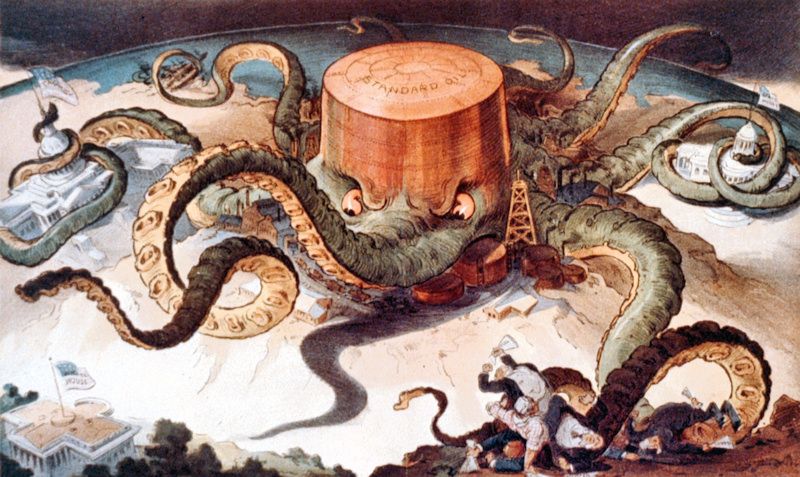










 For example, in the author's description of Oklahoma State Senator Constance N. Johnson from Oklahoma City, she gives a description of the "African American Centennial Plaza" which is intended to be around the State Capitol Building in the areas shown below. The source of the map is





 A giant pot ... large enough to put a small beagle in ... a pot at least 12-14" in diameter and 12" or more high, with a lid



 Yusuf Islam. "Who's that," you say? That would be the person you know as Cat Stevens. Born in England as Steven Demetre Georgiou in 1948, in his prominent professional carrier he was known as Cat Stevens until he converted to Islam in 1977 ... he assumed his new name in 1979. Now, fairly elusive, his "Morning Is Broken" remains associated with Christmas and also, perhaps, presents the Christian world's present greatest challenge to acceptance of someone outside their Christian sphere ... shall we accept Yusuf Islam, a Muslim, whether he accepts US or not? What a Christian might ask is, "What would the Christ Child Jesus have done?"
 About Margery Turner.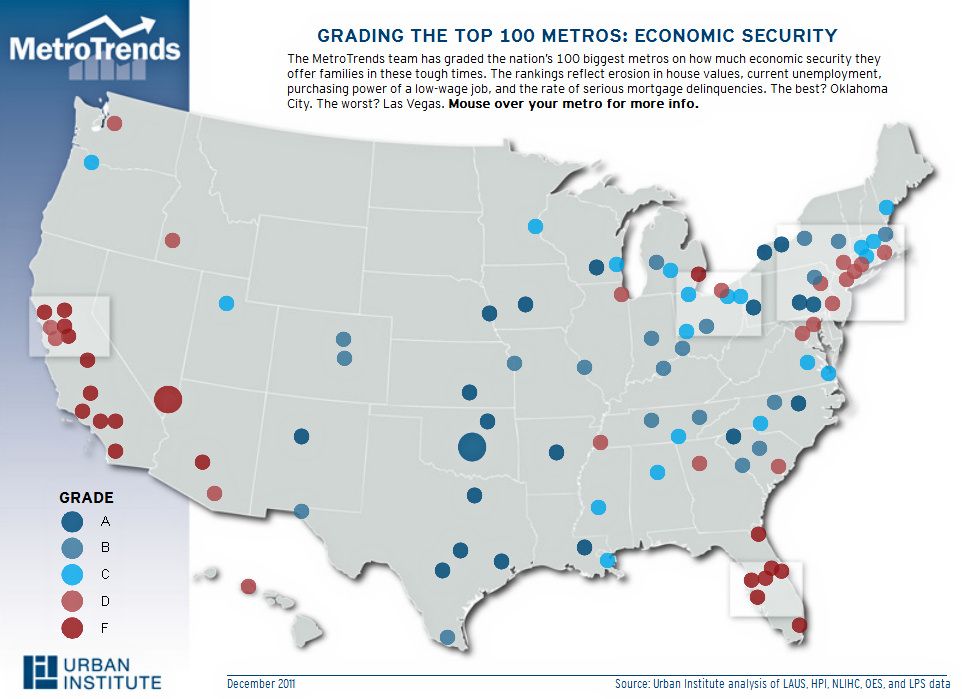
 Although you can click on any of the charts and maps shown in this post to get a larger view, here's the crop of the Oklahoma City summary shown in the above map. Note that one can download a much more detailed spreadsheet (Excel or comma delimited) file which I've done and will get back to shortly.
 But for those who mainly want to play with that map, it is very easily done. The map also gives a reader the ability to change the weight given the 4 factors previously mentioned, if one doesn't like the equal (25%) weight given by the Urban Institute to the 4 factors used in reaching the conclusions that it did.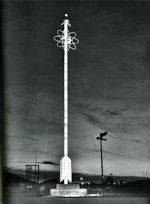



 Posts
Posts


