In this article, click on an image for a larger view, unless otherwise stated.
This article traces how Oklahoma City got a fabulous downtown park, the Crystal Bridge Tropical Conservatory of which celebrated its 20th Anniversary on March 25, 2008, and gives a heck of a lot of eye candy in the process!
If you want to skip the "history" part and go straight to "today," click here for an outside stroll. To jump directly to the March 25, 2008, 20th Anniversary festivities, click here.
When There Were No Big Parks Downtown. Maybe I've missed something, but a major "park" in downtown Oklahoma City wasn't something originally contemplated during the Land Run or at any time thereafter ... not until 1946. Early on, getting your Land Run "claim" staked out and the development of commerce, theaters, etc., were the things. The only things. A major park in downtown ... where's the bucks in that? You gotta be crazy!
Not that our ancestors didn't care for parks, but Wheeler Park and Delmar Garden were fairly near downtown, one to two miles to the west and south. And, Stiles Park at NE 8th & Stiles was even closer (though from what I know at this point it doesn't seem to have been much of a park). So, what's the point of having a "downtown" park?
By 1946, some "urban planners" (of which group doubtless none existed in the 1889 Land Run) started seeing it differently ... wouldn't it be cool if downtown Oklahoma City had a major park, sports facilities, and all that goes with it? By that time, Oklahoma City's population was somewhere between 1940's 204,424 and 1950's 243,504. The proposal below, from a July 11, 1946, Oklahoman article, shows a proposed downtown park and sports facilities complex that might have been ...
... but never did. The ideas of a downtown park and sports facilities would need to germinate for many, many years to come. Sports facilities would need to wait until MAPS ... but the renewed idea of a downtown park came sooner, with Urban Renewal.
Fast forward 16 years to 1962 and things began to change for the "park" part. Urban Renewal was starting to pick up steam, and a park was planned to be a part of that renewal. According to an August 17, 1962, article in the Oklahoman,
Creation of a park area in the heart of downtown Oklahoma City along the lines of Copenhagen's famed Tivoli Gardens is being planned by the newly-organized Urban Action Foundation.
Sam Zisman, the city's urban planning consultant, said Thursday he will leave for Europe next Wednesday with several of the foundation's members to visit Copenhagen and will study the world-famous garden as a first step toward carrying out the plan.
Dean A. McGee, President of the Urban Action Foundation and widely regarded as the downtown park's principal cheerleader, benefactor, and mover, was on the trip, also. The image shown here was in Roy Stewart's 1977 Born Grown. Without McGee's longstanding efforts, it is doubtful that the project would have been accomplished. Dean A. McGee became president and chief executive officer of Kerr-McGee in 1954, Chairman of the Board in 1963 upon the death of Robert S. Kerr. In 1973, the company's headquarters moved to its new 30 story Kerr-McGee Tower in downtown Oklahoma City.
Following the 1962 article, a national competition was announced in February 1963 for landscape architecture students to submit designs inspired by Copenhagen's prestigious and tenured (since 1843) Tivoli Gardens, the 1st prize being a study trip to Copenhagen or its cash equivalent. 149 entries were received from 12 colleges around the country. Judging was done by several notables in such things – Grady Clay, Editor of Landscape Architecture, Louisville, Kentucky, Alan Tanaguchi, Professor of Architecture at the University of Texas, and Steward E. King, San Antonio landscape architect, occurred on April 4 and 5. Henning Soager, managing director of Copenhagen's actual Tivoli Gardens, spent a week in Oklahoma City and assisted in the judging – a "Scandinavian Ball" was held in his honor at the newly constructed Sheraton-Oklahoma Hotel.
At the time, no particular area had been defined for such a proposal – if, in fact, it would ever come to fruition – but the contestants were given the area shown below for contest purposes ...
Also Notice the Possible Convention Center at the Left and the Transportation Terminal at the Right
According to an April 5, 1963, Oklahoman article, Mr. Soager described Copenhagen's Tivoli Garden's long-standing success as being, "40 percent Beethoven, 40 percent Hans Christian Anderson, and 20 percent high-brow Coney Island." He also noted that "Tivoli," spelled backwards, is "i-lov-iT." But the Oklahoma City counterpart did not contemplate an amusement park ... so skip the Coney Island, if not the Hans Christian Anderson, version for us! Ours was to be, quite simply, a beautiful downtown park, sans bumper cars which could then be had at Springlake!
Kenneth Sangster of Raleigh, North Carolina, graduate student at the University of North Carolina, won 1st prize with this design ...
As the "Pei Plan" moved forward, the plans for the "Tivoli Gardens" did also. The image below shows that, by this time, nearly twin botanical tubes were planned (as was an observatory) ... the orientation of this picture is north (Sheridan) at the right, and east (Robinson) at the bottom ...
Credit OKC: 2nd Time Around and OCURA
The "Tivoli Gardens" name and concept caught on. The venerable 1922 "Oklahoma Club" had been purchased and remade into the "Tivoli Inn."
Larger Image Not Available
A June 2, 1972, Oklahoma Journal article announced on page 1 that,
$17 Million 'People's Park Plan Unveiled
Perhaps the most imaginative dream for a people's park in the heart of a large American city was unveiled Thursday as the plan for Oklahoma City's Myriad Gardens. Local officials say they hope to reach for the stars and have most of the park finished by 1976. * * * Everything from a children's zoo to an ice skating pond and including a 30 foot deep canyon, a two-acre lake, botanical gardens, a sports hall of fame, a classic car museum, arts and science centers, a planetarium, a cluster of restaurants and movie houses, museums and a new Main Library for Oklahoma City is included in the Gardens plan. * * * A Phase Two plan for the gardens will extend west to Shartel and triple the park's size to a total of 33 acres.
The image which accompanied the article showed the Gardens as looking like this:
Taking some liberties, I've colorized the image marking areas that I could identify ...
If a botanical "tube" exists in the picture, I can't see it. But, the Biltmore (aka Hotel Oklahoma) and Tivoli Inn were clearly contemplated in the plan, as were numerous other items, the "commercial" parts of which were said in the article to provide monies for the maintenance and expansion of the Gardens.
When the "Work Begins" picture shown in the exhibit at the end of this article was taken, the Biltmore (Oklahoma Hotel) was gone but the Tivoli Inn was still standing, south of the Colcord, below.
Its owner wanted it to remain at its location at the southwest corner of Sheridan & Robinson, but that didn't happen, though, since the Tivoli's existence eventually got whacked by OCURA!
Today, however, the curvy red sculpture, "Gateway," by sculptor Hans Van de Bovenkamp located south of the Colcord Hotel, marks the spot where the Tivoli Inn once stood.
The 1932 26-floor Biltmore Hotel (then Hotel Oklahoma), was also originally included within the "sphere" of the new downtown park and would border and be incorporated into its northeast corner. Only later, after it was determined that fruitful renovation of that downtown landmark would be cost-prohibitive, did it get the axe, also, in 1977.
Larger image not available
In the end, there would be nothing but park. And ... seeing what finally emerged, as you will, below ... I'm not at all persuaded that the more pastoral park that came to be was a less desirable ambition.
A succinct history of Myriad Gardens is at this page in the Okc Parks & Recreation website. It notes that on May 5, 1970, the name Myriad Gardens was officially adopted and that Oklahoma City purchased the 17-acre site in 1975 for $900,000. Investment in the development phase, including initial site clearing and utility relocation, was approximately $1.2 million. After demolition of the Oklahoma Club/Tivili Gardens Hotel, the City National Bank, the Biltmore and many lesser buildings, a ceremonial groundbreaking occurred on November 17, 1977.
Splashy headlines and stories in the Oklahoman followed the progress. This one, on June 11, 1979, presents an interesting view of the water, then at ground level. The Garden's lake water is supplied via an underground channel of the North Canadian (Oklahoma) river.
Work On The 3-Story Tube Began 4/22/1983 (Larger image not available)
Gala Opening on 3/25/1988
An aging Dean A. McGee, shown here on that grand day (courtesy OKC: 2nd Time Around and the City of Oklahoma City), lived to see it done.
Oklahoman articles reflect that such an end was not all all certain. The raising of private funding to pay for huge portions of the cost, doubts about the Gardens' success after the retail elements of the Urban Renewal plan fell through, and economic woes following the Oil Bust, caused grave doubt that it would ever be done. A June 11, 1979, Oklahoman article, reports,
Soon, the gardens project was shelved along with the whole downtown renovation, McGee said. It surfaced from time to time, but not until 1975, when the trust was created, did the gardens become a distinct possibility. McGee is chairman of the Myriad Gardens Authority.
He feels a change of the times led to the revival of Myriad Gardens, a name adopted to go along with the Myriad Convention Center.
"There were several years when we made no headway," McGee recalls. "There was a question whether it would be built at all. Then there was a change in the times. It finally has moved to our part of the country. Investors are beginning to see the opportunities. Time has been helpful."
Mr. McGee's perseverance, and his infectious enlistment of others in the community to see the task done, proved to win the day. Dean A. McGee died September 15, 1989, but, look closely and you'll see him still.
The Myriad Gardens Today. Since the summer of 1987, the Oklahoma City Parks and Recreation Department has operated and maintained the Gardens. The Crystal Bridge opened its doors to the public on March 25, 1988, hence the March 25, 2008, festivities! Click this link or the picture below to have a look at its Myriad Gardens website.
A 2006 overhead view, from the Oklahoma County Assessor's website, is shown below:
Enjoy a stroll around the park ... March 25 & March 28, 2008. The grass isn't quite green yet and trees are just beginning to turn ... both were very beautiful days! Click on any pic for a larger view.
First, March 28 ...
The construction shown in a few of the above pics relates to elevator work being done in conjunction with the $2.5 million expansion and renovation of the Water Stage, completed in 2007. In the same year, it became the home of Oklahoma Shakespeare in the Park. This Wikipedia article says that the Water Stage now contains 210 chair-backed seats and 100 bleacher backed seats.
The March 25, 2008, 20th Anniversary. In honor of the occasion, the Oklahoma City Parks and Recreation Department granted free access all day long to the Crystal Bridge Tropical Conservatory.
The first pics were taken outside in the morning, looking West.
I arrived for the afternoon's activities at about 5:15 and walked to the north end where the Dean A. McGee Center is located. According to the Oklahoma City Parks & Recreation website, this area was opened for public use on June 28, 2001, and is a 5,000 square foot, multi-use and meeting facility funded by the Myriad Gardens Foundation. It was here that the following pictures were taken of historic exhibits located there which trace Myriad Gardens' development and of members of the Foundation and its guests.
Unfortunately, my "flash" is reflected by the glass-enclosed exhibits shown below. Click on a pic for a larger view.
Oklahoma City in 1960 Look closely to see a marker showing the planned location As usual, click the image for a larger view, but click here for a much larger view
A very nice exhibit that I did not photograph is a large "press clipping" book which, among other things, shows that not everyone was happy spending public money on such a project ... some things never change!
A Few People Pics
Michael Laird, President of the Myriad Gardens Foundation, Addresses The Group
Jim Tolbert, Chairman Emeritus of the Myriad Gardens Foundation, addresses the group and gives a history of how things came to be
Allan Storjohann, Myriad Botanical Gardens and Crystal Bridge Tropical Conservatory Manager since 1991 Releases Some New Butterflies
On the way out, I took these pics inside the Crystal Bridge/Botanical Gardens ...
After Climbing To The Top Level, Looking South
Proceeding Toward The Bottom
There you have it! March 25, 2008, was a great great day for Oklahoma City, thanks largely to one of Oklahoma City's greatest benefactors, Dean A. McGee!
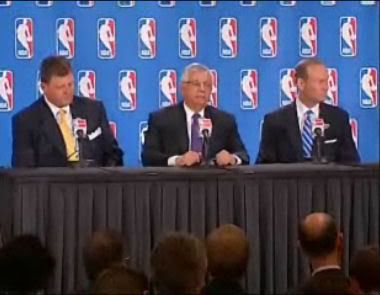
After an NBA Relocation Subcommittee met yesterday in Oklahoma City, March 25, a most excellent press conference was conducted at the Skirvin Hilton beginning at around 4:45 p.m. Although only a subcommittee, it was quite evident that the remaining procedures are pretty much if not completely a formality ... 1st, the full committee will meet (probably by conference call, according to Stern's remarks, below), 2nd, the NBA Board of Governor's will meet on April 18, and, at that time, the official NBA vote will be taken.
To view Channel 9's Video of the 28 minute press conference, click here or on the image below. For a text transcript of the press conference, click here.
NBA officials present for the day's events included David Stern, NBA Commissioner, Deputy Commissioner Adam Silver, president of league, basketball operations Joel Litvin, Los Angeles Lakers owner Jerry Buss via his daughter, Jeanie Buss, Indiana Pacers Herb Simon, and part-owner of the New Jersey Nets, Lewis Katz. City and State leaders present included all members of the Professional Basketball Club, LLC, as well as a host of publicly elected officials, past and present. This Darnell Mayberry Oklahoman article notes that,
A unified front by Oklahoma leaders at the Skirvin Hotel impressed the relocation committee enough to give Oklahoma City the thumbs up. NBA executives were greeted by Oklahoma City Mayor Mick Cornett, Tulsa Mayor Kathy Taylor, Gov. Brad Henry, Oklahoma State House Speaker Chris Beng and former Gov. Frank Keating.
Leading businessmen and Sonics part owners Aubrey McClendon, Tom Ward and Jay Scaramucci also attended the meetings as well as Jeffrey Records of MidFirst Bank, Everett Dobson of Dobson Communications and Bob Howard. OSU President Burns Hargis, OU football coach Bob Stoops and OSU athletic director Mike Holder also represented the state.
About that, David Stern commented in the afternoon's news conference:
"There's just something about being in the room with all of the people who are in charge,” said Stern, adding that Oklahoma City would have "no chance” of landing an NBA team if voters didn't approve $121 million in tax funding on March 4 to go toward renovating the Ford Center.
"I think in its totality, the way it was presented, it had a great influence on the committee members. It was very impressive, and one understands why it's more than Oklahoma City. It's Oklahoma.”
Said Henry of the relocation committee: "They're impressed with the cohesiveness of this community and this state. I just can't imagine that the owners would turn down our request for a team on April 18.”
While the NBA officials were being given a tour of the Ford Center, existing and as will be upgraded because of the successful March 4 vote, the City Council met and gave its unanimous approval of the Letter of Intent that the Sonics had presented earlier. A couple of nay-sayers were present in the audience to voice their objections, Wanda Jo Stapleton and David Glover. Their comments brought some harsh words by Council Member Skip Kelly ... according to today's Journal Record article, he said,
Councilman Ronald “Skip” Kelly said, “It seems like that there are certain people in our city that don’t want to see any kind of progress on any type of project. And I take offense when someone comes in here and says we were led by some fancy brochures.”
Doug Dawg is in complete agreement with Council Member Skip Kelly on that!
One of the NBA officials attending was Lewis Katz, part owner of the New Jersey Nets. He spoke glowingly about the NBA in Oklahoma City ... see this video at Channel 9 for the full video ...
According to today's Oklahoman (and you can here him say many of the words in the above video clip), he said,
"There's no question among the minds of the committee,” Katz said. "This is going to be an amazing experience for the NBA.” * * * Katz, who seemed to be running for mayor while holding court after Stern's press conference, said, "Can you imagine this market with a championship-caliber team? You had $800,000 a game (gross) for a team you knew was leaving. You keep talking about being a small market. It's not a small market.”
In an interview with Oklahoma City reporters Tuesday, New Jersey Nets part owner and relocation committee member Lewis Katz spoke candidly about whether the Seattle SuperSonics will soon call Oklahoma City home and why concerns over Oklahoma City's market size are exaggerated.
Q: What were your impressions of Oklahoma City coming in and what do you think now?
A: I had no idea what Oklahoma was about. I thought I was going somewhere was there was plains and a lot of wind. I've never seen a better presentation in my life. I've been to a bunch of these relocation meetings. I never saw better support from the business and political and government community. A vote of (61.9 to 38.1 percent) to self-impose a tax for an arena, it's just beyond anybody's wildest imagination that all this could be put together.
Q: Is this something you feel like the other owners are going to buy into?
A: Absolutely. This is wonderful for the league, wonderful for basketball, a strong wonderful ownership group that you have out here that can lead this thing. Oklahoma City, you can't believe that you can build an arena with no debt and turn it into an opening for a new team at $200 million, which is thecost of what you have with the renovations.
Q: What are the concerns from the owners about relocating a team to a smaller market?
A: Let me say this about small markets. Everybody keeps telling me that you think you're a small market. There's an hour and a half between Tulsa and Oklahoma City. That hour and a half has 2 ½ million people or 70 percent of your state. This is not Oklahoma City. And my view is 20 percent of your ticket sales came from the Tulsa market. I really didn't look at this as a small market.
Q: Do you think the Sonics will come here, and when do you think they'll arrive if they do?
A: It's just a question of when. And the hope is somebody makes the appropriate approach from Seattle, people get together to sit down and make a deal and everybody walks away with something good for their community. Hopefully, Seattle will then realize that the NBA is not walking away from them.
News Conference Transcript. From Olympia Washington's News Tribune, here's a transcript of the March 25, 2008, NBA Press Conference at the Skirvin Hilton:
Transcript of OKC press conference Posted by Eric Williams @ 09:13:58 pm
Here's the full transcript of the Tuesday's press conference in Oklahoma City that included Sonics chairman Clay Bennett, NBA Commissioner David Stern and Oklahoma City Mayor Mick Cornett.
Opening Statements:
Oklahoma City Mayor Mick Cornett: I’d personally like to thank Commissioner Stern, his NBA staff and the members of the Relocation Committee that came to Oklahoma City today and allowed us to give our presentation. We had a number of Oklahomans who were there, many of them as part of the presentation but also there in a support role.
[More:]
Former Mayors Humphreys and Norick, Mayor Kathy Taylor from Tulsa was down in a support role, Governor Keating, Governor Henry were on hand, Mike Holder, the Athletic Director at Oklahoma State, Joe Castiglione from the University of Oklahoma, Bob Stoops, the Oklahoma head football coach was in the room; as well as the entire ownership group of the Sonics franchise.
So, it was a great show of support and I think symbolic of Oklahoma City’s long or at least through two years support of the NBA in this city, and I think (it) reflects well on our stance that we are a perfect relocation site for an NBA franchise. Commissioner, thank you very much for all of the attention that you gave us today.
Bennett: It’s a very proud day for me. I’m very proud of Oklahoma and Oklahoma City, of our Ford Center, of our recent vote to improve the building, and the demonstration of state, local, civic, business, political leadership that was in the room today was really extraordinary and was unified on a common goal of bringing the NBA to Oklahoma City.
So, I’m thrilled to sit here today having completed the process of the day and survived the Commissioner’s many questions, but hopefully we responded well and showed well and again, I just think it’s a great day for the city and a proud moment for our group and I think should be a proud moment for all of Oklahoma.
Stern: Well, we were here with eight members of the NBA staff, including myself, and we want to also really say special thanks to Lewis Katz, an owner of the New Jersey team; Herb Simon, an owner of Indiana and Jeannie Buss, an owner of the Lakers for their full day in the work and analyzing this.
At the last moment, Peter Holt was not able to make it. We had an extraordinary tour of the current Ford Center with a complete demonstration using the latest technology and a lot of footwork to demonstrate how it will be brought up to be a state of the art NBA arena should the team relocate here.
And, in the afternoon session, we were presented with an in-depth look at the economy of the state of Oklahoma and various sectors in depth that I don’t think we had previously had presentations on.
And, to Clay and the Mayor’s point, the array of support in that room by former Mayors, former Governors, current Mayors, current Governors, the leaders of the legislature and the business community were quite extraordinary. And those that weren’t there in person were there in video presentations covering virtually every sector from aviation to education to medical research and medical care to the energy industry.
It was quite an extraordinary demonstration of the breath and array of the assets that are Oklahoma and the support that was going to be forthcoming. On the basis of the various materials that have been prepared previously and distributed to the committee, which were reviewed by them and the presentation today at a meeting subsequent to the presentation, the three members of the committee concluded that they would recommend to the Relocation Committee that it recommend that the franchise be permitted to relocate from Seattle to Oklahoma City.
That meeting will take place between now and April 17th, whether it is in person or telephonically, most likely telephonically with a report prepared, and then whatever that committee decides will be reported to the Board for action on April 17th. Is that the Thursday or the Friday? The Thursday? April 18th. That’s the day of Paul Revere’s ride. You didn’t know that did you? And that’s our days work and I guess we’re all here to answer questions.
Q: I wanted to ask you, Mr. Bennett, about the state-side of incentives package. You talk about the Quality Jobs program. Why change the Quality Jobs program and not ask for a direct appropriation from the legislature?
Bennett: Well, we just believe that a revenue neutral approach to the state is appropriate and we think this is a significant economic development pursuit that Quality Jobs was really designed to address and that the expansion now to include this particular sector was appropriate. So, we think it is a fair and reasonable approach.
Q: Did you ask for an appropriation originally?
Bennett: No, we did not.
Q: Clay, what were some of the questions from the Commissioner that you survived?
Stern: Well, those are an executive session. He’s not allowed to – if they ask you anything publicly – the rest are covered by the Commissioner/Owner privilege, but he did get shorter.
Q: Commissioner, what did you learn today about Oklahoma City that you didn’t already know?
Stern: We knew about the support of the team and the Hornets and how well this community responded to the tragedy of Katrina, but we hadn’t been through, in effect, the soon-to-be re-modeled Ford (Center) and seen the plans and the care for some combination of loges and sky suites and restaurants and food service and you know, outdoor roofs, and very modernistic design that is really going to move this Ford Center into the first rank of NBA arenas.
And, I would say there’s just something about being in the room with all of the people who are in charge, for the Governor to talk about the quality of jobs, legislation with both leaders of the legislature there; for the mayor to take us through the MAPS program with respect to his predecessors and him for the head of the business units to take us through, really, the breakdown specifically through video travels of the aviation industry, the medical research industry, indeed the 18 universities that are here – to have it graphically spoken to the Committee with respect to the continued flow of quality jobs and quality graduates to fill those jobs, the per capita income, the lower cost of living – I think in its totality as it was presented, it had a great influence on the Committee members, it was very impressive and one understands why it is more than simply Oklahoma City, it is Oklahoma.
I thought that the Mayor of Tulsa being there was extraordinary. The support, the editorial today in the Tulsa paper – you can tell I’m a New Yorker – was, I thought, generous and meaningful to our ownership. And, we learned a lot about the economy of the state of Oklahoma and its demographic and a little bit about its geography. And I’m not sure I quite believe that there’s never been a traffic jam between Tulsa and Oklahoma City so that you can always make it in 89 minutes, but that’s me, and I’m a skeptical New Yorker, but we learned a lot about that. And there was a fair amount of discussion on DMA’s and standard market definitions and the proximity and the like. It was a pretty full explication and pretty much a tour de force on behalf of Oklahoma that I’d say impressed the members of the Committee greatly.
Q: Commissioner, what will your role be in terms of aiding the franchise with its negotiations with Seattle?
Stern: Well, I’m available to Clay and to Seattle, as I’ve always been. I would say I’m completely available. But there is a lease to be honored, there’s a court deciding whether that lease has to be honored by the payment or has to be honored by the team being physically there. There is an interesting issue because if the team is there for the remainder of the lease. We’re assured that the construction necessary on Ford Center will be complete by the time the team comes here. But I think there may or may not be a discussion to have about a fair settlement for both sides. I’m certainly prepared to participate in that fully and look for some fair resolution.
Q: Mr. Bennett, you called this a proud day. Do you feel we sealed the deal today?
Bennett: We made important progress today, and this was a serious meeting, a lot of information. The league is represented by their professional staff with some very impressive people who know what they’re doing and know the questions they’re asking. More evaluation will come from meeting and more discussion, and of course we had some very experienced owners here who know about the business, know a lot more about the business than certainly I do. A lot more to be done, but a very important step. I think it was a very successful day, and we look forward to the next step.
Stern: We had with us lawyers – we never travel without lawyers; we had team marketing people who were testing and stressing assumptions; we had our chief financial officer; we had our construction expert; and we had … and then there was just the rest of us -- Joel Litvin, Adam Silver and myself … we just sort of came along for the ride, the Commissioner, the Deputy Commissioner and the President of the League and Basketball Operations.
But there was a group represented here that did a lot of work before we got here, has been pushing at Clay and his team, and are as anxious as I think the members of the committee were to hear the presentation and to learn of the depth of support for this project in Oklahoma.
Q: If the funding for the existing arena hadn’t been approved, would you be as positive about this as you are?
Stern: No chance. Ford Center was a great temporary facility. It is not the facility of tomorrow and the $100-plus mullion that were allocated and approved overwhelmingly by the taxpayers was a huge statement and actually how that is going to be spent and the ways for locker rooms and every possible amenity is really what makes this an NBA arena.
Q: Can you talk about the difference between Oklahoma City and Seattle?
Stern: I think Seattle is actually a terrific market; it just doesn’t have an NBA-ready arena of the future. That’s been agreed by both parties for many years, so it’s a very strong market that has in fact supported NBA basketball over the years. When you come to a place Oklahoma, you look for the single-team market as opposed to for example a market that has three or four major professional sports leagues.
You look for that. You look for a kind of support that Mayor Cornett has spearheaded, really, years before we brought the Hornets here. And then you look for the statement from the fans which are here with respect to the Hornets support, which I think the Committee feels can be extrapolated to their own team. And the array of support – the Governor was forceful in his presentation with assistance from the leaders of the Legislator were here; the Mayor was forceful; the business community was forceful. It was really extraordinary.
So, you look for something that says, on paper this is a small community but then you recognize that it’s a well-populated state in a certain way. It’s got important businesses and you are going to have to make your estimates of the kind of support. And I think the Committee members that were here had come to the belief that the extra, the supercharging aspects of it, were present here in the presence of the sectors represented and the fact that this would be the sport, not just in town, but in state. And we got a pretty good primer on sports in this state, starting with the Sooners, but going to the Cowboys and also focusing, I might add – I would be remiss returning to New York and the WNBA, without adding there appear to be two women’s teams still in the hunt. So this is a sports market that cuts across gender and we got a little bit of a lesson on that as well. It was pretty impressive.
Q: Mr. Bennett, can you talk about the upcoming trial and how the city of Seattle is trying to keep you in Seattle until 2010?
Bennett: Well, we are prepared to engage in the trial and we are prepared to abide by the rules.
Stern: I would sort of step in and say that it is not a question of force, but rather enforce. The question is, what is required under the lease? If the lease can be satisfied by the payment of money, that’s one thing. If it can’t, then it’s got two more years to run after this. That’s just what happens when you either sign or inherit documents. We respect that and I know that the owners of the Sonics respect that.
Q: Commissioner, how do you react to people who have ridiculed Oklahoma City as a viable NBA city?
Stern: I think that facts and education ... there were people who actually ridiculed the notion that we would have an All-Star Game in New Orleans. I would say it’s been our most successful All-Star Game in a very long time … Weekend. So, and questions were raised by players and they learned what we were doing, etc. I daresay, what the owners on the Committee would tell me that if in fact the players had seen what we saw, and they will in an abbreviated form, shortened form, that they would not have said that.
Q: Mr. Bennett, what is on the personal agenda for Clay Bennett tonight?
Stern: This is live on NBA TV, you know that, don’t you? (laughter) It’s going to be recorded for posterity.
Bennett: Relax a bit, maybe. It’s been a busy time and this is a demanding business, but it’s also very energizing, so I am absolutely committed to this process, and view today as a very important step, and, again, I am very pleased and very proud of how we showed. Happy tonight. Sleep well tonight.
Q: Commissioner, how will the Board vote giving the pending court case? And will you continue to encourage the ownership group to seek a buyout?
Stern: I would say the following: The Board of Governors, if in fact the Committee recommends – remember this is a sub-committee of the Committee that’s recommending this to the Relocation Committee. If the Relocation Committee recommends it to the Board and the Board votes in appositive fashion, they will do so recognizing that everything is subject to the terms of the lease in Seattle. Period.
So the approval will be with respect to whenever the team is free to move they will be approved to move. With respect to the ... I would say there are pros and cons to the timing of the move, but on balance we would as I answered earlier recommend to Clay and the ownership group that they negotiate in good faith if there is another party to negotiate with for a monetary settlement of the terms of the lease and possible beyond for the benefit of Seattle and I would be willing to participate in that if I could be constructive. And Clay agrees. (laughter)
Q: Mayor, with the sales tax passed and today’s proposal, what’s left for you to do?
Cornett: I’ve been all ears. This has been enlightening because we spent a lot of time and attention on making our presentation, making our case. And to hear the feedback that was apparently generally positive was refreshing to say the least. Our citizens have done everything we asked them to do. We asked them to support that team two years. They did. We asked them for the opportunity to improve the Ford center. And they’ve given us the go-ahead to do that.
So, really the ball was back in our court as city leaders to try and convince this Relocation Committee to bring the team to Oklahoma City. It’s another step in the relocation process and this is really an if-when scenario. The part of Oklahoma City’s involvement is if the team is going to come. We don’t have any part to play in the when the team might arrive here. But we are very involved in the if and this is another significant step.
Stern: The Mayor is too modest because he told me he personally is going to get overalls and supervise the reconstruction; although they are going to be smaller than when I first met him. (laughter)
Q: Mr. Bennett, how confident can the citizens of the city be that you won’t come back and ask for more improvements or a new arena?
Bennett: I’m pretty confident. We expect to play in the Ford Center for a long time. It will be among the top tier of buildings in the country. It provides the revenue streams that are important for our model. We like the building very much. And we think these improvements are going to enhance the fan experience and provide what we need for a business and certainly provides a very exciting bowl and atmosphere and for games. We like the building and it’s our anticipation that we will be there for a long time.
Q: Some people in Seattle have said all they need to do is wait this thing out. If the Relocation Committee votes to move the franchise, are you committed to wait until 2010 to move?
Bennett: Yes
Stern: Yes.
Q: There’s been talk of donors in Seattle willing to donate half the cost to keep the team in Seattle. What is the status of that and how willing would be if that happened to keep the team in Seattle?
Stern: The reason that this journey began was because Key Arena was not an adequate arena going forward and there were a lot of recommendations made for another arena, plans and the like. But the tax revenues and the various contributions weren’t forthcoming, and I’d say that as far as we know, the footprint of Key is at the present time is not viewed at the present time as adequate to support what’s necessary going forward.
One of the interesting things about the Ford Center is when it was built it was built to a large footprint – I think over one-half million square feet … 580. And they are talking about adding 300,000. Key Arena is a much smaller footprint. I think it’s in the threes. Also, as far as I know, we have owners there that own the team and they’ve told us based on the present state of the record and their inability to get any assistance, that the team is not for sale and the application for a move has been made. The Sub-Committee is going to recommend to the Committee and the Committee will make its recommendation. Then there will be a move to Oklahoma City if it gets approved, whether it is the end of this year or two more years.
What do the March 25 events and remarks on tht day mean? Just one thing ... Oklahoma City IS now an NBA city ... if not next year, only one or two years down the line. It is done.
Those in Washington State who think that they can magically change the course of events laid down today are just whistling in the wind ... they would be better served by negotiating a deal with the Sonics owners which would keep the "SuperSonics" name in Seattle and pay off the KeyArena debt (not a present obligation of the Sonics) ... although local wisdom there has so far not seen such wisdom.
Not a problem, Seattle. Your history in recent years, perhaps most marked by Seattle icon/visionary Chris Van Dyk, defines your concept of the term "visionary." Seattle and Washington, you got what you asked for. Nothing. You have a chance to salvage "something" from "nothing" by negotiating with the Sonics for a quick release from Seattle. But, that's in the hands of your visionaries.
In this post, unless otherwise noted, click on images in this post for larger views.
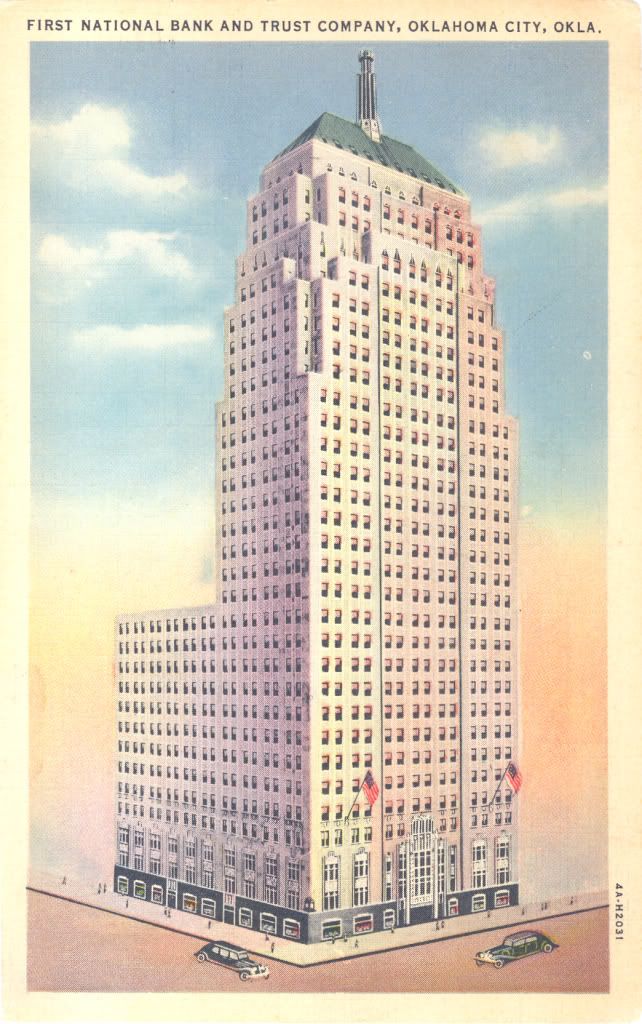
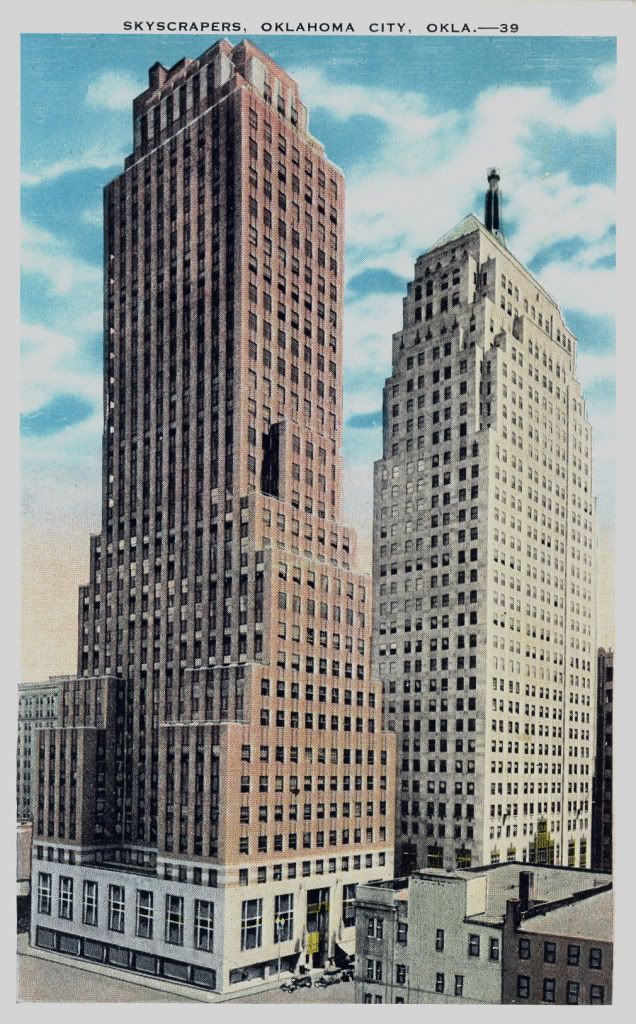
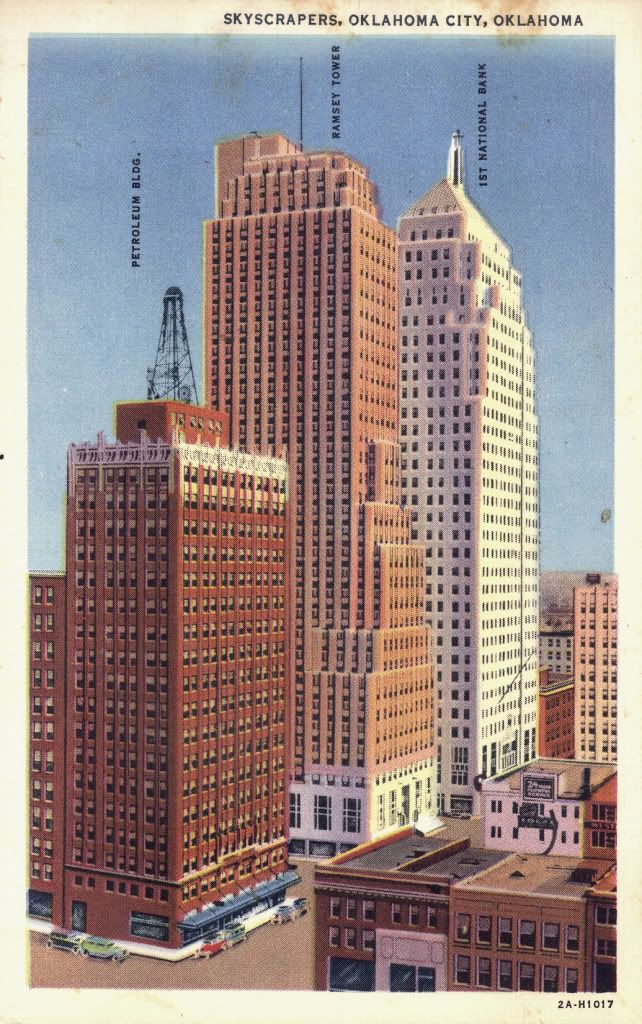
First National Postcards from my collection
Standing Alone
Next To Ramsey Tower
And Showing The Older Petroleum Building
Plans for "the tallest building in Oklahoma" were splashed across The Oklahoman's front page on April 20, 1930 ...
Actually, other "significant" buildings were then or shortly thereafter contemplated to be built, making "1931" one of the most dazzling years of downtown's construction history ... it was a "heady" time ... the Skirvin Tower, the YWCA (on Park Avenue, then 1st Street), the Ramsey Tower (City Place, today), the Biltmore Hotel, as well as the 1st National, had target completion dates in the year 1931, as was shown in this January 4, 1931, Oklahoman article ...
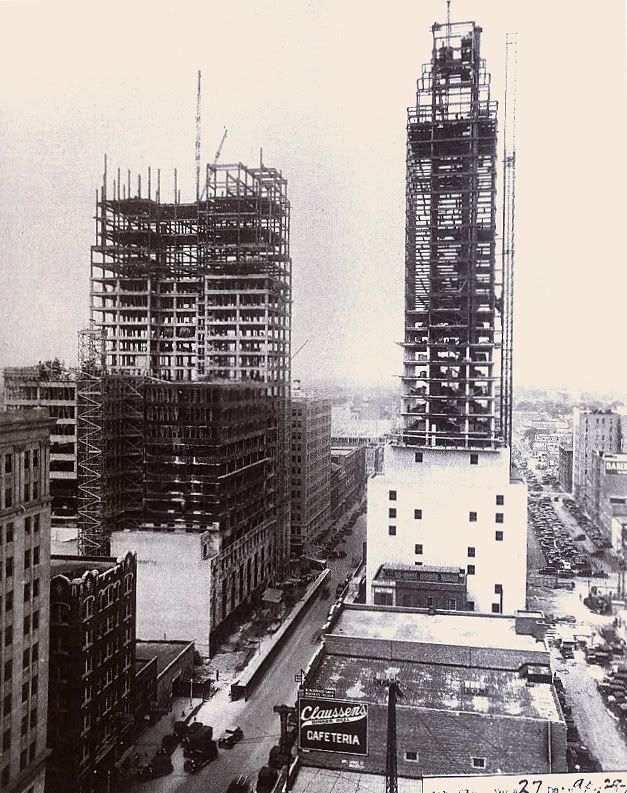
Some didn't make the schedule ... the scaled back Skirvin Tower was done in 1932 and I think that's true for the non-scaled back YWCA and Biltmore. See Other Hotels for more about that. The "focal point" as to what actually did occur in 1931 was the 1st National Bank and Ramsey Tower, each apparently being engaged in a "race" to see which finished "first."
Credit: Terry L. Griffith's Oklahoma City – 1930 to the Millennium (Arcadia Publishing 2000)
The Great Race
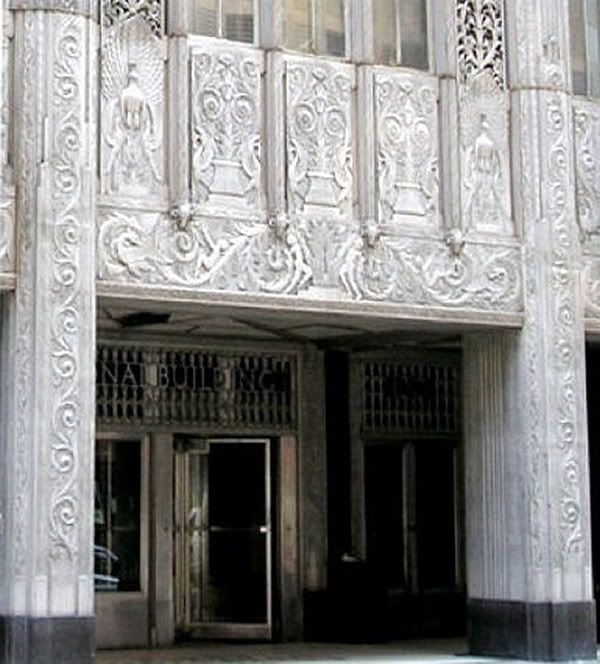
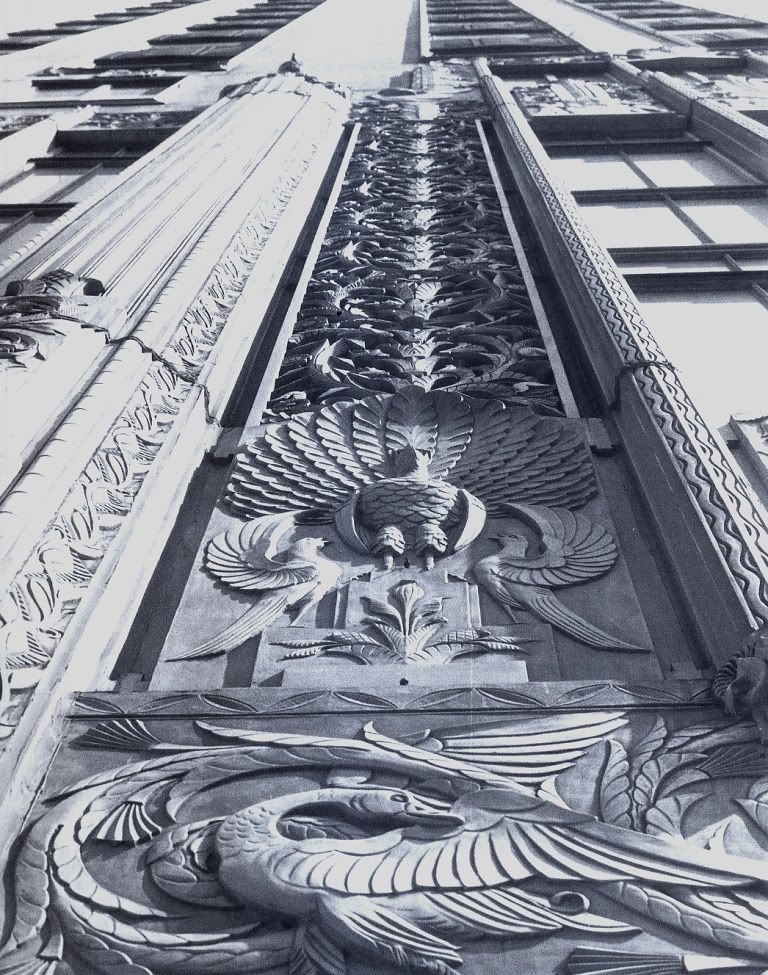
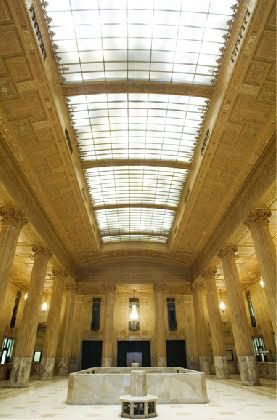
The Ramsey Tower (now City Place) won the race by a hair on October 3, 1931. Even though both buildings have the same number of stories (32), most observers would come to identify the First National as the city's "signature" downtown skyline building, perhaps because of its similarity to New York's Empire State Building, perhaps because it edged out Ramsey in overall height (not stories) by reason of its prominent "beacon," or, perhaps, it was just a little fancier! Have a look at the very fine art deco swans, peacocks, and ivy, on the entry's facade ...
The Entry
Credit: Terry L. Griffith's Oklahoma City – 1930 to the Millennium (Arcadia Publishing 2000)
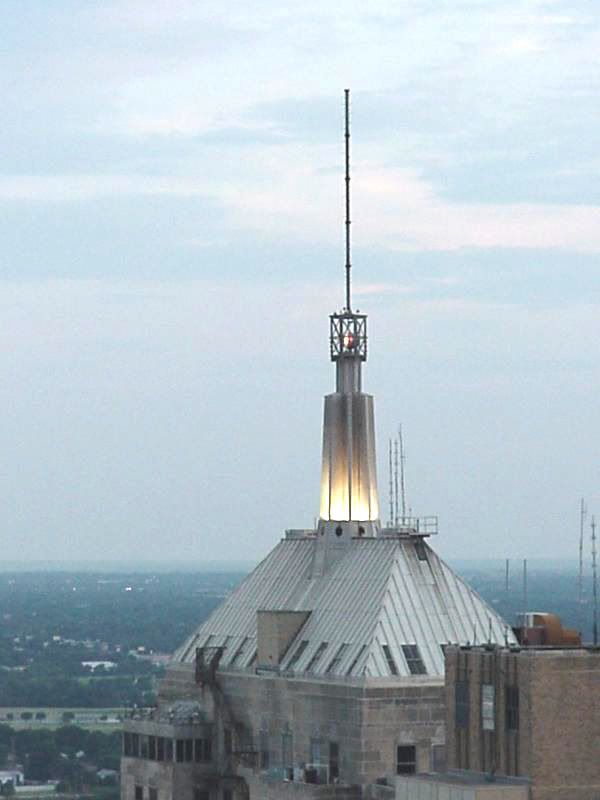
The Beacon. The "beacon" at the top wasn't a "radio transmission tower," as I'd earlier thought. Instead, it was an "aviation" beacon, which, according to a November 29, 1930, Oklahoman article, would be "visible for 50 miles." The article said,
Present plans call for a revolving beacon visible 50 miles, the distance between Oklahoma City and Chickasha. A stationary beacon, constantly pointing toward the municipal airport, will be a part of the equipment. This beacon will be so strong it will cast shadows at the airport, eight miles from the bank.
The "antenna" shown atop the beacon, below, was not in the original building.
Credit O'Daniel Photography
Skipping a decade but along the same vein, Oklahoma City's excellent "Beacon Club" located itself in the top of the 1st National in 1941, below the "beacon." According to the Beacon Club's history page ...
The Club opened in the late 1941 on the 31st floor of the First National Building. All equipment and furnishings were owned and operated by Faber "Goob" Reid and he called his operation the "Rainbow Room."
The club would eventually come to occupy the top 3 stories of the 1st National. But, with the building's decline and it having no apparent prospects for revitalization, the club moved to the Oklahoma Tower in 1997.
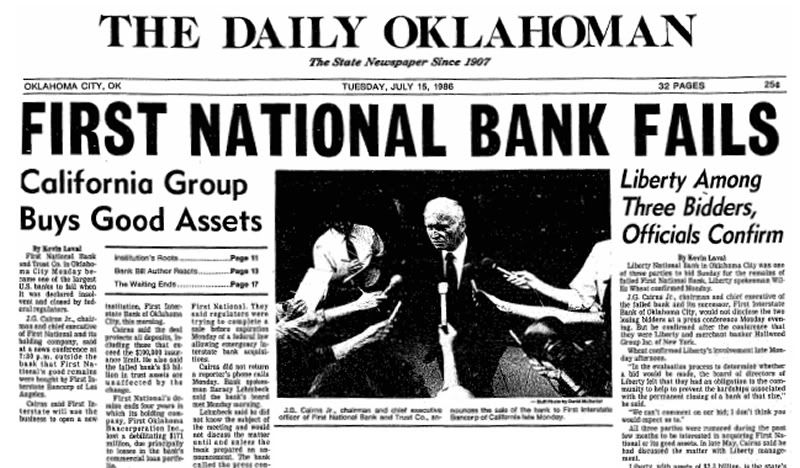
The Big Bust. Fueled by the domino effect of July 1982's Penn Square Bank closing and the "Oil Bust" itself, the 1st National Bank, once the state's largest bank with assets reported to be $3.3 billion in 1982, collapsed, as well. The Oklahoman's headlines on July 15, 1986, told the tale:
By this time, huge losses ($66 million in 1985, $45 million in 1st quarter 1986) had occurred and assets had shrunk to $1.8 billion from 1982's $3.3 billion. 1st Interstate Bank of California acquired the assets and, for time, it operated in the existing premises. That bank was acquired by Boatsmen's Bank in 1991 and in 1992 Boatsmen's decided that 1993 would be the time to move on, to Leadership Square. According to a May 29, 1992, Oklahoman article,
Boatsmen's and its predecessors have served as anchor tenant in the 1 million share-foot First National Building since its construction at 120 N Robinson in 1931. Loss of the bank, which occupies about 25 percent of the 32-story skyscraper, casts uncertainty over the future of what many consider an architectural masterpiece, observers say.
"It's the demise of that building ... you can forget it," said Ed Townsend, president of Local Federal Bank, the First National Building's largest creditor. "This thing is dead. There's no way the building can survive without the bank there. Boatsmen's decision to vacate will force a total closing of the facility. This demonstrates total lack of sensitivity for the historical importance of this building and shows no concern over what this would do to downtown Oklahoma City. I think they're making a terrible mistake," Townsend said. * * * The drama began unfolding in the late 1980s, when officials with First Interstate Banks of Oklahoma – purchased by Boatmen's in 1991 – essentially issued an ultimatum to building owner First Oklahoma Corp. To either rehabilitate the aging tower, or lose the bank as a tenant. Estimates of the needed repairs and upgrading ran as high as $20 million.
But the building also has about 36 creditors and mortgage holders. Because of the unusually large number of parties involved, no consensus on its rehabilitation has ever been reached, according to those involved in negotiations. * * * The bank's departure will send the historic First National Building's occupancy from 72 percent to about 54 percent, according to the Price Edwards data.
"I think it's a major blow to one of the real landmarks in downtown Oklahoma City," said local historian and author Bob Blackburn.
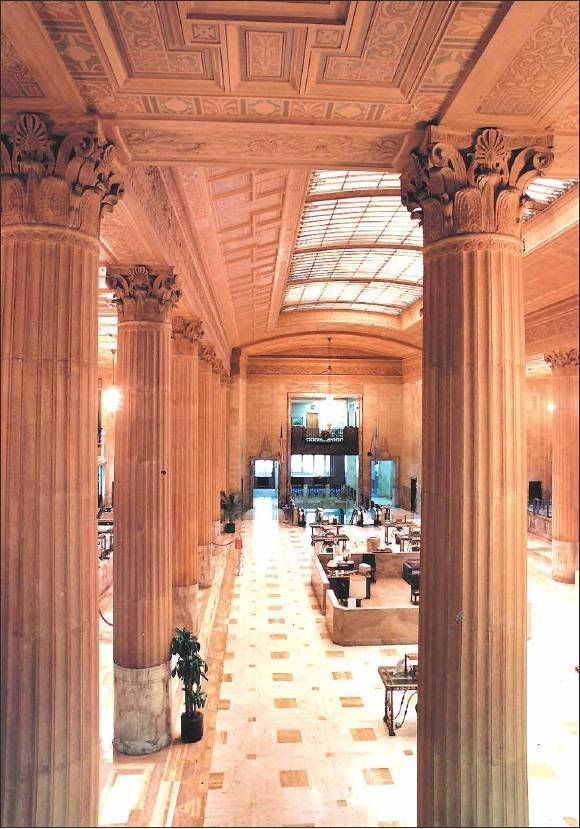
But, even after the 1993 Boatsmen's move, by hook or crook the building has remained open, even though its Great Banking Hall has remained empty.
Skipping over legal stuff, changes in ownership, etc., some apparent good news occurred in May 2006 with a California group’s purchase of the First National Center which includes more than one million square feet of leasable space. As reported in The Oklahoman and as discussed at OkcTalk.com and at OkMetropolis.com, according to the agent that handled the transaction, the new owners have great intentions:
"Plans are to bring it back to its former glory as the crown jewel of downtown Oklahoma City. To fill it up – and dress her up and take her to the ball. Have a centennial ball in the Grand Banking Hall."
During the year since the 2006 sale, "innards" have been worked on but nothing splashy has been done yet, nor have any overall plans been announced by the California owners. A few press articles keep the hope alive, though, that the First National will rise again like the other Phoenixes that downtown seems to be enjoying in this time that we live.
An April 16, 2007, Journal Record article discussed possible plans for making the basement "vault" areas into a glorious restaurant. A September 20, 2006, Oklahoman article by Steve Lackmeyer said, in part,
The new owners of the First National Center pledged Tuesday they are prepared to spend at least $6 million on renovations and are considering converting some floors into housing.
Owners of Los Angeles-based Milbank Real Estate shared their plans Tuesday morning with about 50 civic and business leaders gathered at the Oklahoma City Golf and Country Club.
Chief Executive Officer Aaron Yashouafar and Raymond Yashouafar, vice president of operations, reiterated promises to return the building to its glory days – including a concierge service that was eliminated several years ago.
So, yes, generalities have been stated but no "visionary" type of plan has yet emerged. A March 23, 2007, Lackmeyer article notes that the new owners had spent about $1 million on renovations so far, largely on infrastructure, except that they had gotten the historic "clock" on the corner of Park and Robinson , dead for a decade, to work again as at least some indicia of visible improvement.
The Yashouafars say they've discovered the costs of bringing the complex back to Class A office space are higher than the $6 million they cited in September. But they remain committed to the overhaul, and will soon unveil a master plan drawn up by Beck and Associates.
We hope, and we wait, for the promise to be fulfilled!
March 25, 2008 Update. Since the above post was written almost a year ago (5/11/2007), the opportunity for the Grand Banking Hall to host a Centennial Ball came and went without one ... the clock on the corner of Robinson & Park Avenue got fixed ... and, according to the owners, a good bit of infrastructure work got done, e.g., sprinkler system updates, etc., at a cost of $1.2 million. For those who noticed, a working "clock" was the only thing publicly visible.
Otherwise, the 1st tangible sign of "new life" came with 1st National hosting the December 11, 2007 watch party for the huge bond proposal that passed with flying colors on that day. In its press release, the owners stated,
OKLAHOMA CITY (Dec. 11, 2007) – Milbank Real Estate, the Property Management Company for First National Center, is hosting the city’s bond election watch party as its first major civic event, bringing back the grandeur of Oklahoma City’s grandest historic building as a statement of their commitment to fully restoring First National Center’s majestic Art Deco architecture and décor. "Together, tonight marks another historic milestone for Oklahoma City and First National Center," said Raymond Yashouafar, vice president of operations for Milbank Real Estate. "As the voters decide on the city’s largest bond issue, we are working to keep the momentum going by renovating Oklahoma City’s most prestigious building to its original stature for business. It will be exciting to see the Great Banking Hall come alive again."
From left, Becky Chapo, Michael Johnson, Mayor Mick Cornett, Aaron Yashouafar and Raymond Yashouafar.
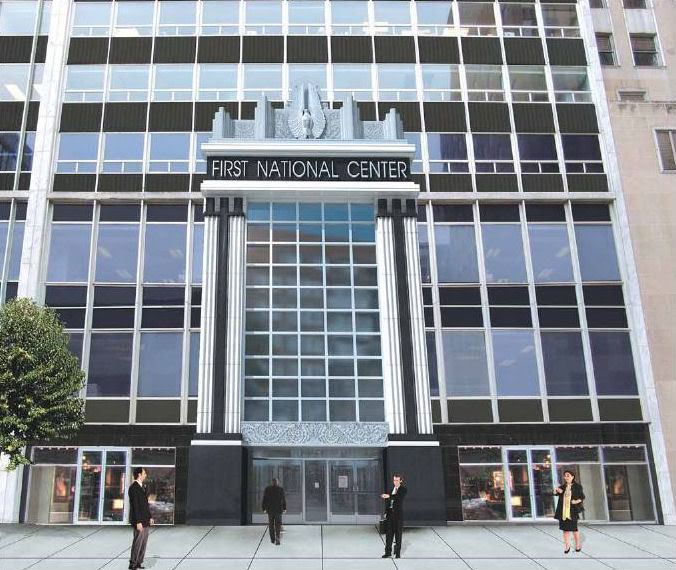
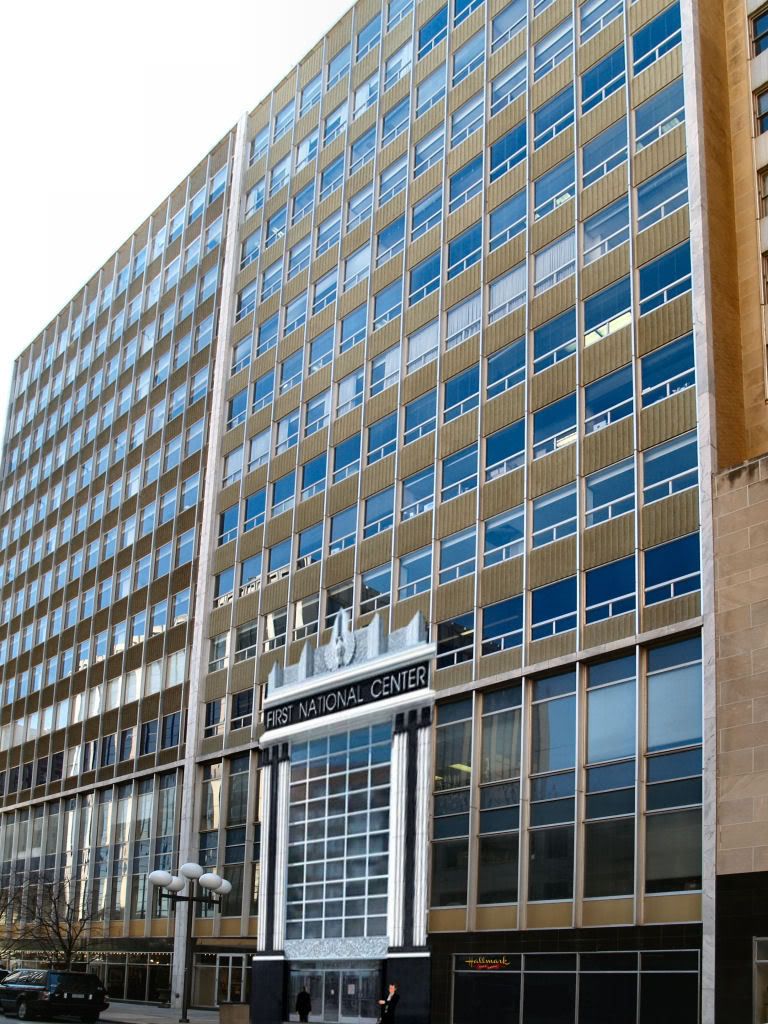
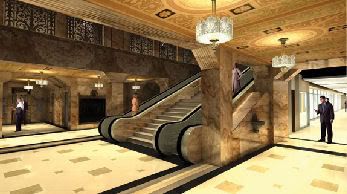
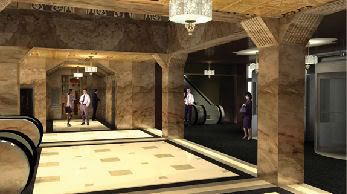
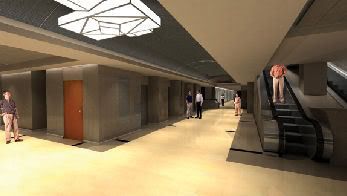
On March 13, 2008, Phase 1 was announced by the owners ... and with something a bit more splashy ... but at $1.5 million, one would be foolish to expect too much. Overhaul of the building's retail arcade and a new Park Avenue entrance were announced.
The Owners' Rendering of the Park Avenue Entrance
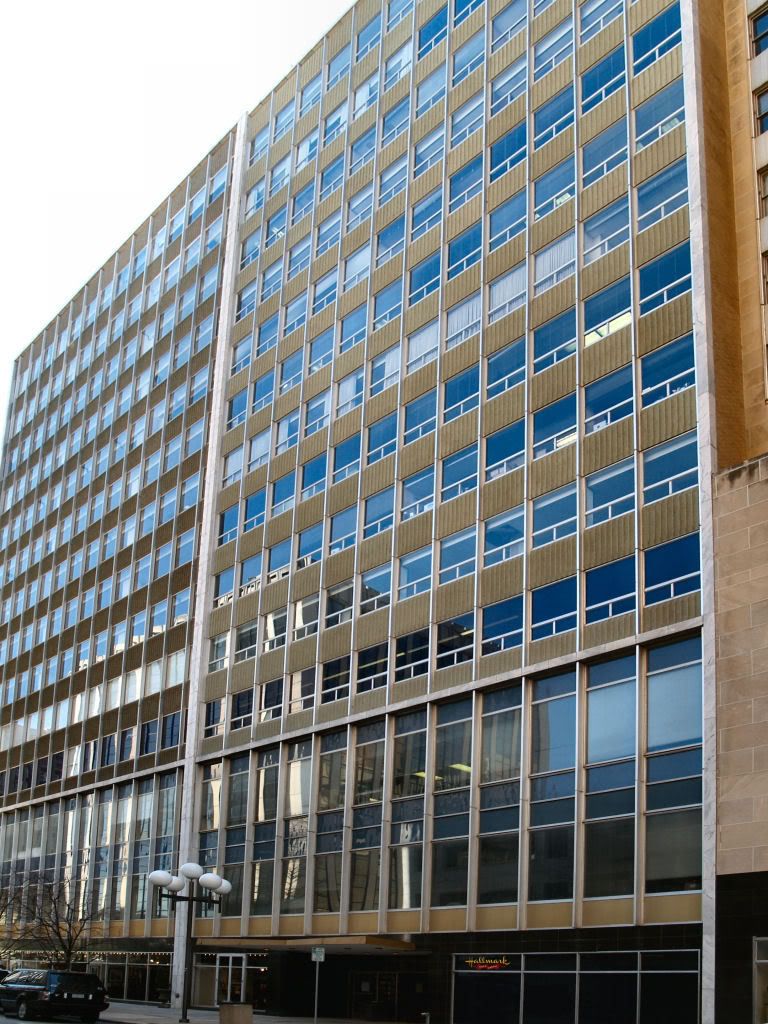
The Existing Park Avenue Entrance (by the Hallmark Shop) (West addition [right] was built in 1957, the East in 1972)
Superimposing the New Entrance Gives This Picture
While nice enough, it doesn't exactly knock Doug Dawgz socks off as amounting to a "major" development.
Lt. Gov. Jari Askins was there for the announcement with a symbolic jackhammer showing signs of getting ready to tear out the marble floor in the 1st National Entry! "Woah!," said some ... getting rid of the marble floor?
According to Steve Lackmeyer's article, Aaron Yashouafar said that it was not original to the tower and the replacement flooring will be in keeping with the original construction. I have no idea what that might mean.
Concerns have been expressed, some by John Hefner, a 3rd generation tenant ... see Steve's March 25, 2008, article,Clock ticking on strategy for First National Tower.
Hefner and several other tenants I've spoken to worry whether the floor's destruction is evidence that the owners have no regard for the tower's history. They previously were upset when an attempt to increase rent on the tower's original barbershop ended with the tenants moving their booths elsewhere. A year later, the barbershop — still adorned with black and white Art Deco tile and fixtures — stands dark and empty.
The Barber Shop Decades Ago Courtesy Norman Thompson
Hefner was more particular in a letter he wrote to Steve Lackmeyer which is set out in Steve's OKC Central blog today. There, among other things, Mr. Hefner said,
At 55, I do not consider myself to be so old that I live in the past, yet I do have appreciation for great things that were created before I was born, and certainly that is the case with historic buildings. When the First National Bank Building was constructed in 1931 at great expense, it was truly an “A” class building, and both the exterior and interior features revealed it. Since it was so high-end, and not average, people wanted to lease space in it. * * * My childhood was filled with endless trips through the building, and year after year, I loved seeing a huge, decorated tree in the Great Banking Hall at Christmas. * * * Overall, it was great fun working downtown.
What changed? The crash of that oil boom carried the First National Bank with it. * * * Several owners since then have failed to have the vision to see that this architectural gem was built to be an “A” class building. Sadly, more “minimalist maintenance” came with the passage of time. As the structures on other corners have achieved lower vacancy rates, the First National has not. Over the years, landlords of the First National have let The Beacon Club, the Post Office, a travel agency, and other amenities slip away from their spaces. Key law firms and oil companies have left too. The current owners lost the barber shop; today, I know of two other tenant-service enterprises planning to leave.
The current owners, as far as I am concerned, have been big on promises, but minimal on spending what is needed. I feel that they, too, do not see the Class “A” fundamentals of the building. A couple of times, I have tried to convince these Los Angeles-based owners to spend money for quality renovations, yet I failed. I have asked for the once-operational elevator security system to be repaired, but it has not. * * *
Sooo ... guess we'll need to wait some more to party in the Great Banking Hall ... we shall see.
This post will be updated again when there's something more to say.
Operation Scissortail - Our Latest Book!
-
[image: devon book cover]
We are very happy to announce the release of our latest book, "Operation
Scissortail," a narative history of the construction o...
Saturday in the Park..on a 113 degree day
-
For those who don't know, there is a reason I've gone very quiet at such a
pivotal moment for Downtown OKC. I accepted a position in Cleveland, Ohio
and I...


 Not that our ancestors didn't care for parks, but Wheeler Park and Delmar Garden were fairly near downtown, one to two miles to the west and south. And, Stiles Park at NE 8th & Stiles was even closer (though from what I know at this point it doesn't seem to have been much of a park). So, what's the point of having a "downtown" park?

 Dean A. McGee, President of the Urban Action Foundation and widely regarded as the downtown park's principal cheerleader, benefactor, and mover, was on the trip, also. The image shown here was in Roy Stewart's 1977 Born Grown. Without McGee's longstanding efforts, it is doubtful that the project would have been accomplished. Dean A. McGee became president and chief executive officer of Kerr-McGee in 1954, Chairman of the Board in 1963 upon the death of Robert S. Kerr. In 1973, the company's headquarters moved to its new 30 story Kerr-McGee Tower in downtown Oklahoma City.


 Its owner wanted it to remain at its location at the southwest corner of Sheridan & Robinson, but that didn't happen, though, since the Tivoli's existence eventually got whacked by OCURA!


 An aging Dean A. McGee, shown here on that grand day (courtesy OKC: 2nd Time Around and the City of Oklahoma City), lived to see it done.
 Mr. McGee's perseverance, and his infectious enlistment of others in the community to see the task done, proved to win the day. Dean A. McGee died September 15, 1989, but, look closely and you'll see him still.
















 Posts


